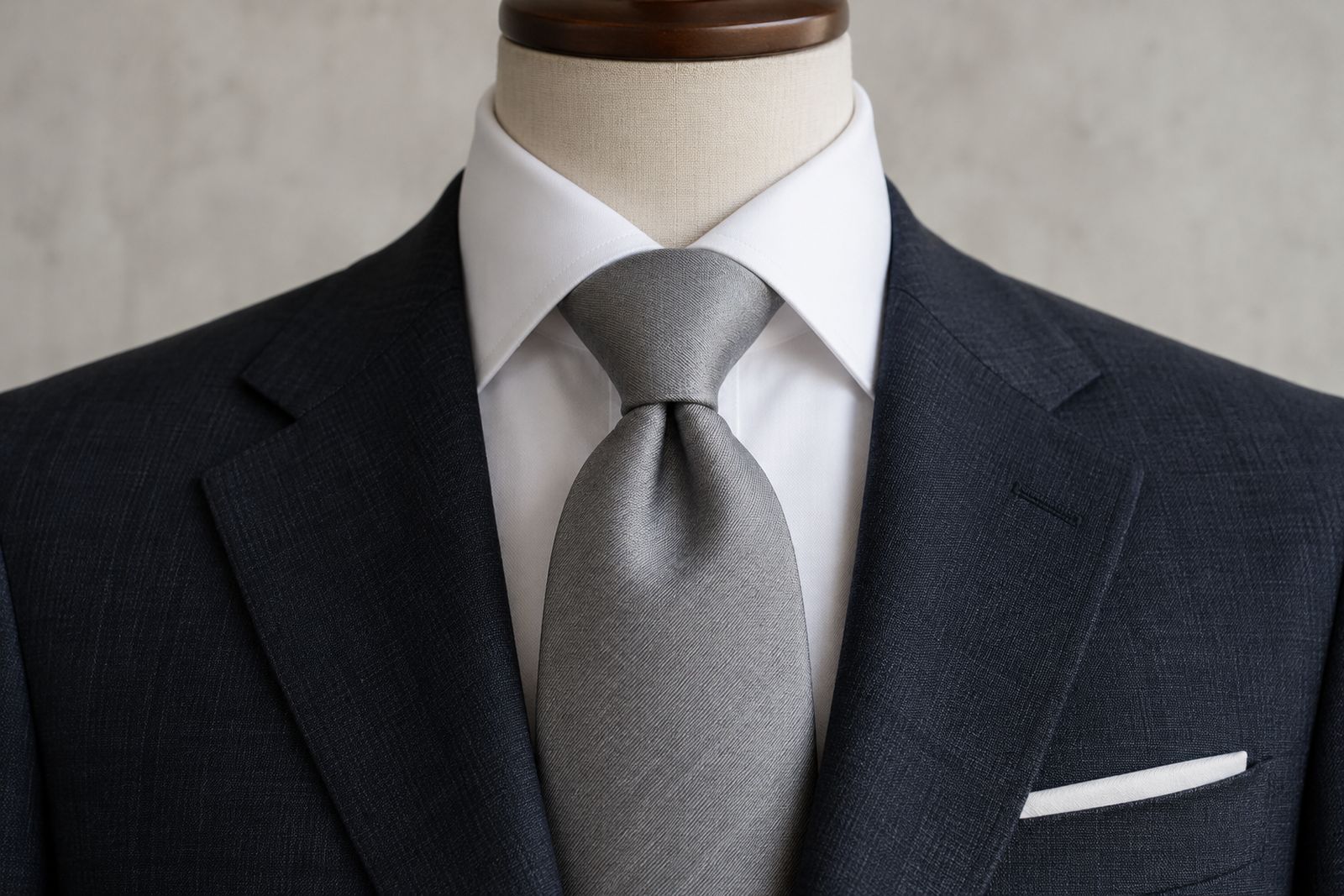
The short answer
To tie a Windsor knot, start seam in with the wide end on your right, hanging well below the narrow end. Cross it over, bring it up through the neck loop and down on your left, behind to the right, up and down through the loop on your right, across the front to the left, up through the loop from underneath, then down through the front band.
- The full Windsor wraps both sides of the neck loop, which makes it broad and symmetrical.
- It needs a spread or cutaway collar; in a point collar it forces the points apart.
- It uses the most tie of any common knot, so start the narrow end high; tall men often need an extra-long tie.
- Tie it with thin to medium silk. A thick tie turns it into a lump.
- Full Windsor and double Windsor are two names for the same knot.
In this guide
- How to tie a Windsor knot, step by step
- How much tie does a Windsor knot use?
- What collar goes with a Windsor knot?
- Is the Windsor knot too big?
- When should you wear a Windsor knot?
- Full Windsor vs half Windsor
- How to fix a lopsided or loose Windsor
- Why is it called the Windsor knot?
- The tailor's view
- Questions people ask
The Windsor knot, also called the full Windsor or double Windsor, is a large, symmetrical triangle built by wrapping the wide end around both sides of the neck loop before finishing as normal. It fills a wide collar the way no other classic knot can. It also uses a great deal of tie and overwhelms narrow collars, so it is a knot for particular shirts and occasions rather than every day.
Full Windsor at a glance
- Size
- Large
- Shape
- Broad, symmetrical triangle
- Difficulty
- Harder: nine moves
- Start
- Seam in, wide end on your right, narrow end high
- Best collars
- Spread and cutaway
- Best ties
- Thin to medium-weight silk
- Tie length used
- The most of any common knot
How to tie a Windsor knot, step by step
Left and right are your own left and right, which is also how they appear when you face a mirror. The neck loop is the loop around your neck above the crossing; the front band is the horizontal wrap you make in step 8. The pattern is easy to remember: wrap the left side of the loop, wrap the right side, then finish like a four-in-hand. For the full set of knots, see our hub on how to tie a tie.
Tie the full Windsor
- 1
Collar up, tie on
Fasten the top button and turn your collar up. Drape the tie around your neck with the seam against your shirt, wide end on your right, narrow end on your left.
- 2
Set the length
Start the narrow end high, with its tip around mid-chest, so the wide end hangs far below it.
Tip: The Windsor eats tie. Starting the narrow end where you would for a four-in-hand almost always leaves the tip several inches short.
- 3
Cross over
Take the wide end across the front of the narrow end, from right to left.
- 4
Up through the neck loop
Bring the wide end up behind the crossing and through the neck loop from underneath, so its tip comes out at the top.
- 5
Down on the left
Bring the wide end down in front on your left side and pull it snug. You have wrapped the left side of the neck loop.
- 6
Behind to the right
Pass the wide end behind the narrow end, across to your right.
- 7
Over and down on the right
Bring the wide end up in front, over the right side of the neck loop, and down through the loop so it comes out on your right. Pull it snug. You have wrapped the right side, and the back of the tie now faces out.
Tip: Make this wrap as tight as the one on the left. Uneven wraps are the main cause of a lopsided Windsor.
- 8
Across the front
Bring the wide end across the front of the knot, from right to left, with the right side of the tie facing out. This is the front band. Hook a finger under it.
- 9
Up through the neck loop
From the left, bring the wide end up behind the knot and through the neck loop from underneath.
- 10
Down through the front band
Feed the wide end down through the front band and draw it through.
- 11
Dimple and tighten
Pinch a crease into the blade just below the knot, then hold the narrow end and slide the knot up evenly, nudging each side with thumb and forefinger so the triangle sits level.
- 12
Finish and check
Fold the collar down, tuck the narrow end into the keeper loop, and check that the tip touches the top of your belt buckle. If it misses, retie with the starting point moved by the same amount.
How much tie does a Windsor knot use?
More than any other common knot. Each side wrap takes several inches of the wide end, so a full Windsor uses noticeably more length than a half Windsor and much more than a four-in-hand. The practical result is that the narrow end has to start high, often around mid-chest, and the narrow end that remains can be too short to reach the keeper loop on the back of the blade.
On many men of average height and neck size, a standard tie of about 57 to 58 inches (145 to 148 cm) can manage a Windsor with little to spare. If you are over about 6 ft 2 in (188 cm), have a neck of 17½ inches (44.5 cm) or more, or wear trousers low on the hips, buy extra-long ties of about 61 to 63 inches (155 to 160 cm) for this knot. Our guide to tie length has a full chart.
What collar goes with a Windsor knot?
A Windsor needs a spread or cutaway collar: one whose points are far enough apart to leave room for a broad knot. In a point or button-down collar it pushes the points outward and lifts them off the shirt. A semi-spread collar can take a Windsor only with a thin tie. Our guide to shirt collar types shows how far each one spreads.
| Point | Semi-spread | Spread | Cutaway | |
|---|---|---|---|---|
| Thin silk tie | ||||
| Medium silk tie | ||||
| Heavy silk or grenadine | ||||
| Wool, cashmere or knit |
Is the Windsor knot too big?
It is too big when it is wider than the gap between your collar points, when it pushes the points up or out, or when it looks wider than your neck. Thick ties make it worse: a Windsor in a heavy silk or wool tie can look like a fist under the chin. On a slim man with a narrow face, even a well-proportioned Windsor can look heavy.
Signs your Windsor is too big
- The collar points lift off the shirt or splay outward
- The knot overlaps the collar edges instead of sitting between them
- The knot is wider than the visible width of your neck
- The tie is heavy wool, knit or thickly lined silk
- The narrow end will not reach the keeper loop
If two or more apply, tie a half Windsor instead. It gives a similar triangle at a more modest size and suits far more shirts.
When should you wear a Windsor knot?
Wear a full Windsor when the collar is wide and the occasion is formal: weddings, ceremonies, formal business events and anywhere a broad, symmetrical knot looks deliberate rather than heavy. It balances a cutaway collar and suits men with a broad face or thick neck, for whom smaller knots can look undersized. It is out of place with button-down collars, knitted ties and casual jackets.
| Situation | Full Windsor? | Better choice if not |
|---|---|---|
| Cutaway collar, thin silk tie | Yes | Not needed |
| Spread collar, medium silk tie, formal event | Yes | Not needed |
| Semi-spread collar, everyday office | Rarely | Half Windsor |
| Point or button-down collar | No | Four-in-hand |
| Knitted, wool or cashmere tie | No | Four-in-hand or simple knot |
| Tall man with a standard-length tie | Only if the tip still reaches the belt | Pratt or half Windsor |
Full Windsor vs half Windsor
The half Windsor passes over the neck loop once; the full Windsor wraps both sides. The result is a knot that is wider, more symmetrical and longer in the tie it uses. For most spread collars the half Windsor is enough, and it suits more ties. Choose the full Windsor when the collar is a true cutaway, the tie is thin, or you want the knot itself to make a statement.
| Feature | Half Windsor | Full Windsor |
|---|---|---|
| Wraps | One pass over the neck loop | One wrap on each side of the neck loop |
| Moves | Seven | Nine |
| Size | Medium | Large |
| Symmetry | Near-symmetrical | Symmetrical |
| Tie length used | Moderate | The most |
| Collars | Semi-spread, spread, some cutaways | Spread, cutaway |
| Ties | Light to medium silk | Thin to medium silk |
How to fix a lopsided or loose Windsor
A lopsided Windsor nearly always comes from uneven side wraps: one pulled tight in step 5, the other left loose in step 7. Retie and give both wraps the same firm tug. A Windsor that loosens through the day was not slid up firmly against the narrow end; hold the narrow end and push the knot up until it meets the collar. If the knot looks lumpy rather than smooth, the tie is too thick for it, and no amount of adjusting will fix that.
Why is it called the Windsor knot?
The knot is named after the Duke of Windsor, the former King Edward VIII, who was known for a wide, triangular knot. He is not known to have tied this knot himself. His broad knots are generally attributed to ties made thicker than usual, and the Windsor was most likely devised by others to imitate the look.
The tailor's view
A Windsor needs a generous tie space, the gap between the collar halves at the neckband, and collar points that spread wide enough to frame the knot without riding over it. If you wear Windsors often, ask your shirtmaker for a cutaway or wide spread with enough collar height to hold the knot up. Ties for a Windsor should have a light enough lining to wrap cleanly around both sides of the neck loop; a tie maker making ties to order can use a lighter interlining and cut them extra long.
If the full Windsor feels like too much, it probably is for that shirt. Keep it for wide collars and formal days, use the half Windsor the rest of the time, and check our guide to matching a tie to your shirt and suit to choose the tie itself.
Questions people ask
What is the difference between a full Windsor and a double Windsor?
There is none. Full Windsor and double Windsor are two names for the same knot. Both names distinguish it from the half Windsor, which has one fewer wrap around the neck loop.
When should you wear a Windsor knot?
Wear it with a spread or cutaway collar on formal occasions such as weddings, ceremonies and formal business events. It suits thin to medium silk ties and men with a broad face or neck. Avoid it with point or button-down collars and with thick ties.
What collar goes with a Windsor knot?
A spread or cutaway collar. These have enough room between the points for the broad knot. In a point collar, a Windsor pushes the points apart and lifts them off the shirt.
Is the Windsor knot too big?
It can be. It is too big when it is wider than the gap between your collar points, when the tie is thick, or when it looks wider than your neck. In those cases a half Windsor gives a similar shape at a more modest size.
Why is my tie too short with a Windsor knot?
The Windsor uses more of the wide end than any other common knot. Start with the narrow end higher, around mid-chest, and move the starting point by however far the tip missed your belt. If the narrow end then cannot reach the keeper loop, you need an extra-long tie.
Did the Duke of Windsor tie the Windsor knot?
He is not known to have tied it. His wide knots are generally attributed to thicker ties, and the knot that bears his name was most likely devised by others to imitate the look.
Is a Windsor knot appropriate for a job interview?
It can be, with a spread or cutaway collar and a quiet tie. For most interview shirts, though, a half Windsor or four-in-hand looks more natural, because a full Windsor can read as more formal than the occasion needs.
TailorGuide is independent. Our guides are written and checked by our team and carry no paid endorsements. How we work.