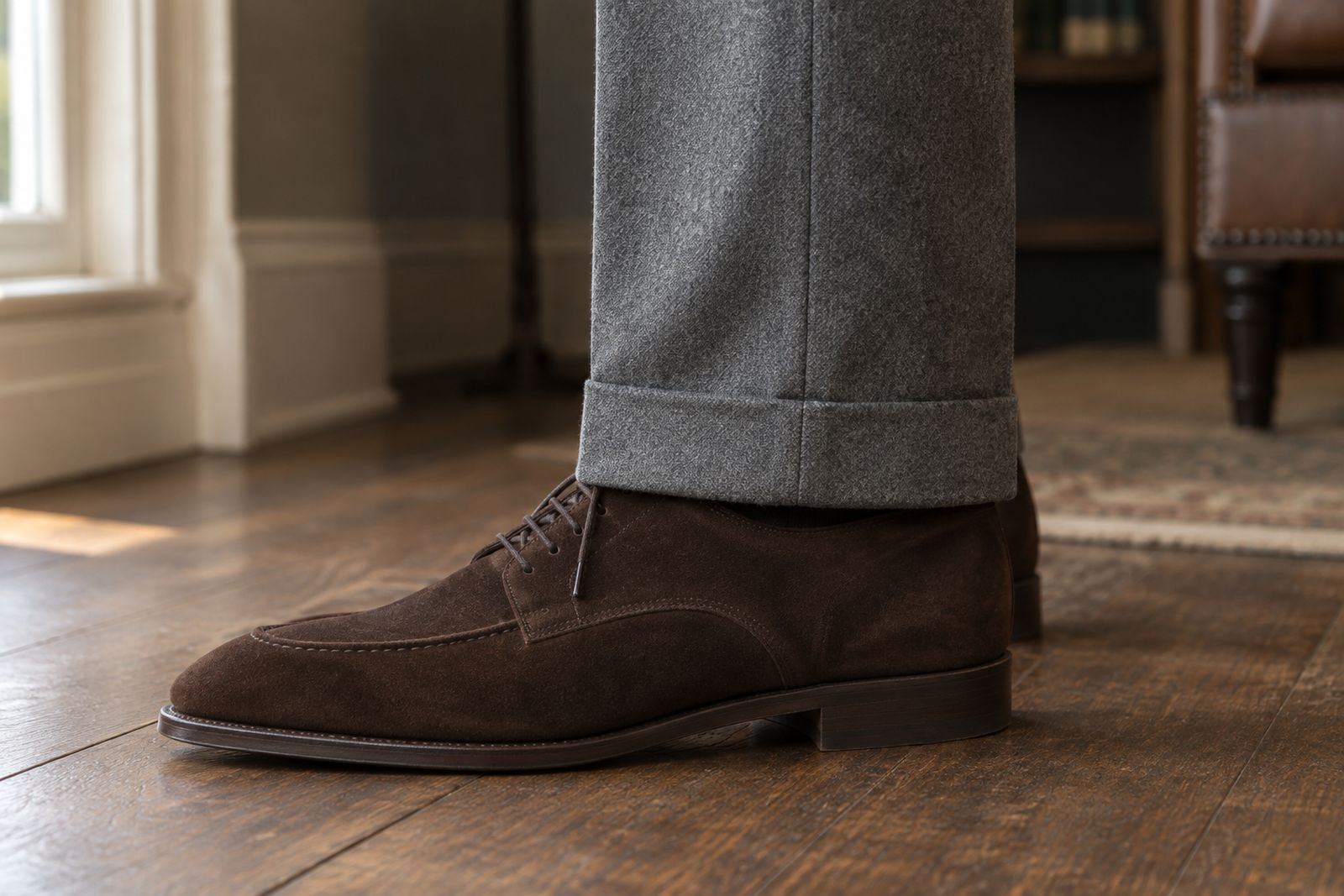
The short answer
Suit trousers can have cuffs (turn-ups) or plain hems, and both are correct on a business suit. Cuffs suit heavier fabrics such as flannel, pleated trousers and taller men, and are usually 1½ to 1¾ inches (3.8 to 4.5 cm) deep. Choose plain hems for very formal suits and slim flat-front trousers. Black tie trousers never have cuffs.
- Typical cuff depth is 1½ to 1¾ inches (3.8 to 4.5 cm).
- Cuffs suit flannel, tweed, heavier worsteds and pleated trousers.
- Black tie trousers never have cuffs; morning dress trousers traditionally don't either.
- Cuffs look best with little or no break.
- A cuff needs at least twice its depth in spare fabric below the finished length.
- Cuffs are cut level, so you give up the option of a sloped hem.
In this guide
- Should suit pants have cuffs?
- How deep should trouser cuffs be?
- When do cuffs work best?
- When should you skip cuffs?
- Cuffs or plain hems: a quick guide by trouser
- Should pleated pants have cuffs?
- Are cuffed trousers more casual?
- Do cuffs make you look shorter?
- How much break should cuffed trousers have?
- Cuffs vs plain hems: the trade-offs
- Can a tailor add or remove trouser cuffs?
- What to tell your tailor
- Questions people ask
Should suit pants have cuffs? It is one of the few trouser questions with no single right answer. The answer depends on five things you can name: the fabric, the cut of the trousers, your height, the break you want and the formality of the suit.
Trouser cuffs at a glance
- Typical depth
- 1½ to 1¾ inches (3.8 to 4.5 cm)
- Best with
- Flannel, tweed, heavier worsteds, pleated trousers, wider legs
- Skip on
- Black tie trousers (never), morning dress, very formal or very slim trousers
- Break
- None to a slight break
- Formality
- Slightly less formal than a plain hem; fine for business
- Fabric needed
- At least twice the cuff depth below the finished length
Should suit pants have cuffs?
Suit pants can have cuffs or plain hems; both are correct on a business suit. Cuffs are the better choice on heavier fabrics, pleated trousers and fuller cuts, where their weight helps the leg hang straight. Plain hems are the better choice on very formal suits, lightweight and very slim flat-front trousers, and they are the only choice on black tie trousers.
Trouser cuff (turn-up)
A trouser cuff, called a turn-up in British English, is a band of fabric folded up and sewn in place at the bottom of a trouser leg. It is a permanent part of the hem, not a rolled-up leg.
Turn-ups are usually traced to the practical habit of turning trouser hems up to keep them out of mud and wet; tailors later sewed the fold in place as a permanent feature. That outdoor origin is why cuffs still read as slightly less formal than a plain hem, and why they look most at home on country fabrics such as flannel and tweed.
How deep should trouser cuffs be?
Most trouser cuffs are 1½ to 1¾ inches (3.8 to 4.5 cm) deep. Within that range, taller men and wider trouser legs can take the deeper end; shorter men and slimmer legs look better at the shallower end. The table gives a common tailor's guide by height.
| Your height | Cuff depth | Notes |
|---|---|---|
| Under 5 ft 8 in (173 cm) | 1¼ to 1½ inches (3.2 to 3.8 cm) | Keep the break minimal so the leg looks long |
| 5 ft 8 in to 6 ft (173 to 183 cm) | 1½ to 1¾ inches (3.8 to 4.5 cm) | The standard range for most men |
| Over 6 ft (183 cm) | 1¾ to 2 inches (4.5 to 5 cm) | Deeper cuffs balance long legs and wider cuts |
Adjust for the trousers too: go toward the deeper end for wide legs and heavy fabrics, and toward the shallower end for slim legs and lighter fabrics.
Scale from 1 in to 2.25 in, with cm below. Shorter men, slim legs: 1.25 to 1.5 in. Typical: 1.5 to 1.75 in. Tall men, wide legs: 1.75 to 2 in. 1½ in: at 1.5 in. 1¾ in: at 1.75 in.
When do cuffs work best?
Cuffs work best where their extra weight and their relaxed character help the trousers. That means:
- Flannel, tweed and heavier worsteds: country and winter fabrics carry cuffs naturally, and the weight keeps a soft fabric hanging cleanly.
- Pleated trousers: the fuller leg needs the weight of a cuff to fall straight, and cuffs are the traditional finish for pleats.
- Wider or straighter legs: a cuff balances a fuller trouser bottom.
- Taller men: a cuff breaks up a long leg line.
- Business suits, sport coat trousers and odd trousers: cuffs are entirely correct for everyday tailoring.
On lighter fabrics cuffs are optional. They can help a lightweight trouser hang by adding weight at the hem, but on a fine, smooth worsted for a sharp, formal suit, a plain hem usually looks cleaner.
When should you skip cuffs?
Skip cuffs on formal evening and day dress, on very slim trousers and wherever you want the cleanest possible line.
- Black tie trousers: never. Dinner suit trousers have plain hems, usually with a silk braid down the outside seam and no belt loops. Our guide to black tie covers the full dress code.
- Morning dress trousers: traditionally plain hems as well.
- Very slim, tapered flat-front trousers: a cuff on a narrow leg can look heavy and stubby.
- Very formal suits: a plain hem is a little cleaner and sharper.
- When you want a sloped hem: a plain hem can be cut longer at the back than the front; a cuff cannot.
Cuffs or plain hems: a quick guide by trouser
If you want a short answer for a particular pair of trousers, the table gives the usual choice.
| Trousers | Cuffs? | Why |
|---|---|---|
| Navy or charcoal worsted business suit | Either | Both are correct; plain is slightly sharper |
| Gray flannel suit or odd trousers | Cuffs | The weight and texture suit them |
| Tweed or corduroy trousers | Cuffs | A country fabric with a country finish |
| Linen or cotton summer suit | Either | Cuffs add useful weight; plain looks lighter |
| Pleated trousers of any fabric | Cuffs, usually | The traditional pairing; helps the fuller leg hang |
| Slim, tapered flat-front trousers | Plain | A cuff looks heavy on a narrow leg |
| Chinos and odd cotton trousers | Either | Cuffs give a relaxed, traditional look |
| Morning dress trousers | Plain | Traditional formal day dress |
| Dinner suit (black tie) trousers | Never | Plain hems are the rule |
A note on jeans and casual chinos: a rolled-up leg is a casual habit, not a tailored cuff. Everything in this guide is about cuffs that are sewn in place by a tailor.
Should pleated pants have cuffs?
Usually, yes. Cuffs are the traditional finish for pleated trousers, because the fuller leg created by pleats hangs better with the extra weight at the hem, and the combination looks balanced. Pleated trousers with plain hems are not wrong, especially in a light summer fabric, but cuffed is the classic pairing. Flat-front trousers can go either way. Our guide to pleated vs flat-front trousers explains the trade-offs.
Are cuffed trousers more casual?
Slightly. Because of that outdoor origin, cuffs sit a small step below a plain hem in formality. That step is small enough that cuffs are completely correct on business suits, and many traditional English suits have them. The line only matters at the most formal end: black tie and morning dress, where plain hems are the rule.
Do cuffs make you look shorter?
A little. A cuff adds a horizontal line at the ankle, which interrupts the vertical line of the leg. On a tall man that is no problem, and can even be an advantage. A shorter man can still wear cuffs well by keeping them to about 1¼ to 1½ inches (3.2 to 3.8 cm), choosing little or no break, and wearing trousers and shoes in tones that don't contrast sharply. If you are short and want the longest possible leg line, a plain hem with no break is the better choice.
How much break should cuffed trousers have?
Cuffed trousers look best with no break or a slight break. A cuff is cut level all the way round, so if the trousers are long enough to break heavily over the shoe, the cuff buckles and tilts at the front. Most tailors hem cuffed trousers so the front of the cuff just touches the top of the shoe.
Our guide to trouser break explains each length and how to choose.
Cuffs vs plain hems: the trade-offs
Trouser cuffs
For
- +Add weight at the hem, so the trousers hang straighter and move well.
- +Balance pleated and fuller trousers.
- +Suit heavier and textured fabrics.
- +Protect the hem edge from wear.
Against
- –Slightly less formal; never correct for black tie.
- –Cut level, so no sloped hem.
- –Need plenty of spare fabric, so they can't be added to every pair.
- –Can shorten the leg line a little.
- –Collect dust and lint, so brush them out.
Can a tailor add or remove trouser cuffs?
A tailor can add cuffs only if there is enough fabric below the finished length, and can almost always remove them. A cuff is made by folding the hem back on itself, so it needs at least twice its depth in spare fabric below the finished length, plus a little for turning. A 1½ inch (3.8 cm) cuff therefore needs more than 3 inches (7.6 cm) of spare fabric. Many good ready-to-wear trousers are sold with unfinished hems and plenty of length, so they can take a cuff; trousers that have already been hemmed plain usually cannot.
Removing cuffs is simpler: the fold is unpicked and the trousers are hemmed plain, often leaving a little extra length. The old fold lines can show faintly. For how a hem is measured and finished, see how to hem suit trousers.
What to tell your tailor
- Whether you want cuffs or plain hems, and the depth: for example, "1¾ inch cuffs" (4.5 cm).
- The break you want: no break or a slight break suits cuffs best.
- Wear the shoes you will wear with the suit when the length is pinned.
- Ask for the cuffs to be tacked at the seams so they don't fall down when you walk.
- On a pair already hemmed, ask whether there is enough fabric in the hem for a cuff before you commit.
Cuffs are one finishing decision among many on a suit. For the rest of the trouser fit, read how suit trousers should fit, and for the jacket's details, our guide to the parts of a suit jacket. If you want trousers cut and finished to your exact preference, our ranking of the best tailors in London is a good place to start.
Questions people ask
How deep should trouser cuffs be?
Most trouser cuffs are 1½ to 1¾ inches (3.8 to 4.5 cm) deep. Shorter men and slim legs suit the shallower end, around 1¼ to 1½ inches (3.2 to 3.8 cm); tall men and wide legs can go to about 2 inches (5 cm).
Are cuffed trousers more casual?
Slightly. Cuffs are traced to a practical outdoor habit, so they sit a small step below plain hems in formality. They are entirely correct on business suits but never on black tie trousers.
Should pleated pants have cuffs?
Usually, yes. Cuffs are the traditional finish for pleated trousers because their weight helps the fuller leg hang straight. Plain hems on pleated trousers are acceptable, especially in light summer fabrics.
Do cuffs make you look shorter?
A little, because they add a horizontal line at the ankle. Shorter men can still wear them with a depth of about 1¼ to 1½ inches (3.2 to 3.8 cm) and little or no break. For the longest leg line, choose a plain hem with no break.
Do tuxedo trousers have cuffs?
No. Black tie trousers never have cuffs. They have plain hems, usually a silk braid down the outside seam and no belt loops.
Can you add cuffs to trousers that are already hemmed?
Usually not. A cuff needs at least twice its depth in spare fabric below the finished length, and a plain hem rarely leaves that much. Ask your tailor to check the hem allowance before you decide.
How much break should cuffed trousers have?
No break or a slight break. Because cuffs are cut level, a deeper break makes them buckle and tilt over the shoe. Most tailors hem cuffed trousers so the front just touches the top of the shoe.
TailorGuide is independent. Our guides are written and checked by our team and carry no paid endorsements. How we work.