The short answer
A bespoke suit usually takes 8 to 12 weeks from first measurement to collection, often longer, and three to four months is common for a first order at a busy house. Many houses quote 50 or more hours of hand work for a two-piece suit; the rest of the time is spent between three fittings. Made to measure takes about 3 to 8 weeks.
- First bespoke suit: usually 8 to 12 weeks, often three to four months.
- Many houses quote 50 or more hours of hand work for a two-piece suit.
- A repeat order on a settled pattern is usually faster, often 6 to 10 weeks.
- Made to measure takes about 3 to 8 weeks; altering a ready-made suit about 1 to 2 weeks.
- For a wedding or other fixed date, start a bespoke suit four to six months ahead.
In this guide
- How long does a bespoke suit take?
- How many hours does it take to make a suit by hand?
- Where the weeks go: a typical bespoke timeline
- Why does a bespoke suit take so long?
- What causes delays?
- Can you rush a bespoke suit?
- How long does bespoke take if the tailor visits your city?
- How long does a made-to-measure suit take?
- How far in advance should I order a wedding suit?
- The tailor's view: how to keep your order on schedule
- Questions people ask
Ask a cutter how long a bespoke suit takes and the honest answer is: much longer than the work itself. The hand sewing for a two-piece suit adds up to a week or two of one tailor's time, yet a first suit rarely reaches you in under two months. The difference is waiting time, and once you understand where it goes you can plan around it.
Bespoke timing at a glance
- First bespoke suit
- Usually 8 to 12 weeks; three to four months is common
- Repeat order
- Often 6 to 10 weeks on a settled pattern
- Hand work
- 50 or more hours for a two-piece at many houses
- Fittings
- Usually three for a first suit, two to four weeks apart
- Made to measure
- About 3 to 8 weeks
- For an event
- Start bespoke four to six months ahead
How long does a bespoke suit take?
A bespoke suit usually takes 8 to 12 weeks, and a first order at a busy house often takes three to four months. The figure depends less on the tailor's speed than on how many fittings you need, how far apart they fall and how long the makers' queue is. The table compares bespoke with the faster routes to a suit that fits.
| Route | Typical time | Fittings | What sets the pace |
|---|---|---|---|
| Bespoke, first suit, local house | Usually 8 to 12 weeks; 3 to 4 months common | Usually 3 | Gaps between fittings and the makers' queues |
| Bespoke, repeat order | Often 6 to 10 weeks | 1 to 2 | The pattern is already settled |
| Bespoke through a visiting house (trunk shows) | 4 to 6 months or more | 2 to 3, tied to visits | How often the cutter visits your city |
| Made to measure | About 3 to 8 weeks | Usually 1 at order, 1 on the finished suit | Factory production slots and shipping |
| Ready-to-wear plus alterations | About 1 to 2 weeks | 1 for pinning, 1 to collect | The alteration tailor's workload |
Typical ranges as of 2026. Ask each house for its current lead time before you order.
Ready-to-wear plus alterations
1–2 weeks
Made to measure
3–8 weeks
Bespoke, repeat order
6–10 weeks
Bespoke, first suit
8–16 weeks
Bespoke through trunk shows
Depends on visit schedule
16–26 weeks
How many hours does it take to make a suit by hand?
A handmade two-piece suit takes 50 or more hours of hand work at many bespoke houses. The Savile Row Bespoke Association sets at least 50 hours of hand work for a typical two-piece as one of its membership requirements, and a three-piece, a double-breasted coat or a heavily patterned fabric that must be matched at every seam takes longer.
Most of those hours go into the jacket. The coatmaker sets the floating canvas, pad-stitches the lapels and collar by hand, shapes the fabric with the iron, sets the sleeves and makes the pockets, and does much of it twice because the jacket is rebuilt after the baste fitting. The trousers are a much smaller job. The finisher's buttonholes, the felling of the lining and the final press add more hours at the end. A factory-made suit is assembled in a fraction of this time, which is one reason it costs a fraction of the price; our guide to why bespoke suits are expensive breaks that down.
Where the weeks go: a typical bespoke timeline
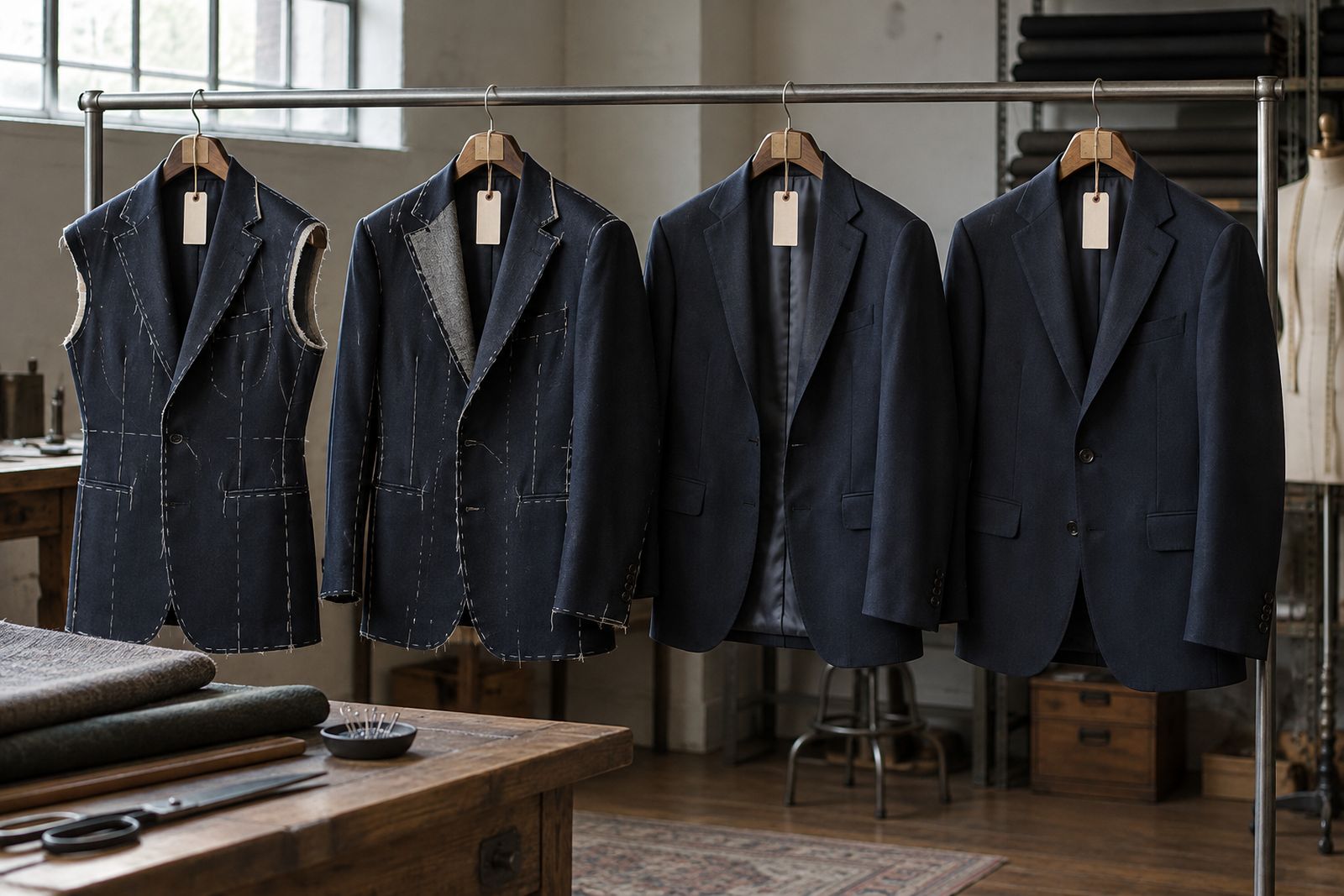
A first bespoke suit follows the same order at almost every house: measure, draft, cut, baste fitting, forward fitting, finish fitting, collection. Between each fitting the suit goes back to the coatmaker to be partly taken apart and rebuilt, and that rebuild waits its turn in the maker's queue. The timeline below is typical for a house with a normal workload. For the work done at each stage, read how a bespoke suit is made.
Stage 1: Consultation and measuring
Week 0
Fabric chosen and ordered, measurements and posture notes taken
Stage 2: Fabric arrives, pattern drafted, suit cut
Weeks 1 to 2
Fabric usually arrives within days to two weeks
Stage 3: Baste made
Weeks 2 to 4
Coatmaker tacks the jacket together with the canvas in
Stage 4: Baste fitting
Weeks 3 to 5
Balance, shoulders and length checked; pattern corrected
Stage 5: Forward fitting
Weeks 6 to 8
Collar, pockets and part of the lining in
Stage 6: Finish fitting
Weeks 8 to 11
Sleeve and trouser length confirmed
Stage 7: Buttonholes, press, collection
Weeks 9 to 12 or later
Final hand finishing and a last check on you
Why does a bespoke suit take so long?
A bespoke suit takes so long because it is fitted while it is being made, and every fitting sends it back into a queue. A ready-made suit is finished before you see it; a bespoke suit is shown to you half-built, corrected, remade and shown again. Each round trip takes time that no amount of skill can remove.
- The rebuild. After the baste, the cutter rips seams, recuts and corrects the pattern, and the coatmaker re-makes the jacket. That is a second round of hand work, not a quick tweak.
- Outworkers. Many coatmakers and trouser makers work in their own workshops for several houses. Your suit waits its turn with everyone else's.
- Your diary. A fitting can only happen when you can attend. A two-week vacation in the middle of an order adds two weeks.
- Specialists. Buttonholes, finishing and pressing are often done by different people at the end, each with their own workload.
What causes delays?
Most delays come from five places, and you control two of them. Ask about the others when you order, so the quoted date already allows for them.
| Cause | Typical effect | How to avoid it |
|---|---|---|
| Fabric out of stock at the merchant or mill | Days to several weeks, or a new choice | Pick a second-choice fabric at the consultation |
| Missed or postponed fittings | Pushes every later stage back by the same amount | Book all fittings early and keep your diary clear |
| Weight change between fittings | An extra fitting and rebuild | Order when your weight is stable |
| Busy seasons and holidays | Longer queues before summer and the year-end holidays; many Italian workshops close for much of August | Order early and ask about holiday closures |
| A problem found at a fitting | An extra fitting, often two to three weeks | Allow buffer time before any event |
Can you rush a bespoke suit?
You can sometimes speed up a bespoke suit, but you cannot rush it much without losing what makes it bespoke. A house with space in its makers' schedule may bring fittings closer together if you can attend at short notice, and some will do so for regular customers whose pattern is already settled. Even then, a first suit rarely comes together in less than about five or six weeks, because each fitting still needs a rebuild.
Be cautious of anyone who offers a fully bespoke first suit in two weeks. Either the fittings are being skipped, or the suit is made to measure under another name. If your date is close, a good made-to-measure suit or a well-altered ready-made one is the honest answer, and bespoke can follow when there is time.
Rushing a bespoke order
For
- +Possible at some houses if you can attend fittings at short notice
- +Realistic for repeat orders on a settled pattern
- +Removes waiting time, not hand work
Against
- –Fewer chances to correct the fit
- –Some houses decline rush orders for first-time customers
- –Any problem at a fitting leaves no margin before your date
How long does bespoke take if the tailor visits your city?
Ordering from a house that visits your city, usually called a trunk show, typically takes four to six months or more for a first suit. Several London houses send cutters to New York and other cities a few times a year. You are measured on one visit, the suit is cut and basted at home, and each later fitting happens on the next visit, so the gap between fittings is set by the travel calendar rather than the workshop.
The result can be just as good, because the same cutter and makers do the work. The trade-off is time and fewer chances to correct problems quickly. If you travel to the house's home city for work, ask whether you can take one fitting there to shorten the wait. Our guide to bespoke tailoring in New York covers local houses and visiting ones.
Questions to ask a visiting house
- How often do you visit, and when are the next three visits?
- How many fittings do you expect for a first suit?
- Can I take a fitting at your shop if I am in town?
- Who adjusts the suit locally if something small needs fixing between visits?
How long does a made-to-measure suit take?
A made-to-measure suit usually takes about 3 to 8 weeks from measuring to delivery. The suit is cut from a standard pattern adjusted to your measurements, made in a factory and shipped back, and you normally try it on once when it arrives. Allow another week or two if it needs adjustments after that fitting, and longer in peak season. If you are unsure which route fits your timeline, our comparison of bespoke vs made to measure covers the differences in fit, price and process.
Altering a ready-made suit is quicker still. Hems, sleeves and taking in a jacket waist usually take about one to two weeks at an alterations tailor, longer in wedding season. Our guide to what a tailor can alter explains which changes are quick and which are not worth doing.
How far in advance should I order a wedding suit?
Order a bespoke wedding suit four to six months before the wedding, a made-to-measure suit about two to three months before, and buy a ready-made suit at least six weeks before so there is time for alterations. Working backward from the date is the simplest way to plan. The schedule below is for a first bespoke suit; see our guide to wedding suits for style choices.
| Time before the event | What should happen |
|---|---|
| 6 months | Choose the house, agree the style and fabric, get measured |
| About 5 months | Baste fitting |
| About 4 months | Forward fitting |
| About 3 months | Finish fitting |
| 2 to 3 months | Collect the suit and wear it a few times |
| 4 to 6 weeks | Final check with the shirt, shoes and accessories for the day; any last adjustment |
| The week before | Have the suit pressed |
If the house quotes a shorter lead time, keep the start date and enjoy the buffer.
The tailor's view: how to keep your order on schedule
Keep your suit moving
- Ask for the current lead time, not the usual one, before you commit.
- Choose a second-choice fabric in case the first is out of stock.
- Book the baste fitting before you leave the first appointment.
- Tell the cutter about travel or vacations in the next three months.
- Keep your weight steady until the finish fitting.
- Bring the same shirt and shoes to every fitting so nothing has to be rechecked.
- Answer the house's calls and emails about fitting dates promptly.
The single biggest time saver is a second suit. Once your pattern is settled, many houses can make a repeat order with fewer fittings and in noticeably less time. To find a house worth staying with, read the questions to ask a tailor and see our ranking of the best tailors in London.
Questions people ask
How many hours does it take to make a suit by hand?
Many bespoke houses quote 50 or more hours of hand work for a two-piece suit, and the Savile Row Bespoke Association sets 50 hours as a minimum for its members' typical two-piece. Three-piece suits, double-breasted coats and patterned fabrics that must be matched take longer. Most of the hours go into the jacket.
Can you rush a bespoke suit?
Sometimes, if the house has space and you can attend fittings at short notice. Rushing removes waiting time, not hand work, so a first suit rarely comes together in less than about five or six weeks. If your date is closer than that, choose made to measure or a well-altered ready-made suit.
How long does a made-to-measure suit take?
Usually about 3 to 8 weeks from measuring to delivery, plus a week or two if adjustments are needed after the first try-on. Peak seasons and shipping can add time.
How far in advance should I order a wedding suit?
Start a bespoke wedding suit four to six months before the wedding, a made-to-measure suit two to three months before, and buy a ready-made suit at least six weeks before to leave time for alterations. Collect the suit early enough to wear it a few times before the day.
Why does a bespoke suit take so long?
Because it is fitted while it is being made. After each fitting the jacket is partly taken apart and rebuilt, and each rebuild waits in the coatmaker's queue. Three fittings two to four weeks apart account for most of the time.
Is a second bespoke suit faster?
Usually, yes. Once your pattern is settled, many houses need only one or two fittings for a repeat order, and 6 to 10 weeks is common. A big change in style or in your weight can bring the full process back.
How long do suit alterations take?
Simple alterations such as hems, sleeves and taking in a jacket usually take about one to two weeks. Some tailors offer faster service for a fee, and wedding season makes every queue longer.
TailorGuide is independent. Our guides are written and checked by our team and carry no paid endorsements. How we work.