The short answer
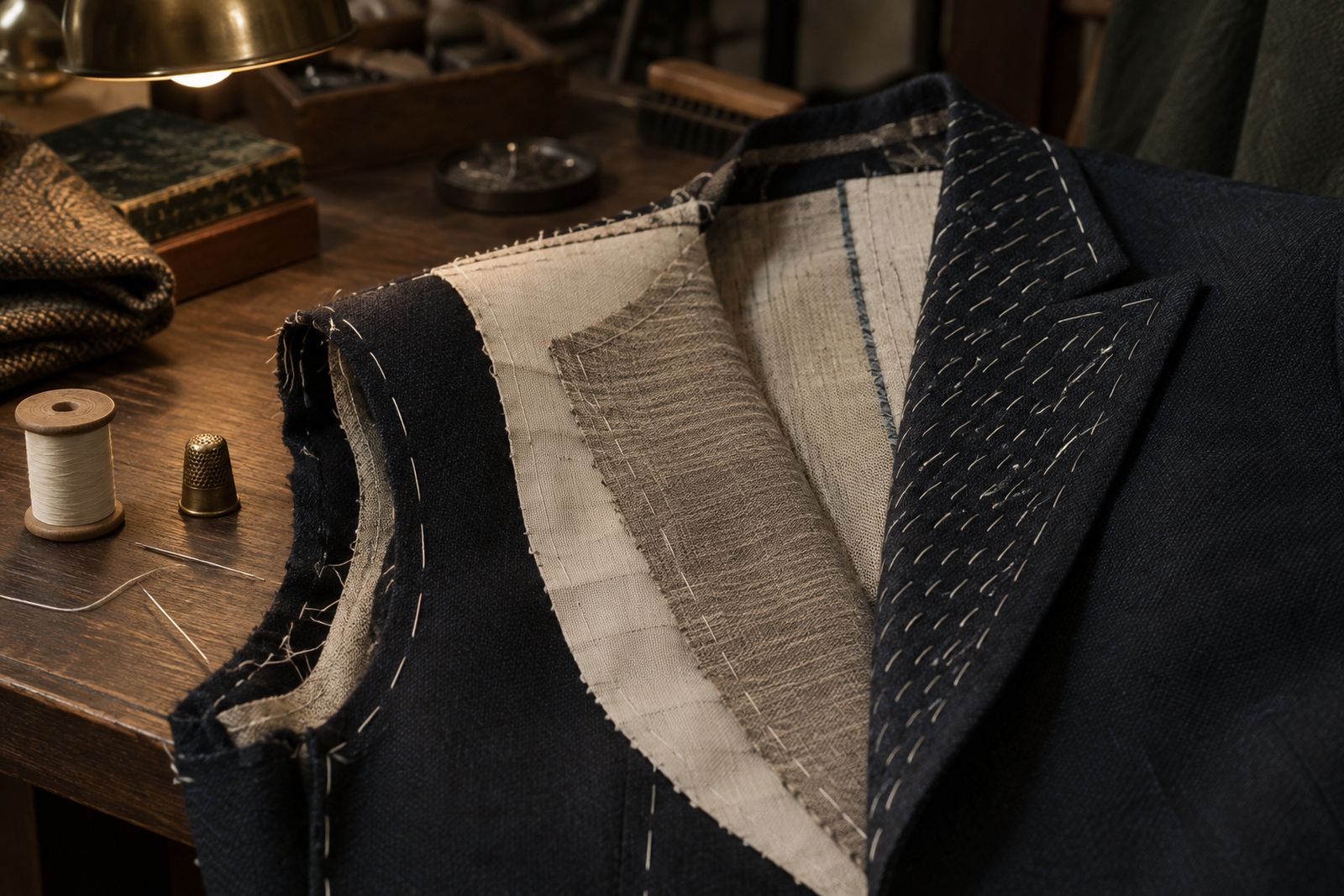
Bespoke suits are expensive because almost all of the cost is skilled time. A cutter drafts a pattern for you alone and fits you three or more times, and Savile Row houses typically put at least 50 hours of hand work into a two-piece. Add fabric, trimmings, prime rents, apprentices and a trade that makes few suits a year, and prices start around $6,600.
- Labor is the largest cost: Savile Row houses typically put 50+ hours of hand work into a two-piece.
- Each fitting means unpicking, recutting and rebuilding the suit, which is rework MTM never pays for.
- Standard worsted is a modest share of the price; rare fibers such as vicuña can cost more than the making.
- Prime rent, London wages, apprentices and aftercare are built into a Savile Row price; UK prices include 20% VAT.
- Hand work does not scale, so the trade's low volume keeps prices high.
In this guide
- Why are bespoke suits so expensive?
- Where does the money go in a bespoke suit?
- How many hours does it take to make a bespoke suit?
- What do the hours of hand work actually buy?
- Why does the cutter cost so much?
- Why do fittings add to the cost?
- How much of a suit's price is the fabric?
- Why are Savile Row suits so expensive?
- Why can't bespoke tailors make suits cheaper?
- Bespoke vs made-to-measure: where the price gap comes from
- Are expensive suits worth it?
- The tailor's view: what to ask about price
- Questions people ask
Why are bespoke suits so expensive? Because you are paying for skilled hours, and a bespoke suit uses a great many of them. A factory suit spreads its pattern, cutting and machinery across thousands of identical garments. A bespoke suit has a pattern drafted once, for one person, and is then cut, basted, taken apart, recut and finished largely by hand. Very little of that can be sped up.
The price at a glance
- Largest cost
- Skilled labor: cutting, fitting, coat making, trouser making, finishing
- Hand work
- Typically at least 50 hours for a two-piece at Savile Row Bespoke Association members
- Fittings
- Three or more, each followed by unpicking and recutting
- Typical starting price
- About $6,600 on Savile Row; roughly $3,300 to $6,600 at many independents (approx., 2026)
- What moves it
- The house, the fabric, extra pieces, the city, and VAT
Why are bespoke suits so expensive?
Bespoke suits are expensive because they combine an individual pattern, repeated fittings and mostly hand construction, all done by a small number of highly trained people. The cutter's time is spent on you alone. The coat maker builds the jacket by hand, then partly rebuilds it after each fitting. The trouser maker does the same. None of that work can be spread across other customers, and none of it can be moved to a production line without ceasing to be bespoke.
On top of the labor come the fabric and trimmings, the cost of premises near the customers, the training of apprentices, aftercare, and in the UK, 20% VAT. For an established Savile Row house the result is a two-piece that usually starts around $6,600, and many houses start higher. For how bespoke compares with the other ways of buying a suit, see bespoke vs made-to-measure.
Where does the money go in a bespoke suit?
Tailors do not publish cost breakdowns, and the split varies from house to house, so the table below gives each component's relative size rather than a percentage. The one precise figure is VAT: in the UK, a VAT-inclusive price is one-sixth tax.
| Component | What it pays for | Relative share |
|---|---|---|
| Making | Coat maker, trouser maker and finishers building the suit by hand, then rebuilding after fittings | The largest |
| Cutting and fitting | The cutter's consultation, pattern drafting, three or more fittings and every recut | Large |
| Premises | A showroom and cutting room near the customers, often in some of the most expensive streets in the city | Large in prime locations |
| Fabric | A cut length from a merchant or mill, chosen from thousands of options | Moderate for standard worsted; can be the largest for rare fibers |
| Trimmings | Canvas, horsehair interlining, linings, pocketing, horn buttons, silk thread | Small but real |
| Training and aftercare | Apprentices, customer records, stored patterns, pressing and repairs | Moderate |
| VAT (UK) | 20% added to the pre-tax price | One-sixth of the price you pay |
Relative shares are typical, not fixed; they vary by house, city and fabric.
How many hours does it take to make a bespoke suit?
A Savile Row bespoke two-piece suit typically takes at least 50 hours of hand work, the figure the Savile Row Bespoke Association uses in its standard for full members. That figure covers the making. The cutter's hours are on top: the consultation, drafting the pattern, cutting, and each fitting, which typically lasts 30 to 60 minutes and is followed by marking and recutting. Most of the hand work goes into the jacket; the trousers take a smaller share.
Stage 1: Consultation and measuring
About 1 hour
Cutter: use, style and fabric agreed; full measurements and posture notes
Stage 2: Pattern and cutting
Cutter drafts your pattern by hand and cuts the fabric with inlays; trimmer prepares canvas, linings and buttons
Stage 3: Baste
Coat maker and trouser maker build a loosely tacked first version
Stage 4: Fittings and recutting
30 to 60 minutes per fitting
Three or more fittings; after each, the suit is unpicked, re-marked and recut
Stage 5: Making up
Hand pad-stitched canvas, hand-set sleeves, felled linings and collar
Stage 6: Finishing
Hand-sewn buttonholes, final pressing and checks before collection
Our guide to how a bespoke suit is made follows the hours stage by stage, at the bench.
What do the hours of hand work actually buy?
The hours of hand work buy shape, movement and longevity that machine methods approximate but do not match. Each of the main hand operations does a specific job.
- Pad-stitching the canvas. Hundreds of small stitches join the canvas to the lapels and chest while the tailor holds them in a curve. The lapel then rolls rather than lying flat, and the chest keeps its shape for years. See fused vs canvas for why this matters.
- Setting the sleeves by hand. The sleeve head is eased into the armhole by hand so it sits cleanly and the cutter can adjust its pitch, the angle at which it hangs, to match how your arms fall.
- Shaping with the iron. Bespoke tailors shrink and stretch the fabric with heat and steam before and during making, so the jacket follows the curves of the body rather than being forced into them.
- Felling linings and collars by hand. Hand stitches leave a little give, so the lining moves with the outer fabric instead of pulling against it, and the undercollar sits close to the neck.
- Sewing buttonholes by hand. A hand-sewn buttonhole, worked in silk over a cord, takes far longer than a machine one and holds its shape through years of buttoning.
None of these is visible from across a room. Together they are why a well-made bespoke jacket still looks shaped after years of wear, when a cheap fused jacket has gone flat or started to bubble.
Why does the cutter cost so much?
The cutter costs so much because cutting is the part no machine or junior can do: turning measurements and observation into a pattern that fits a body nobody has cut for before. A cutter learns to read posture, to know how a given fabric will behave, and to correct a pattern from what they see at a fitting. That takes years of training, usually after an apprenticeship.
A cutter's time is also the scarcest resource in the shop. Each customer gets a consultation, a pattern drafted from scratch and three or more fittings, and the cutter must mark every change and recut the parts. A cutter can only look after so many customers a year, and that limit, more than anything, sets the price.
Why do fittings add to the cost?
Fittings add cost because each one creates rework. After a basted fitting, the jacket is unpicked, the cutter re-marks the pieces in chalk and recuts them, and the coat maker builds it again. The forward fitting can mean another round of changes. In made-to-measure, by contrast, the order goes to the factory once, and any errors are fixed by alterations at the end. Our guide to bespoke fittings explains what happens at each one.
How much of a suit's price is the fabric?
For a standard worsted from a good mill, the fabric is a modest share of a bespoke suit's price. A two-piece usually needs about 3½ yards (3.2 m) of fabric, a three-piece more, and bespoke tailors buy each suit's fabric as a single cut length from a merchant, which costs more per yard than buying by the roll. Even so, for most worsteds the making costs far more than the fabric.
The share rises sharply with premium fibers. Very high Super numbers, cashmere blends and rare fibers cost much more, and a fiber such as vicuña can cost more than the making itself. Many houses quote a starting price for their standard fabric range and more for premium books. Remember that a higher Super number means a finer fiber, not a more durable suit; see Super numbers explained.
Why are Savile Row suits so expensive?
Savile Row suits are expensive because the street's standards and location add costs on top of the work itself. Full members of the Savile Row Bespoke Association must be based on or within 100 yards (91 m) of Savile Row, in central London. They must make most of their bespoke garments on Savile Row and within the UK, employ at least one salaried apprentice, offer at least 2,000 fabrics and provide aftercare including sponging, pressing, repairs and button matching.
Each of those requirements costs money: Mayfair rent, London wages, a training program that loses money for years, and a large fabric library. A Savile Row price guide from Luxury London, updated in December 2025, listed starting prices for a bespoke two-piece at the established houses of roughly $6,600 to $9,900. Prices vary by house and fabric. Our guide to what Savile Row is covers the street's history and houses.
Why training raises the price
Bespoke skills are passed on by apprenticeship, and an apprentice takes years to become productive. For much of that time the house pays a wage while an experienced cutter or tailor gives up part of their own time to teach. The Savile Row Bespoke Association makes a salaried apprentice a condition of full membership, so every member carries that cost, and it is part of how the trade keeps enough skilled hands to exist at all.
Why can't bespoke tailors make suits cheaper?
Bespoke tailors cannot make suits much cheaper because hand work does not scale. A factory can add a machine or a shift; a workshop can only add trained people, and it takes years to train them. Each coat maker produces a limited number of jackets a year, each cutter can serve a limited number of customers, and the whole trade is small. That low volume is the cost floor.
Some of the price is the address and the name. A skilled independent cutter away from the prime streets can charge less for similar hand work because the rent is lower, and some firms cut costs by having the making done outside the city or by machine. Those can be good suits, but you should know which you are buying. Our guide to bespoke on a budget ranks the cheaper routes, and what a bespoke suit costs in each city compares London, New York, Milan and Dubai.
Bespoke vs made-to-measure: where the price gap comes from
The price gap between bespoke and made-to-measure comes from the pattern, the fittings and the making. This table shows each cost driver side by side.
| Cost driver | Bespoke | Made-to-measure |
|---|---|---|
| Pattern | Drafted by hand by a cutter, for one person | A standard block adjusted, usually by software |
| Fittings | Three or more, with unpicking and recutting after each | One before the order and one at delivery |
| Making | Mostly by hand, by specialist coat and trouser makers | Mostly by machine on a production line |
| Location | Usually near the shop, often in a high-cost city | Often in a lower-cost country |
| Volume | A few garments per maker per month | Many garments a day per factory |
| Fabric | A single cut length per suit | Bought by the roll |
| Typical price (approx., 2026) | From about $6,600 on Savile Row; roughly $3,300 to $6,600 at many independents | Mostly $650 to $3,300 |
Are expensive suits worth it?
An expensive suit is worth it when the money goes into fit and making rather than marketing. With bespoke, most of the price is labor you can see in the result: a jacket that hangs cleanly around your posture, a collar that stays on your neck, a suit that can be altered for years. An expensive designer ready-to-wear suit is different: much of its price pays for the brand, the shop and the retail margin, and it is still cut for a standard size. Whether bespoke is worth it for you depends on your build and how often you wear a suit; see is a bespoke suit worth it.
The tailor's view: what to ask about price
A good tailor will give you a written quote and explain what it covers. Ask these before you pay a deposit.
Price questions to ask
- Which fabric range does this price cover, and how much more are the premium books?
- Are trimmings, buttons and the lining included, or extra for silk or special buttons?
- How many fittings are included, and is an extra fitting charged?
- What does a second pair of trousers or a waistcoat (vest) add?
- What deposit do you take, and when is the balance due?
- Are alterations after collection included, and for how long?
- Is VAT included in the quoted price?
Then compare like with like: the same number of pieces, a similar fabric and the same number of fittings. If you want to see how the established houses compare on style, process and price, start with our ranking of the best tailors in London.
Questions people ask
How many hours does it take to make a bespoke suit?
A Savile Row bespoke two-piece typically takes at least 50 hours of hand work, the figure the Savile Row Bespoke Association uses in its standard for full members. The cutter's time for the consultation, pattern and three or more fittings comes on top. Most of the hand work goes into the jacket.
Why are Savile Row suits so expensive?
Savile Row suits are expensive because of the hand work, the cutter's individual pattern and fittings, and the cost of operating in central London. Savile Row Bespoke Association members must also train apprentices, offer at least 2,000 fabrics and provide aftercare. As of 2026, a two-piece at an established house usually starts around $6,600.
How much of a suit's price is the fabric?
For a standard worsted, the fabric is a modest share of a bespoke suit's price; the labor costs far more. The share rises with premium fabrics, and rare fibers such as vicuña can cost more than the making. Many houses charge more for premium fabric books.
Why is bespoke more expensive than made-to-measure?
Bespoke costs more because a cutter drafts a pattern for you alone, fits you three or more times and recuts after each fitting, and the suit is made mostly by hand. Made-to-measure adjusts a standard pattern, usually by software, and is made by machine in a factory. The labor difference is several-fold.
Why do bespoke suits take so long?
Bespoke suits take time because each fitting needs the suit to be built, tried on, unpicked and recut before the next stage. A first suit on Savile Row usually takes around 8 to 12 weeks, often longer. The gaps between fittings depend on the workshop's queue and your availability.
What is a fair price for a bespoke suit?
As of 2026, a fair price for a hand-made bespoke two-piece is roughly $3,300 to $6,600 at many independent tailors and from about $6,600 at established Savile Row houses, varying by house, city and fabric. Well below that range, expect more machine work, making done elsewhere or fewer fittings. Compare quotes for the same fabric and number of pieces.
Does a more expensive fabric make a better suit?
Not necessarily. A higher Super number means a finer fiber, which feels softer but usually wears out and creases faster. For a suit you will wear often, a firmer worsted in the Super 100s to 130s range is usually the better choice.
Are expensive suits worth it?
An expensive suit is worth it when the money goes into fit and construction you will feel every time you wear it. Bespoke pricing is mostly labor; expensive designer ready-to-wear pricing includes much more brand and retail margin. Whether bespoke is worth it depends on your build and how often you wear a suit.
TailorGuide is independent. Our guides are written and checked by our team and carry no paid endorsements. How we work.