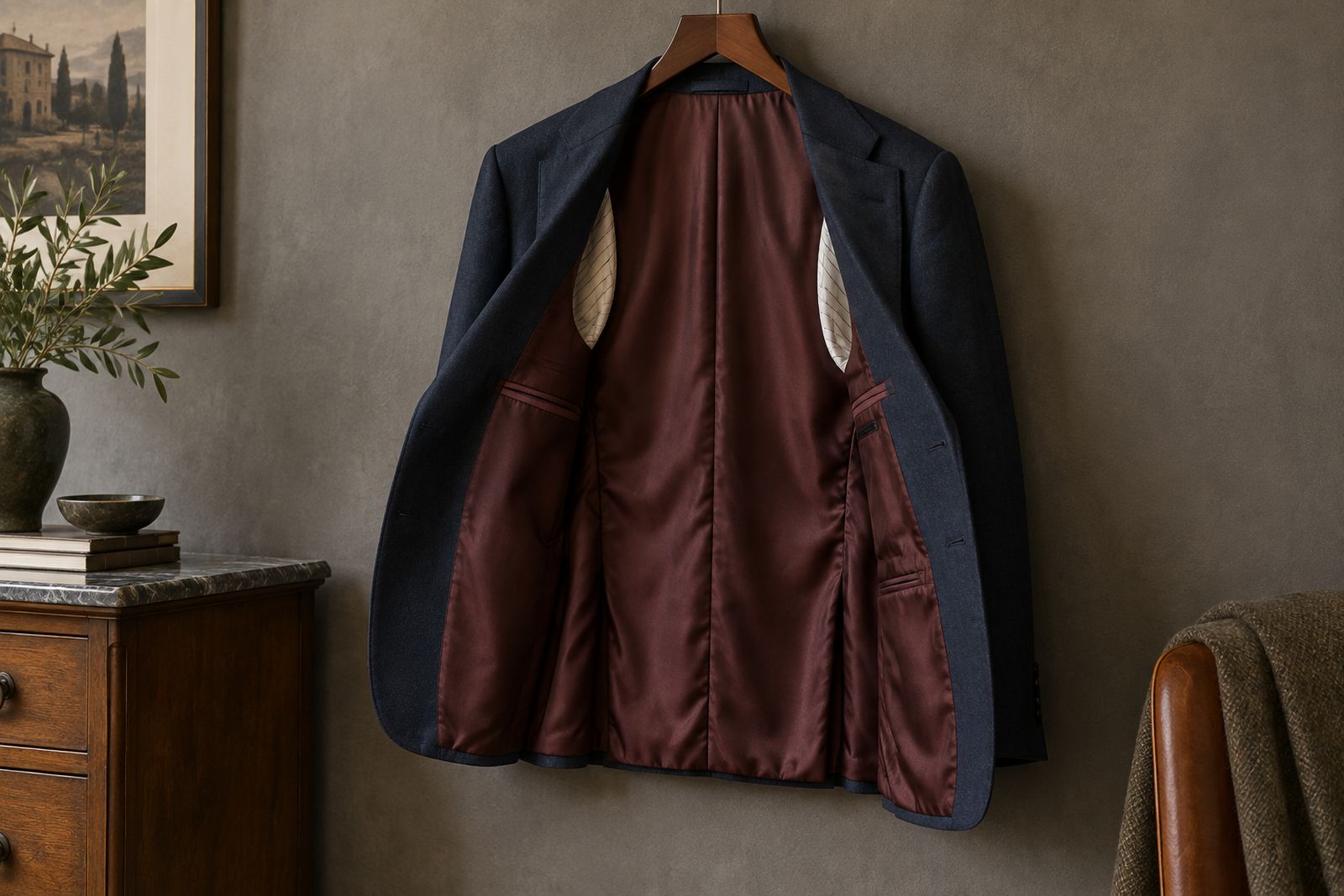
The short answer
The best suit lining for most people is cupro, often sold under the brand name Bemberg: it breathes, absorbs moisture, resists static and lasts well. Viscose breathes almost as well but wears faster. Polyester is cheap and durable but traps heat and builds static. Silk feels luxurious but wears through sooner. For hot weather, choose cupro in a half-lined jacket.
- Cupro (Bemberg) is the standard in good tailoring: breathable, antistatic and hard-wearing.
- Viscose breathes almost as well as cupro but is weaker, especially at the armholes.
- Polyester lasts, but it does not breathe, so it feels clammy in heat and builds static.
- Silk is luxurious but wears faster than cupro; most tailors prefer cupro.
- For hot weather, choose a cupro lining in a half-lined or unlined jacket.
- The composition label lists the lining separately; read it before you buy.
In this guide
- What does a suit lining do?
- Suit lining materials compared
- What is Bemberg lining?
- Is polyester lining bad?
- Viscose and acetate: the middle ground
- Are silk linings worth it?
- Full, half and unlined jackets
- What is the best suit lining for hot weather?
- Sleeve linings, trouser linings and pocketing
- How long does a suit lining last?
- How to tell what lining a suit has
- The tailor's view: choosing and replacing a lining
- Questions people ask
Most people choose a suit by its outer fabric and never look inside. Yet the suit lining is what your shirt slides against all day, and it has a direct effect on comfort, static, heat and how long the jacket stays presentable inside. A good lining is easy to identify once you know what to look for, and it costs little more than a poor one.
Suit linings at a glance
- Best all-round
- Cupro, often sold as Bemberg
- Budget breathable
- Viscose (rayon)
- Cheapest
- Polyester, which does not breathe
- Luxury
- Silk, beautiful but less durable
- Hot weather
- Cupro in a half-lined or unlined jacket
- Relining a jacket
- Roughly $120 to $300, as of 2026
What does a suit lining do?
A suit lining is the smooth inner layer of a jacket, and often of the trousers, that covers the construction and lets the garment slide over your shirt. It does five jobs, and how well it does them depends on the material.
- Lets the jacket glide. A smooth lining lets the jacket slip on and off and move over your shirt without dragging.
- Covers the construction. It hides and protects the canvas, padding and seam allowances inside the jacket.
- Handles moisture. A breathable lining absorbs some perspiration and lets it pass, which keeps you more comfortable and protects the outer fabric.
- Helps the jacket hang. A lining cut with the right ease lets the outer fabric hang cleanly instead of catching on your shirt.
- Adds a little warmth. Every layer traps some air, which is welcome in winter and less so in summer.
Suit lining materials compared
Five materials cover almost every suit lining: cupro, viscose, acetate, polyester and silk. The first three are made from plant cellulose, which absorbs moisture; polyester is made from petroleum and does not; silk is a natural animal fiber. The table compares them on the points that matter in wear.
| Material | What it is | Breathability | Static | Durability | Relative cost |
|---|---|---|---|---|---|
| Cupro (Bemberg) | Regenerated cellulose made from cotton linter | High | Resists static | Good | Medium |
| Viscose (rayon) | Regenerated cellulose made from wood pulp | High | Resists static | Fair; weaker when wet | Low to medium |
| Acetate | Chemically modified cellulose with a bright sheen | Moderate | Can build some static | Fair to poor | Low |
| Polyester | Synthetic fiber made from petroleum | Low | Builds static | Very good | Lowest |
| Silk | Natural protein fiber | High | Some static in dry air | Fair; wears at friction points and weakened by sweat | High |
| Breathes | Absorbs moisture | Resists static | Hard-wearing | Low cost | |
|---|---|---|---|---|---|
| Cupro (Bemberg) | |||||
| Viscose | |||||
| Acetate | |||||
| Polyester | |||||
| Silk |
What is Bemberg lining?
Bemberg
Bemberg is a brand name for cupro, a regenerated cellulose fiber made by the Japanese company Asahi Kasei from cotton linter, the short fibers left on cotton seeds after ginning. In tailoring the name is often used for any cupro lining.
Cupro is made by dissolving cellulose and spinning it back into a fine, smooth filament. The result looks and feels close to silk: smooth, with a soft sheen, and cool against the skin. Because it is cellulose, it absorbs moisture and lets it pass, which also means it resists static. It is stronger than viscose and wears well at the armholes and cuffs, where linings fail first.
These qualities make cupro the default lining in most good ready-to-wear, made to measure and bespoke suits. When a tailor says a suit is lined in Bemberg, that is a sign of care about the inside of the jacket, though a cupro lining can still be sewn into a poorly made one.
Is polyester lining bad?
Polyester lining is not bad in every way, but it is the wrong choice for comfort. It is cheap, strong and hard to tear, and it resists creasing. The problem is that it absorbs almost no moisture. Perspiration stays on your shirt instead of passing through, so a polyester-lined jacket feels clammy in warm rooms, and the dry surface builds static that makes the lining cling and crackle in winter.
In a winter suit worn occasionally in a cool climate, a polyester lining is a small compromise. In a suit worn every day, or anywhere warm, it is a real one. Some modern polyesters feel better than older ones, but none handles moisture like cupro or viscose. A polyester lining is also a useful clue: it often goes with fused construction and other cost-cutting, so look more closely at the rest of the suit.
Viscose and acetate: the middle ground
Viscose, also called rayon, is a regenerated cellulose fiber made from wood pulp. It breathes and absorbs moisture almost as well as cupro and feels smooth and pleasant, which makes it a good lining at a lower price. Its weakness is strength: viscose loses much of its strength when wet, so linings in it tend to wear or split sooner at the armholes and other stress points, especially if you perspire heavily.
Acetate is cellulose that has been chemically modified, giving a bright, slippery lining with a strong sheen. It is cheap and drapes well, but it breathes less than viscose or cupro, abrades more easily and can be damaged by some solvents and heat. You will find it in mid-priced suits, often mixed with viscose.
Are silk linings worth it?
A silk lining is a pleasure, not a performance upgrade. Silk breathes, feels smooth and takes dye well, which is why it appears in luxury jackets and as a special request in bespoke. But it is expensive, it wears faster than cupro at the elbows, armholes and cuffs, and perspiration weakens and discolors it over time. Many tailors steer customers toward cupro for a suit that will be worn hard and keep silk for a jacket worn less often.
Full, half and unlined jackets
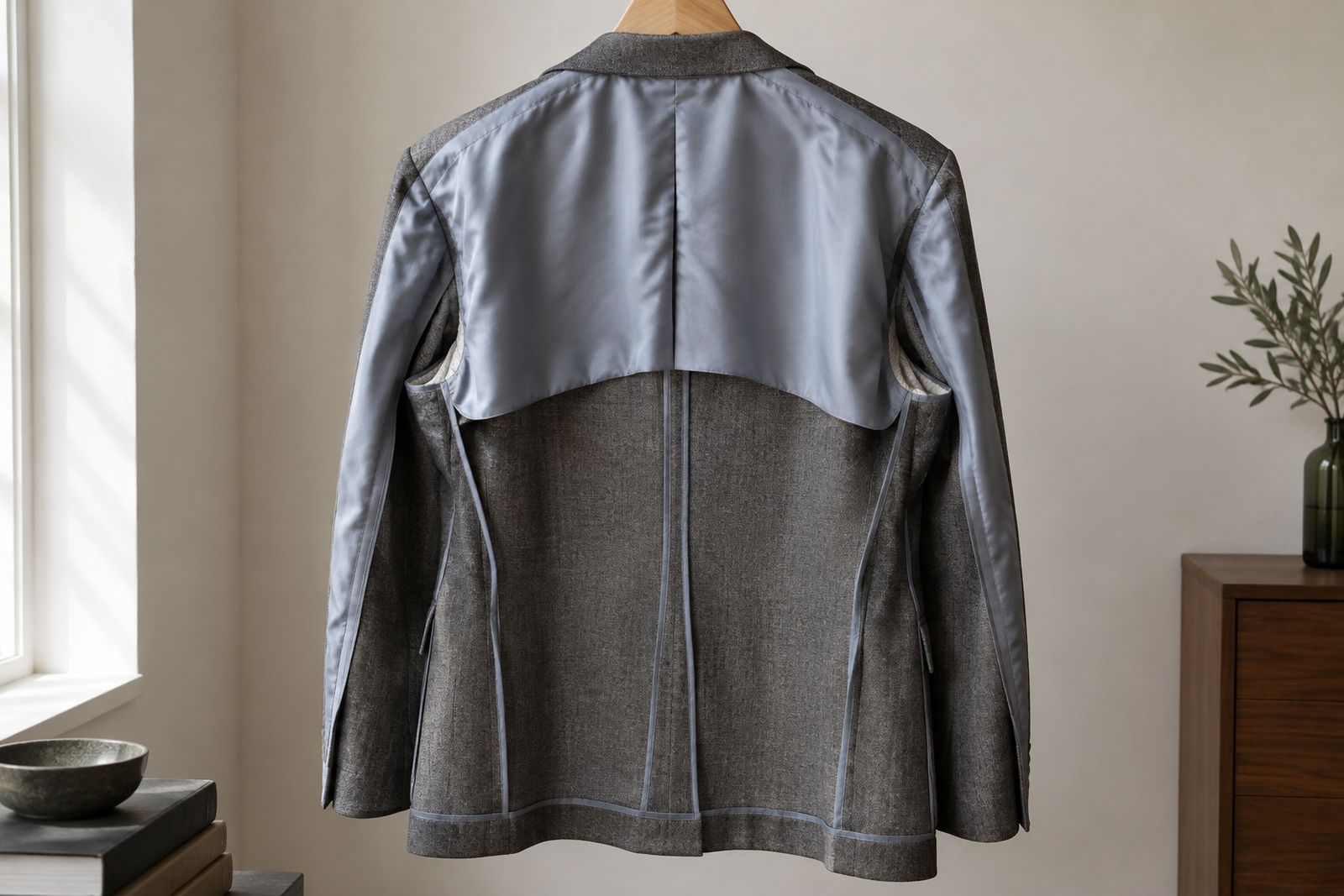
How much of the jacket is lined matters as much as the material. A full lining covers the whole inside of the body; a half lining, sometimes called a quarter lining or butterfly lining depending on how much is covered, lines the front and the shoulders but leaves most of the back open; an unlined jacket has little or no body lining. Sleeves are almost always lined, even in unlined jackets, so your arms slide in easily.
Fully lined
Body and sleeves lined
- Smoothest on and off
- Hides all the construction
- Warmest
- Standard for business suits and winter weights
Half lined
Front and shoulders lined, back mostly open
- Noticeably cooler across the back
- Lighter and softer
- Back seams must be neatly finished
- A good choice for summer suits
Unlined
Little or no body lining
- Coolest and lightest
- Softest drape
- All inside seams on show and bound
- Best for casual jackets in linen or cotton
What is the best suit lining for hot weather?
The best suit lining for hot weather is cupro, in a jacket that is half lined or unlined. Cupro breathes and absorbs moisture, so it adds little heat; cutting the lining away from the back adds more air flow than any material change. Avoid polyester linings in warm climates entirely. Remember that the lining is only part of the picture: an open-weave fabric in a light weight matters more. See our guides to the best suit fabric for hot weather and staying cool in a suit.
Sleeve linings, trouser linings and pocketing
Sleeve linings are often a different fabric from the body lining. In traditional English tailoring they are frequently a pale fabric with fine stripes, chosen to be smooth and hard-wearing so your shirt sleeves slide through. Many tailors use cupro for both.
Suit trousers are often lined at the front to just below the knee. The knee lining reduces friction on the inside of the fabric, helps the trousers hang straight and cuts down on bagging at the knee. Trousers in scratchy or very light fabrics are sometimes lined fully. Pocket bags and the curtain inside the waistband are made from strong cotton twill, often called silesia, because they take far more wear than a lining.
How long does a suit lining last?
A suit lining usually wears out before the outer fabric of a good suit. How soon depends on the material, how often you wear the suit and how much you perspire. Linings fail first at the armholes, where sweat and friction meet, then at the cuffs, the inside pockets and the hem. A cupro lining in a suit worn once or twice a week typically lasts for years; viscose and acetate tend to go sooner, and silk sooner still.
You can slow the wear. Rest a suit for a day or two between wears so the lining dries out, hang it on a shaped hanger, and dry clean only when the suit is actually dirty, because solvents and heat are hard on linings as well as fabric. Our guide to caring for a suit covers the routine.
How to tell what lining a suit has
The fastest way to tell what lining a suit has is the composition label inside the jacket, which usually lists the shell and the lining separately, for example: Shell 100% wool, Lining 100% cupro. If there is no label, your hand and eye will get you most of the way.
Checking a lining in the shop
- Read the composition label for the lining fiber, and the sleeve lining if listed separately.
- Feel it: cupro feels cool, soft and slightly matte or softly lustrous; polyester feels slick and a little plasticky.
- Rub it against your shirt sleeve: a polyester lining often clings or crackles with static.
- Look for a vertical pleat at the center back and a fold of extra lining at the hem, which give the lining room to move.
- On a second-hand jacket, check the armholes and cuffs, where linings wear and split first.
The tailor's view: choosing and replacing a lining
A good tailor cares as much about how the lining is cut as what it is made of. The lining must have more ease than the outer fabric. A pleat down the center back and a fold of extra length at the hem, sometimes called the jump, let the lining move when you reach forward, so it does not pull on the outer fabric or tear at the seams. A lining cut too tight drags the jacket out of shape.
Linings wear out before good outer fabric does, and replacing one is normal on a suit you intend to keep. Relining a jacket typically costs about $120 to $300 in the US and $120 to $260 in the UK as of 2026, depending on the tailor and whether the sleeves are included; see our suit alteration cost guide for other prices.
What to tell your tailor
- Ask for cupro for the body and sleeves unless you have a reason to choose otherwise.
- In a summer suit, ask for a half lining with the back seams bound.
- Choose a lining color that tones with the outer fabric for business suits; save bold linings for casual jackets if you want one.
- Ask for the trousers to be lined to the knee.
- When relining an old favorite, ask the tailor to check the pocket bags and repair them at the same time.
The lining is one of ten things worth checking before you buy a suit. For the rest, see our 10 signs of a high-quality suit, and for what sits underneath the lining, read fused vs canvas construction.
Questions people ask
What is Bemberg lining?
Bemberg is a brand of cupro, a regenerated cellulose fiber made by Asahi Kasei from cotton linter. It is smooth, breathable, absorbs moisture and resists static, which makes it the standard lining in good tailoring. Tailors often use the name for any cupro lining.
Is polyester lining bad?
It is durable and cheap, but it does not breathe or absorb moisture, so it feels clammy in warm conditions and builds static. It is a small compromise in a winter suit worn occasionally and a real one in an everyday or summer suit.
What is the best suit lining for hot weather?
Cupro, in a jacket that is half lined or unlined. Cupro breathes and absorbs moisture, and removing the back lining adds air flow. Avoid polyester linings in hot climates.
Is cupro better than viscose?
For linings, generally yes. Both breathe and absorb moisture, but cupro is stronger, especially when damp, so it lasts longer at the armholes and cuffs. Viscose is a good lower-cost alternative.
Are silk suit linings worth it?
Silk linings feel luxurious and breathe well, but they cost more and wear faster than cupro, and perspiration weakens them. They suit a jacket worn occasionally better than an everyday suit.
Can a tailor replace a suit lining?
Yes. Relining a jacket is a standard job that typically costs about $120 to $300 in the US and $120 to $260 in the UK as of 2026, depending on the tailor and whether the sleeves are included. It is worth doing on any suit with good fabric and construction.
Why are suit trousers lined to the knee?
A knee lining reduces friction on the inside of the fabric, helps the trousers hang straight and reduces bagging at the knee. It is a common sign of a well-made pair of trousers.
TailorGuide is independent. Our guides are written and checked by our team and carry no paid endorsements. How we work.