The short answer
To stay cool in a suit, start with the fabric: an open-weave wool, linen or mohair blend of about 7 to 9 oz (220 to 280 g). Ask for a half-lined or unlined jacket with soft shoulders and a little extra ease. Wear a light cotton or linen shirt, a thin undershirt only if you sweat heavily, and carry the jacket until you arrive.
- Fabric and lining do most of the work: open weave, 7 to 9 oz (220 to 280 g), half-lined.
- A little extra ease lets air move; a tight suit traps heat and shows sweat.
- Lighter colors reflect sunlight, but an open weave matters more than color.
- A thin, close-fitting undershirt helps heavy sweaters; skip it if you sweat lightly.
- Carry the jacket on the commute and put it on once you have cooled down.
In this guide
- What suit is best for hot weather?
- Choose a jacket built for heat
- Get the fit right for heat
- Should you wear an undershirt with a suit in summer?
- Pick a cooler shirt and tie
- What color suit is coolest in summer?
- How to not sweat in a suit
- Commuting in a suit in the heat
- Heat outside, air-conditioning inside: Dubai and the tropics
- Common mistakes in hot weather
- The tailor's view
- Questions people ask
How to stay cool in a suit in hot, humid weather is mostly settled before you get dressed. The fabric, the lining and the cut decide how much heat and sweat the suit holds in; the shirt, the undershirt and your habits do the rest. Get the first three right and a suit in July can be more comfortable than you expect. Get them wrong and no trick will save you.
Staying cool in a suit at a glance
- Fabric
- High-twist wool, hopsack, mohair blend or linen
- Weight
- 7 to 9 oz (220 to 280 g)
- Jacket
- Half-lined or unlined, soft shoulders, cupro lining
- Fit
- A little extra ease through the chest, seat and thighs
- Shirt
- Light cotton poplin, voile or linen
- Undershirt
- Thin and close-fitting, only if you sweat heavily
- Colors
- Light gray, tan, stone, mid-blue; navy in an open weave
- Commute
- Carry the jacket; put it on when you arrive
What suit is best for hot weather?
The best suit for hot weather is an open-weave wool, such as a high-twist (fresco-type) fabric or hopsack, of 7 to 9 oz (220 to 280 g), in a half-lined jacket. It breathes, handles sweat and keeps its shape in humidity. Linen is cooler in dry heat but creases, and a mohair-wool blend is the crispest option for humid days and evenings. Our guide to the best suit fabric for hot weather ranks every option with weights.
| Element | Choose | Avoid |
|---|---|---|
| Fabric | High-twist wool, hopsack, mohair blend, linen, seersucker | Polyester, flannel, tweed, dense gabardine |
| Weight | 7 to 9 oz (220 to 280 g) | Anything over about 10 oz (310 g) |
| Lining | Half-lined or unlined; cupro where lined | Full polyester lining |
| Shoulders | Soft, lightly padded or unpadded | Heavy padding |
| Chest | Soft half canvas or full canvas | Stiff, heavily fused fronts |
| Fit | A little extra ease | Tight through the chest, seat and thighs |
| Trousers | Light fabric, slightly fuller leg, side adjusters | Tight legs and a heavy belt |
Choose a jacket built for heat
The jacket traps more heat than anything else you wear, so its construction matters as much as its fabric. A half-lined jacket keeps lining in the sleeves, so it slides on easily, and usually across the shoulders and front, but leaves much of the back open. A quarter-lined jacket keeps less still, usually little more than a small panel across the upper back. An unlined jacket has no body lining at all, and its inside seams are neatly bound. Each step removes a layer.
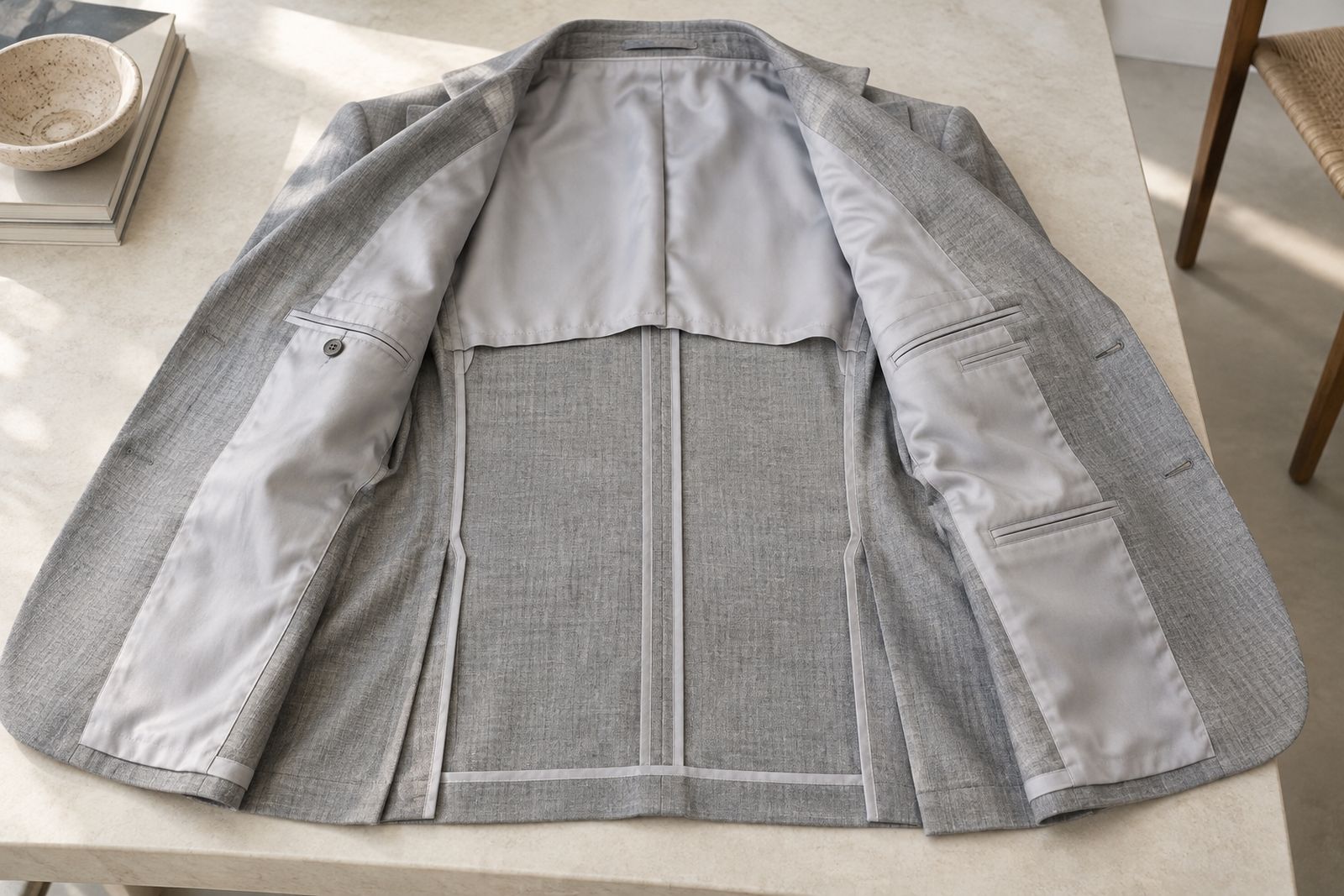
Where there is lining, ask for cupro (often sold as Bemberg) rather than polyester, because cupro absorbs moisture and breathes. Ask for soft shoulders with light or no padding, and a soft canvas rather than a fused front. Our guide to suit linings explains the options.
Get the fit right for heat
A suit cut close to the body traps heat, presses fabric against damp skin and shows every sweat mark. For hot weather, ask for a little more ease: enough room through the chest and back that the fabric does not cling when you move, and a slightly fuller trouser leg so air can circulate. This is not a loose suit; it is a suit with room to breathe.
At the waist, side adjusters or braces (suspenders) let you skip a belt, which removes a band of trapped heat. Pleats give the trousers a little more room through the hips and thighs. A slightly higher rise keeps the shirt tucked as you move, so you are not constantly adjusting it.
Should you wear an undershirt with a suit in summer?
Wear an undershirt in summer if you sweat heavily; skip it if you do not. A thin undershirt absorbs sweat before it reaches the shirt, which prevents visible sweat patches and protects the shirt's underarms from staining. The cost is an extra layer. For light sweaters, that layer adds warmth for no real benefit.
If you wear one, choose it carefully. It should be thin and close-fitting so it does not bunch under the shirt, with a V-neck that stays hidden when you open your collar. Fine cotton, modal, merino or a technical wicking fabric all work; a heavy cotton T-shirt does not. Pick a color close to your skin tone: under a white shirt, a white undershirt shows its outline, while a skin-toned one all but disappears.
With an undershirt
Best for heavy sweaters
- Absorbs sweat before it reaches the shirt
- Prevents visible sweat patches
- Protects shirts from underarm stains
- Adds a thin layer of warmth
Without an undershirt
Best for light sweaters
- One layer fewer, so cooler at rest
- Shirt shows sweat sooner
- Shirts need washing after every wear
- Simplest in dry heat
Pick a cooler shirt and tie
The shirt sits against your skin all day, so its fabric matters as much as the suit's. Choose light, open weaves and avoid dense ones.
| Fabric | What it is | In heat |
|---|---|---|
| Voile | Very fine, open plain-weave cotton | Coolest cotton option; slightly sheer |
| Poplin | Fine, smooth plain-weave cotton | Cool and crisp; the best all-round choice |
| End-on-end | Plain weave alternating colored and white yarns | Light and breathable |
| Linen | Plain-weave flax | Very cool, but creases |
| Seersucker | Puckered cotton | Stands off the skin; casual |
| Oxford | Heavier basket weave | Warmer; better on cooler days |
| Twill | Diagonal weave | Denser and warmer than poplin |
For ties, choose open, light constructions: grenadine (an open, gauze-like silk weave), knitted silk, linen or a light wool-silk blend. If the dress code allows, skip the tie and open the collar. A soft collar without stiff interlining looks better open than a heavily fused business collar; see our guide to shirt collars.
What color suit is coolest in summer?
Light colors are coolest in direct sun, because they reflect more sunlight; dark colors absorb more. Light gray, tan, stone, cream and mid-blue are the classic summer shades. But the openness of the fabric matters more than its color: a navy open-weave wool is cooler than a cream gabardine, and indoors the difference between colors largely disappears.
Color also changes how much sweat shows. Mid tones such as light gray and light blue show damp patches most clearly. Navy, darker tones and small patterns hide them better, which is one reason navy hopsack remains a favorite summer choice.
Classic
Light gray suit, white shirt, navy grenadine tie
Light gray
Suit
White
Shirt
Navy grenadine
Tie
Brown suede
Shoes
Classic
Navy hopsack, white shirt, no tie
Navy hopsack
Suit
White
Shirt
Tan loafers
Shoes
Works
Tan suit, light blue shirt, brown knit tie
Tan
Suit
Light blue
Shirt
Brown knit
Tie
Dark brown
Shoes
Works
Stone linen, white shirt, navy knit tie
Stone linen
Suit
White
Shirt
Navy knit
Tie
Dark brown suede
Shoes
Avoid
Charcoal flannel in summer
Dense, dark and warm: the hottest combination you can wear.
Charcoal flannel
Suit
White
Shirt
Black
Shoes
How to not sweat in a suit
You cannot stop sweating in heat, and you should not try: sweat is how your body cools down. What you can do is reduce how much you sweat into your clothes and how much of it shows.
Habits that keep you cooler
- 1
Apply antiperspirant at night
Antiperspirant works best on dry skin while your sweat glands are less active. Applied before bed, it has time to take effect by morning; a top-up after your shower is fine.
- 2
Cool down before you dress
Finish your shower with cooler water and give yourself ten minutes before putting on the shirt. Dressing while still warm from the shower starts the day damp.
- 3
Carry the jacket
Walk in your shirt, with the jacket over your arm or in a garment bag. Put it on once you have cooled down indoors.
- 4
Slow down and take the shade
Walking fast in heat raises your temperature quickly. Leave a few minutes earlier and walk on the shaded side of the street.
- 5
Arrive early
Ten minutes in a cool lobby lets you stop sweating before you shake hands.
Tip: Use the time to blot your face and neck with a handkerchief, not a paper napkin that leaves fibers behind.
- 6
Keep a spare shirt
A fresh shirt in a desk drawer or bag rescues the afternoon after a hot commute or a lunch outdoors.
- 7
Drink water through the day
Staying hydrated does not stop you sweating, but it helps your body manage heat.
Commuting in a suit in the heat
The commute is where most suits get sweated through. A few habits help:
- On foot or by public transport: carry the jacket and keep the tie in a pocket until you arrive.
- By car: lay the jacket flat on the back seat or hang it on a hook rather than wearing it, and cool the car before you get in.
- By bike: ride in other clothes and change at work, keeping the suit in the office if you can. No suit fabric survives a summer bike commute.
- At the office: keep a spare shirt, a wooden hanger and a handkerchief at your desk.
Heat outside, air-conditioning inside: Dubai and the tropics
In cities such as Dubai, summer heat outdoors is fierce and often humid on the coast, while offices, malls and cars are kept cold. The suit has to cope with both. The answer is usually a light wool rather than linen: 8 to 9 oz (250 to 280 g) in a high-twist or tropical worsted, half-lined, which is comfortable in a chilled interior and bearable on the short walks between buildings. Carry the jacket outdoors and wear it inside.
In tropical climates, hot and humid all year, the suit is in effect a summer suit worn every day. Choose high-twist wool of 7 to 9 oz (220 to 280 g), unlined or half-lined. Own several suits and rotate them so each can dry out fully between wears, and lean on cotton and linen shirts. Patterned and darker fabrics hide sweat better than mid-gray.
| Climate | Main challenge | What to wear |
|---|---|---|
| Hot and dry | Strong sun; sweat dries quickly | Linen or high-twist wool in light colors; sunglasses and a hat outdoors |
| Hot and humid | Sweat does not evaporate | High-twist wool or mohair blend, unlined or half-lined; a spare shirt |
| Hot outside, cold inside | Swings between heat and chill | Light wool, half-lined; carry the jacket outdoors |
| Occasional heatwaves in a mild climate | A year-round suit feels too warm | Your lightest suit, an open collar and the jacket carried; consider a dedicated summer suit |
Common mistakes in hot weather
- Wearing a year-round suit in real heat. A year-round suit of about 10 oz (310 g) is right for most of the year, not for a humid July.
- Choosing polyester to avoid creases. It will not crease, and you will be uncomfortable all day.
- Wearing the suit too tight. Close fits trap heat and show sweat.
- Wearing a thick cotton T-shirt underneath. It adds warmth and shows at the collar.
- Putting the jacket on too early. Wait until you have stopped sweating.
- Wearing the same suit two days running. Wool needs a day to dry out and air.
The tailor's view
A good tailor in a hot city will ask how you get to work, how long you spend outdoors and how cold your office is before suggesting a fabric. Tell them, and ask about construction as well as fabric: a half lining, soft shoulders and a little more ease make as much difference as the weave.
What to ask your tailor for in a hot-weather suit
- An open-weave wool, linen or mohair blend of 7 to 9 oz (220 to 280 g)
- A half-lined or unlined jacket, with cupro where lined
- Soft shoulders with light or no padding
- A soft canvas rather than a fused front
- A little extra ease through the chest, seat and thighs
- Side adjusters instead of belt loops
- A second pair of trousers
If you face heat often, invest in one proper summer suit before anything else; suit fabrics explained shows how the summer fibers compare. If linen appeals, read our guide to linen suits first, and for summer celebrations, see beach and summer wedding attire.
Questions people ask
What suit is best for hot weather?
An open-weave wool, such as a high-twist (fresco-type) fabric or hopsack, of 7 to 9 oz (220 to 280 g), in a half-lined jacket, is best for most hot weather. Linen is cooler in dry heat but creases. A mohair-wool blend is the crispest choice for humid days.
Should you wear an undershirt with a suit in summer?
Wear one if you sweat heavily, because it absorbs sweat before it reaches your shirt and prevents visible patches. Choose a thin, close-fitting V-neck in a color close to your skin tone. If you sweat lightly, skip it; the extra layer only adds warmth.
How do you not sweat in a suit?
You cannot stop sweating in heat, but you can reduce it and hide it. Wear a light, open-weave, half-lined suit, apply antiperspirant at night, carry the jacket until you have cooled down and arrive a few minutes early. A thin undershirt and a spare shirt help on the hottest days.
What color suit is coolest in summer?
Light colors such as light gray, tan, stone and cream are coolest in direct sun because they reflect more sunlight. The openness of the fabric matters more than color, though, so a navy open-weave wool can be cooler than a light, dense fabric. Navy and small patterns also hide sweat better than mid-gray.
Is it acceptable to wear a suit without a tie in summer?
In most offices and at many summer events, yes. A suit with an open-collar shirt is cooler and looks deliberate if the collar is soft and sits well. Keep the tie for formal meetings, weddings that call for one and conservative workplaces.
Can you take your jacket off in a meeting?
Follow the host's lead. If the host or the most senior person removes their jacket, or invites you to, it is fine to do the same. In a formal meeting where nobody does, keep it on, and choose a cooler suit next time.
Does a linen suit keep you cooler than wool?
In dry heat, yes: linen is the most breathable suit fabric. In humid heat, an open-weave wool is often just as comfortable and looks far better after a few hours, because it resists creasing and handles sweat well. Many people who dress for heat own one of each.
TailorGuide is independent. Our guides are written and checked by our team and carry no paid endorsements. How we work.