The short answer
To clean a suit at home, brush it with a natural-bristle brush, air it overnight, steam out odors and creases, and spot clean marks by blotting with cold water and a little wool detergent, testing a hidden area first. Do not machine wash a wool suit: it can shrink, felt and ruin the interlinings. Wash a suit only if its care label allows it.
- Brushing, airing and steaming handle most of what a suit needs.
- Blot stains, never rub, and work from the edge inward with cold water.
- Use a wool detergent; enzyme (biological) detergents and bleach damage wool.
- Never machine wash a wool suit unless the care label says it is washable.
- Take oil that will not lift, ink and large or old stains to a dry cleaner promptly.
In this guide
- What you need to clean a suit at home
- How to clean a suit at home, step by step
- How to spot clean a suit
- How to remove common stains from a suit
- How to get smells out of a suit
- Can you wash a suit in the washing machine?
- Can you hand wash a wool suit?
- How to read a suit's care label
- When to stop and take it to a professional
- Common mistakes when cleaning a suit at home
- Questions people ask
You can clean a suit at home, as long as cleaning means brushing, airing, steaming and spot cleaning rather than washing. Those four methods handle almost everything a suit picks up in normal wear. What you should not do with a wool suit is put it in a washing machine or a sink full of water.
Home cleaning also spares a suit unnecessary trips to the dry cleaner, where solvent and pressing wear the fabric a little each time. Below are the method, a stain-by-stain table, how to remove smells, and the rare cases where washing is allowed.
Cleaning a suit at home at a glance
- Works at home
- Brushing, airing, steaming, spot cleaning
- Never for wool suits
- Machine washing, soaking, tumble drying
- Water temperature
- Cold
- Detergent
- A few drops of wool detergent; never biological detergent or bleach
- Time
- 15 to 30 minutes, plus drying
- Call a cleaner for
- Oil that will not lift, ink, large or old stains
What you need to clean a suit at home
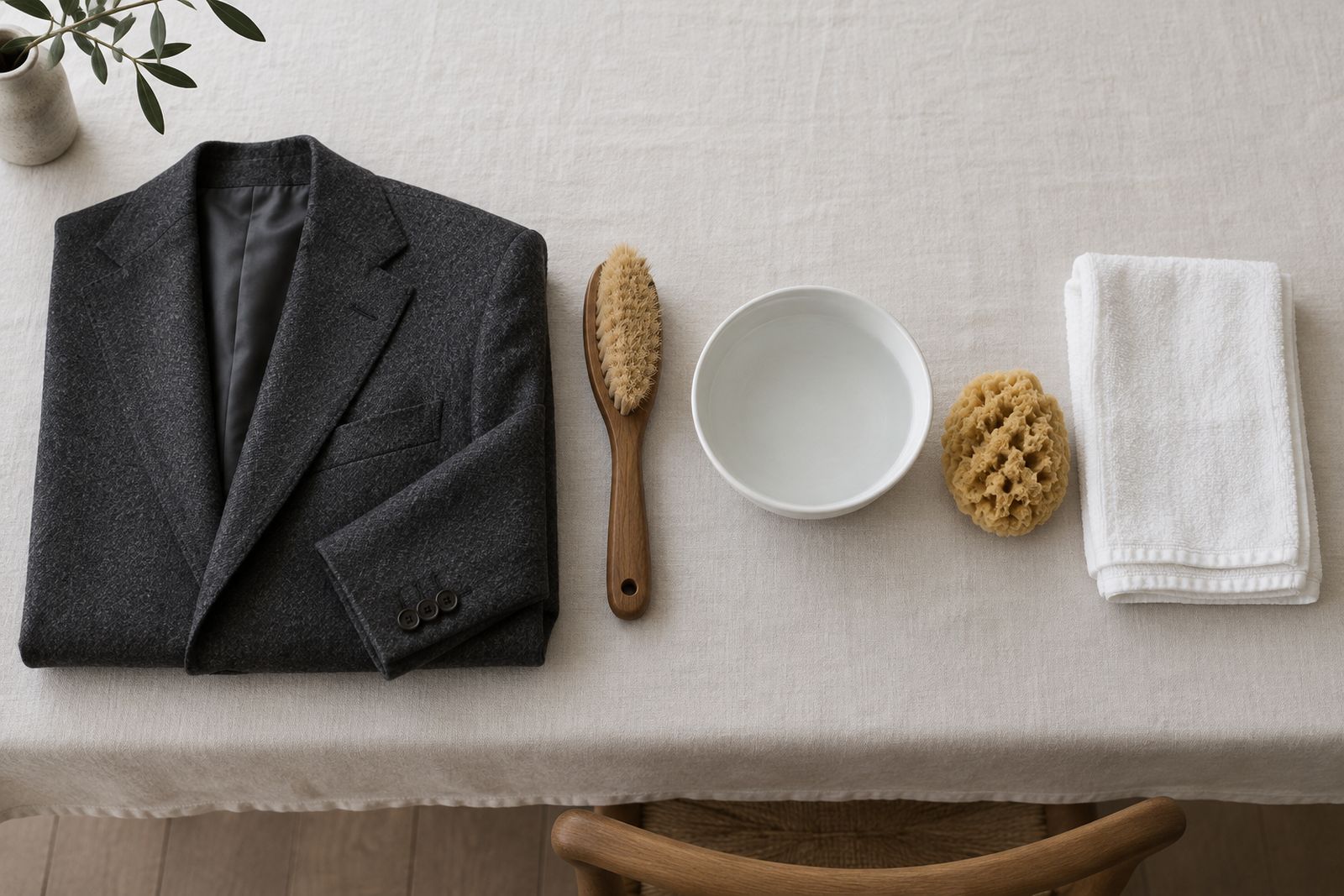
- A natural-bristle clothes brush: horsehair for fine fabrics, boar bristle for heavier ones.
- A handheld or upright garment steamer.
- Wool detergent: a gentle, enzyme-free liquid made for wool.
- Clean white cotton towels or napkins, so no dye transfers to the suit.
- A soft sponge and a bowl of cold water.
- Cornstarch or unscented talc for oil marks.
- A blunt knife or the edge of a spoon for lifting solids.
- A wide, shaped wooden hanger.
How to clean a suit at home, step by step
The home cleaning routine
- 1
Read the care label
Find the label inside the jacket or trousers (pants) and check what it allows. A crossed-out washtub means no washing of any kind. The label is written for that exact mix of fabric, lining and interlining, so follow it over any general advice, including ours.
- 2
Empty the pockets and brush
Brush the whole suit with short downward strokes, starting under the collar, to remove dust and dried crumbs before any water touches it.
- 3
Air it
Hang it overnight on a shaped hanger near an open window, out of direct sun. Many light odors leave on their own.
- 4
Spot clean marks
Treat each mark as described below: blot, test, clean from the edge inward and rinse by blotting.
Tip: Work on one mark at a time and let each dry before you judge it. A damp mark always looks worse than it is.
- 5
Steam
Steam the suit from the top down to release creases and freshen it. Do not steam over any mark that is still visible, because heat can set a stain. See how to get wrinkles out of a suit for the full method.
- 6
Dry and rest
Leave the suit on its hanger at room temperature, away from radiators and heaters, until it is completely dry. Brush it lightly once dry to lift the surface.
How to spot clean a suit
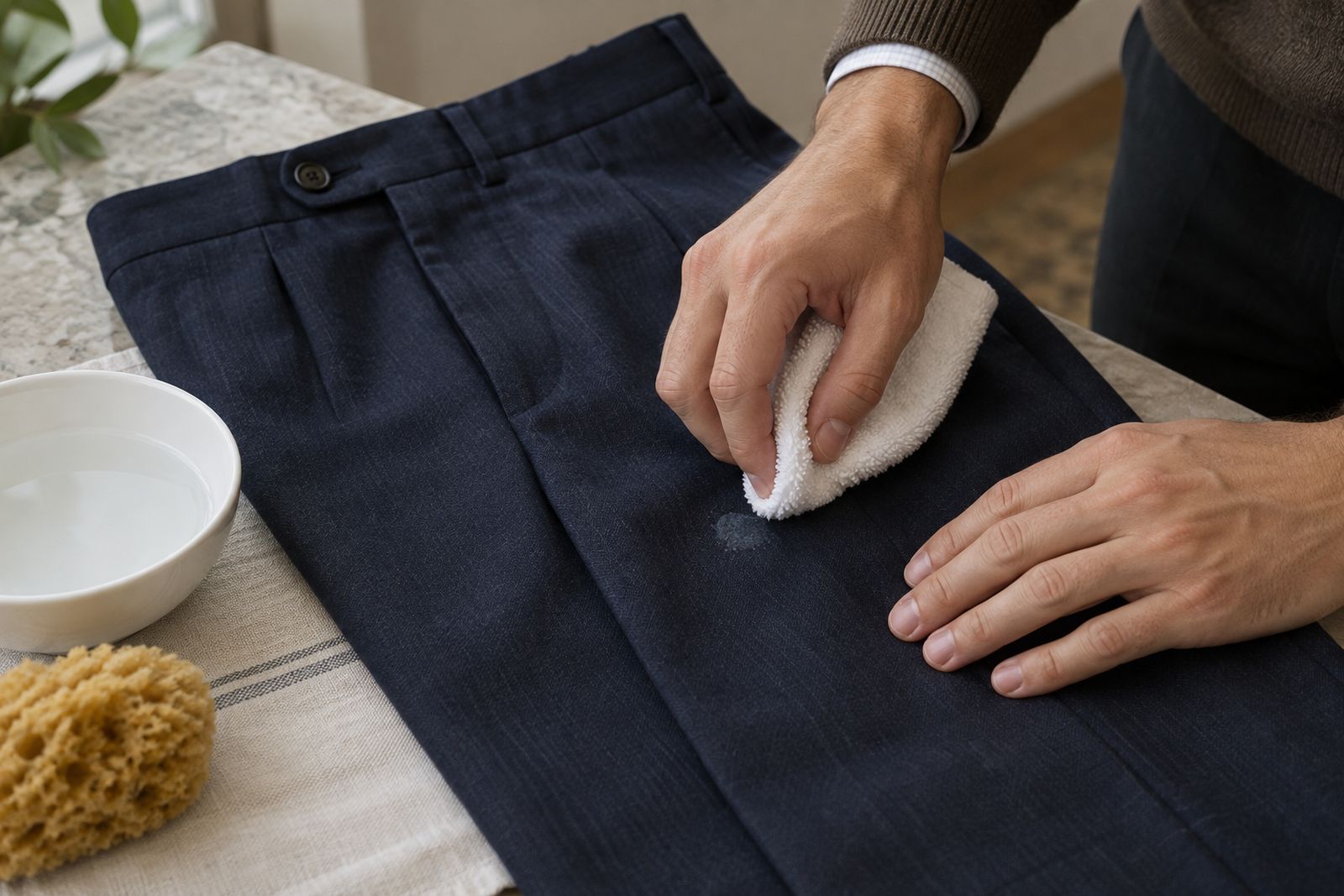
Spot clean a suit by blotting the mark with cold water and a little wool detergent, working from the outside of the mark toward its center, then rinsing by blotting with plain water. Two rules matter more than any product: never rub, and always test first.
Spot cleaning, step by step
- 1
Act quickly
The fresher the mark, the easier it lifts. Scrape off any solids with a blunt edge, lifting rather than pushing them into the fabric.
- 2
Blot the excess
Press a clean white towel onto the mark to absorb what you can. Do not rub: rubbing spreads the stain and roughens the surface of the wool.
- 3
Test in a hidden place
Dab your cleaning solution on an unseen area, such as the inside of a trouser hem, and check after a few minutes that the color has not changed.
- 4
Clean from the edge inward
Mix a few drops of wool detergent into a bowl of cold water. Dampen a sponge or the corner of a towel and dab from the outer edge of the mark toward its center, so you do not spread it.
- 5
Rinse by blotting
Dab the area with plain cold water to remove the detergent, then blot it dry with a fresh towel.
- 6
Feather the edges
With a barely damp sponge, dampen slightly beyond the treated area, blending outward, so the fabric dries evenly without a water ring.
- 7
Dry naturally
Let it dry on the hanger at room temperature. No hair dryer, iron or radiator until the mark has gone, because heat sets stains.
How to remove common stains from a suit
| Stain | What to do | Take it to a cleaner if |
|---|---|---|
| Food and sauce | Lift off solids, blot, then sponge with cold water and a drop of wool detergent | It contains oil and leaves a dark mark |
| Coffee or tea | Blot at once, sponge with cold water, then wool detergent if needed | A brown ring remains after drying |
| Red wine | Blot immediately, then sponge with cold water from the edge inward; do not rub | Any color remains, especially on light fabrics |
| Oil or grease | No water. Cover with cornstarch or talc, leave for several hours, brush off and repeat | A shadow remains after two treatments |
| Sweat | Sponge with cold water and wool detergent, rinse by blotting, air dry | Marks or yellowing persist |
| Makeup | Brush off powder; treat oil-based foundation like grease | Color has soaked into the fabric |
| Blood | Cold water only, blotting until no more color transfers; never hot water | Any trace remains |
| Ballpoint or fountain pen ink | Blot gently; do not add water or alcohol | Always: ink spreads easily, so let a professional treat it |
| Chewing gum | Harden it with an ice cube in a plastic bag, then lift it off with a blunt edge | Residue remains |
| Candle wax | Let it harden, then gently flake it off with a blunt edge | A greasy mark remains |
| Mud | Let it dry completely, then brush it out; sponge any remaining mark | A stain remains after brushing |
| Sugary drink or white wine | Sponge with cold water and blot, even if it dries clear | Always mention it: sugar can turn brown later under heat |
Test on a hidden area first. On silk, velvet, pale linen or any fabric with a special finish, go straight to a cleaner.
How to get smells out of a suit
Most smells leave a suit with time and air. Hang it on a shaped hanger outside the wardrobe overnight, ideally near an open window or in a well-ventilated room, out of direct sun. Steam it the next morning: the heat and moisture release odors held in the fibers.
- Food and smoke: a night of airing and a steam usually clears them. Heavy smoke can take two or three nights.
- Sweat: air and steam it. If the smell returns as soon as the suit warms up on your body, the sweat is in the fabric and the suit needs dry cleaning.
- Musty storage smell: air it for a day or two in a dry, ventilated room, then steam it.
- Stubborn odors: a light mist of plain, unflavored vodka is a theater wardrobe trick. It dries without leaving a scent and kills some of the bacteria behind body odor. Test it on a hidden area and let the suit dry fully before wearing.
Can you wash a suit in the washing machine?
No. Never machine wash a wool suit unless its care label specifically allows it. Washing a tailored wool suit is one of the few suit mistakes that cannot be fixed, because three things go wrong at once.
- Shrinkage and felting. Wool fibers are covered in tiny overlapping scales. Warm water and agitation make the scales catch on one another and lock together, so the fabric shrinks, thickens and turns fuzzy. Felting is permanent.
- Interlinings. A fused jacket's front is held by an interlining glued on with a heat-activated adhesive; water, heat and tumbling loosen it, and the front bubbles and ripples. In a canvassed jacket, the canvas, chest pieces and shoulder pads shrink at different rates from the outer fabric, so the jacket twists and puckers.
- Linings and trims. Linings, pocketing and waistband interlinings shrink differently from the outer fabric, pulling seams and hems out of line.
The exceptions: washable suits
A small number of suits are made to be washed. Some travel suits, in wool treated to resist felting or in polyester and technical blends, are built with washable interlinings and carry a washtub symbol on the care label. Some unstructured cotton and seersucker suits are washable too. If the label shows a washtub, follow it exactly: the temperature, the cycle and the drying instructions. Never tumble dry a suit unless the label allows it, and dry it on a shaped hanger. Our comparison of polyester and wool suits covers the trade-offs of easy-care fabrics.
Can you hand wash a wool suit?
No, not a tailored jacket. Hand washing is gentler than a machine, but soaking still drives water through the canvas, interlinings and shoulder pads, and the weight of a wet jacket pulls it out of shape as it dries. The same applies to trousers with a waistband interlining and pocketing. Spot clean and steam at home, and dry clean when the suit is genuinely soiled.
| Brush | Steam | Spot clean | Hand wash | Machine wash | |
|---|---|---|---|---|---|
| Wool suit, canvassed | |||||
| Wool suit, fused | |||||
| Washable travel suit | Per label | Per label | |||
| Unstructured cotton or seersucker suit | Per label | Per label | |||
| Linen suit | Per label | Per label | |||
| Velvet jacket |
How to read a suit's care label
The care label is the maker's instruction for that exact combination of fabric, lining and interlining, so it overrides general advice. The symbols follow an international system.
| Symbol | Meaning |
|---|---|
| Washtub with a number or dots | Machine washable; the number (in °C) or the number of dots shows the maximum water temperature |
| Washtub with a hand | Hand wash only |
| Crossed-out washtub | Do not wash |
| Circle with a P or an F | Professional dry cleaning; the letter tells the cleaner which solvents are safe |
| Circle with a W | Professional wet cleaning |
| Crossed-out circle | Do not dry clean |
| Square with a circle inside | Tumble drying allowed; crossed out means do not tumble dry |
| Iron with dots | Maximum iron heat: one dot about 230°F (110°C), two dots about 300°F (150°C), three dots about 390°F (200°C) |
When to stop and take it to a professional
Stop and take the suit to a good dry cleaner, telling them exactly what the stain is, when you see any of the signs below. A professional's chances drop once a home attempt has spread or heat-set a mark, so the earlier you hand it over, the better.
Hand it over when
- Oil or grease has not lifted after two rounds of cornstarch.
- The stain is ink of any kind.
- The stain is larger than about 1 inch (2.5 cm) across, or old and set.
- The fabric is silk, velvet or pale linen.
- Your own attempt has left a water ring or a change of color.
- An odor returns as soon as the suit warms up.
If the fabric itself is damaged, by a burn, a bleach spot or a moth hole, a tailor can send it to a specialist reweaver, who weaves in threads taken from a seam allowance. If your suit is bespoke, ask your tailor whether they kept any spare fabric from the cut.
Common mistakes when cleaning a suit at home
- Rubbing a stain, which spreads it and roughens the surface.
- Using hot water, which sets protein stains such as blood, sweat and milk.
- Using biological detergent or bleach on wool.
- Putting heat on a mark before it has gone, whether from a hair dryer, an iron or a steamer.
- Soaking a patch so wet that it leaves a water ring.
- Machine washing a wool suit, or tumble drying any suit not labeled for it.
- Blotting with a colored towel, which can transfer dye.
Most weeks, a brush, a night of air and a steam is all a suit needs. When it does need a professional clean, read how often to dry clean a suit and how to brief the cleaner, and keep up the full routine in our suit care guide.
Questions people ask
Can you wash a suit in the washing machine?
Not a wool suit, unless the care label shows a washtub symbol. Machine washing shrinks and felts wool and makes fused interlinings separate, which no tailor can reverse. A few travel suits and unstructured cotton suits are made to be washed; follow their label exactly.
Can you hand wash a wool suit?
No. Hand washing still soaks the canvas, interlinings and shoulder pads, and the weight of the wet jacket pulls it out of shape as it dries. Spot clean and steam at home, and dry clean when the suit is genuinely soiled.
How do you remove a stain from a suit?
Lift off any solids, blot with a clean white towel, then sponge from the edge of the mark inward with cold water and a drop of wool detergent, testing a hidden area first. Rinse by blotting with plain water and let it dry naturally. For oil, use cornstarch instead of water; for ink, go straight to a cleaner.
How do you get smells out of a suit without dry cleaning?
Hang it overnight on a shaped hanger near an open window, out of direct sun, then steam it. A light mist of plain vodka, tested on a hidden area first, helps with stubborn odors. If a smell returns as soon as the suit warms up, it needs a professional clean.
Can you clean a suit with a steamer?
A steamer freshens a suit and removes creases and light odors, but it does not remove stains or dirt. Brush the suit first, spot clean any marks, and never steam over a stain, because heat can set it.
How do you dry a suit that got soaked in the rain?
Hang it at once on a wide, shaped hanger at room temperature, away from radiators and direct heat, and let it dry slowly. Empty the pockets so they dry flat, and do not iron it while it is damp. Once it is fully dry, brush it and steam out any creases.
Is it safe to use fabric refresher spray on a suit?
Usually, if you spray lightly from a distance and test a hidden area first. These sprays mask odors more than they remove them, so airing and steaming do more good. If a smell keeps coming back, the suit needs cleaning.
TailorGuide is independent. Our guides are written and checked by our team and carry no paid endorsements. How we work.