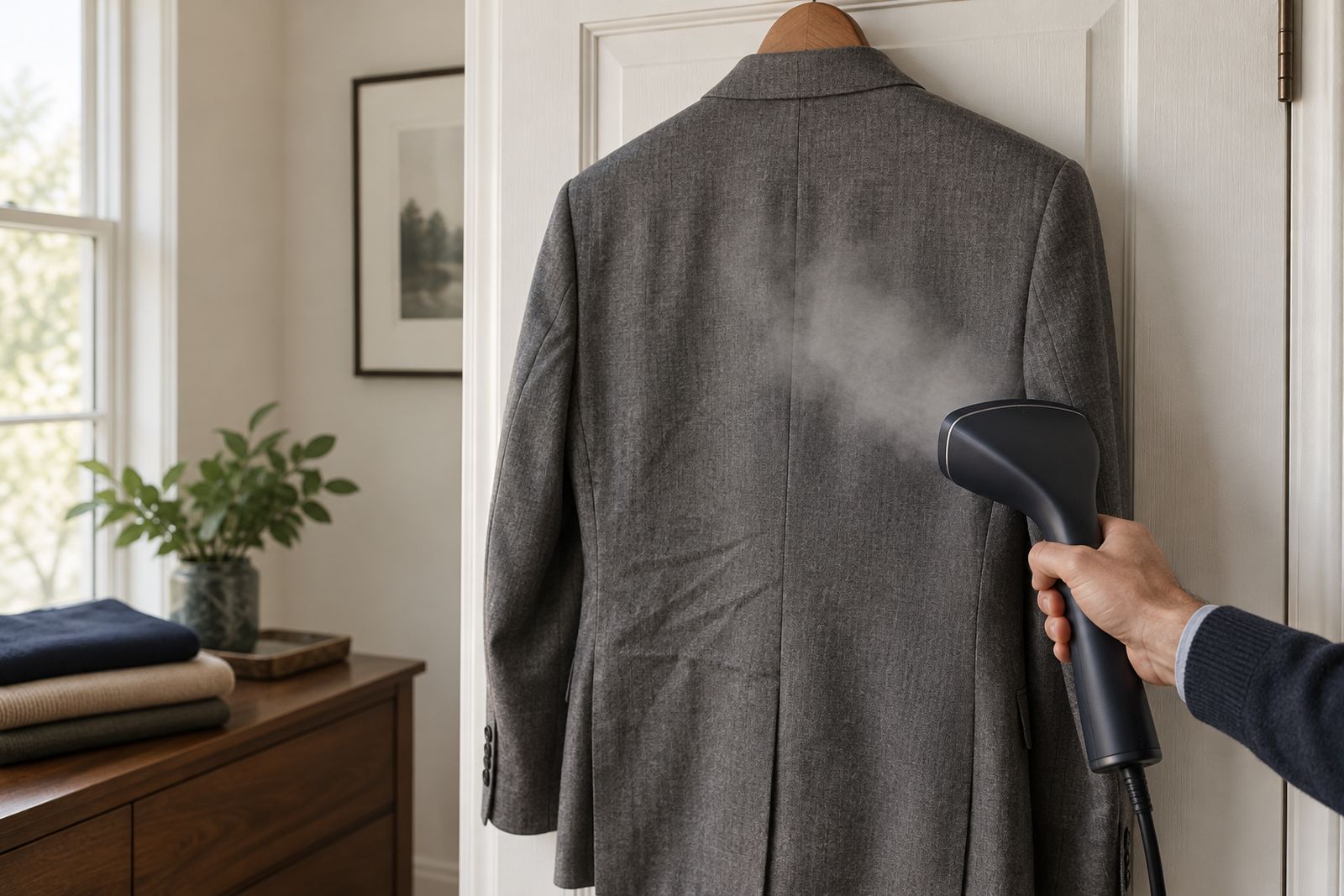
The short answer
To get wrinkles out of a suit, hang it on a shaped hanger and steam it with a handheld steamer, or hang it in a closed bathroom while a hot shower runs for 10 to 15 minutes. For sharper results, press it with the iron on the wool setting, about 300°F (150°C), through a damp cotton pressing sheet. Never put a hot iron directly on wool.
- Steam first: it removes most wrinkles without touching the fabric.
- No steamer? A hot shower and 15 minutes in a closed bathroom.
- Press wool on the two-dot setting, about 300°F (150°C), through a damp pressing sheet.
- Lift and lower the iron; sliding it stretches the fabric and causes shine.
- Leave lapels rolled, never pressed flat.
- Let the suit cool and dry for 15 to 30 minutes before wearing it.
In this guide
- Is it better to steam or iron a suit?
- How to steam a suit, step by step
- How to get wrinkles out of a suit without a steamer
- Can you iron a suit jacket?
- How to get wrinkles out of a suit in a hotel room
- Removing wrinkles from linen, cotton and other fabrics
- Common mistakes
- What a tailor's pressing does differently
- Questions people ask
The best way to get wrinkles out of a suit is steam. A handheld steamer, or the steam from a hot shower, relaxes wool so creases fall out under the suit's own weight. Pressing with an iron gives sharper results, but only through a damp pressing sheet and never with the iron directly on the wool.
Wool is forgiving. Its fibers are naturally springy, so a good wool suit loses light creases overnight on a proper hanger. The methods below are for what is left: the back of a jacket after a long drive, trousers creased behind the knees, a suit just out of a suitcase.
Removing wrinkles at a glance
- Fastest
- Handheld steamer, 5 to 10 minutes
- No tools
- Steamy bathroom for 10 to 15 minutes, then drying
- Sharpest finish
- Iron through a damp pressing sheet
- Iron setting for wool
- Two dots, about 300°F (150°C)
- Never
- A hot iron directly on wool
- Before wearing
- Let it cool and dry for 15 to 30 minutes
Is it better to steam or iron a suit?
Steam a suit for everyday wrinkles and press it only for sharp lines such as trouser creases. Steaming never touches the fabric, so it cannot cause shine or flatten the shape of the jacket. Pressing flattens and sets, which is exactly right for a trouser crease and exactly wrong for a lapel.
| Steaming | Pressing (iron and pressing sheet) | |
|---|---|---|
| Best for | Creases at the elbows, back and knees; freshening | Trouser creases, stubborn creases, crisp edges |
| Touches the fabric | No | Yes, through a pressing sheet |
| Main risk | Water spots if the steamer spits | Shine, scorching or seam imprints if done badly |
| Trouser crease | Softens it | Restores it |
| Lapels | Safe | Avoid: pressing flattens the roll |
| Time for a suit | 5 to 10 minutes | 15 to 25 minutes |
| Equipment | Handheld or upright steamer, or a hot shower | Iron, ironing board, pressing sheet, ideally a tailor's ham |
How to steam a suit, step by step
Steaming a suit
- 1
Hang it properly
Put the jacket on a wide, shaped hanger and the trousers (pants) on a clamp hanger by the hems, hung from a door or rail where you can reach all sides. Empty the pockets.
- 2
Fill and heat the steamer
Use the water your steamer's instructions specify (some call for distilled water to limit mineral buildup) and let it heat fully. Point the first burst away from the suit, because a steamer that is not fully hot can spit water.
- 3
Start at the top
Work from the shoulders down, holding the steamer head an inch or two (2.5 to 5 cm) from the fabric, and keep it moving in slow vertical strokes.
- 4
Hold the fabric taut
With your free hand, pull the hem of the panel you are steaming gently downward so the crease opens. Keep that hand below the steam, which can scald.
Tip: On a sleeve, hold the cuff and pull lightly downward while you steam from the shoulder toward it.
- 5
Steam the lining
Open the jacket and steam the lining, which creases as much as the outside and pushes its creases through to the front.
- 6
Do the trousers
Steam the trousers from hem to waist, paying most attention to the backs of the knees and the creases across the top of the thighs.
- 7
Let it set
Leave the suit on its hanger for 15 to 30 minutes to cool and dry before you wear it. Wool that is still warm and damp creases again at once.
How to get wrinkles out of a suit without a steamer
Hang the suit in a closed bathroom while you run a hot shower. The steam does the same job as a steamer, only more slowly. It works best on wool; linen and cotton respond less.
The hot-shower method
- 1
Hang it near, not in, the shower
Hang the suit on its hanger from the shower rail, a door hook or a towel rail, well clear of the spray and any drips.
- 2
Make steam
Close the door and window, and run the shower as hot as it goes for 10 to 15 minutes.
- 3
Let it absorb the steam
Turn off the water and leave the suit in the closed room for another 10 to 15 minutes.
- 4
Smooth by hand
Gently smooth any remaining creases downward with flat palms. Do not tug at seams.
- 5
Dry it completely
Move the suit to a dry, airy room for at least 30 minutes, longer if you can, before you put it on.
Avoid two shortcuts. Do not put a suit in a tumble dryer, which can shrink wool and damage the interlinings, and do not soak it with a spray bottle, which can leave water marks on some fabrics as it dries.
Can you iron a suit jacket?
Yes, but you press a suit rather than iron it, and you never let the hot iron touch the wool. Ironing means sliding an iron across fabric; pressing means lowering it, holding it for a few seconds and lifting it again. Sliding stretches wool out of shape and polishes its surface, which shows as shine.
Pressing sheet
A pressing sheet is a piece of plain cotton or linen fabric laid between the iron and the garment. Used damp, it turns the iron's heat into steam and keeps the soleplate off the wool. A clean white cotton handkerchief or pillowcase works.
What temperature should you iron a wool suit?
Set the iron to the wool setting: two dots on the dial, a maximum of about 300°F (150°C). Higher heat can scorch wool and melt synthetic linings. A lower setting with plenty of steam from the damp sheet is better than too much heat.
Scale from 180°F to 420°F. One dot: 180 to 230°F. Two dots: 230 to 300°F. Three dots: 300 to 390°F. Silk, polyester, acetate (110°C): at 230°F. Wool (150°C): at 300°F. Cotton, linen (200°C): at 390°F.
| Fabric | Iron setting | Maximum temperature |
|---|---|---|
| Wool, cashmere and wool blends | Two dots (wool) | About 300°F (150°C) |
| Silk, polyester and acetate, including polyester and acetate linings | One dot (low) | About 230°F (110°C) |
| Cotton and linen | Three dots (high) | About 390°F (200°C) |
| Mixed fibers | The setting for the most delicate fiber | Check the care label |
These are the maximum soleplate temperatures in the international care label system. Where your suit's label differs, follow the label.
How to press a suit jacket
Pressing a jacket
- 1
Set up
Set the iron to the wool setting. Wet a pressing sheet and wring it out until it is damp, not dripping. Have a tailor's ham, or a firmly rolled towel, ready for the curved areas.
- 2
Press the back and fronts
Lay one panel at a time flat on the board, cover it with the pressing sheet, lower the iron and hold it for a few seconds. Lift, move and repeat. Do not slide.
- 3
Use the ham for curves
Press the chest and the area below the shoulders over the ham, so the jacket keeps its shape instead of being flattened.
- 4
Press sleeves without a crease
Slide a rolled towel or a sleeve board inside each sleeve and press lightly. A suit sleeve should have no sharp crease along its top or bottom edge.
- 5
Leave the lapels and shoulders alone
Do not press the lapels flat or press down on the shoulders. Steam the lapels lightly, then roll them back into shape with your fingers.
- 6
Hang it to cool
Put the jacket straight back on its shaped hanger and leave it for at least 15 minutes before you wear it.
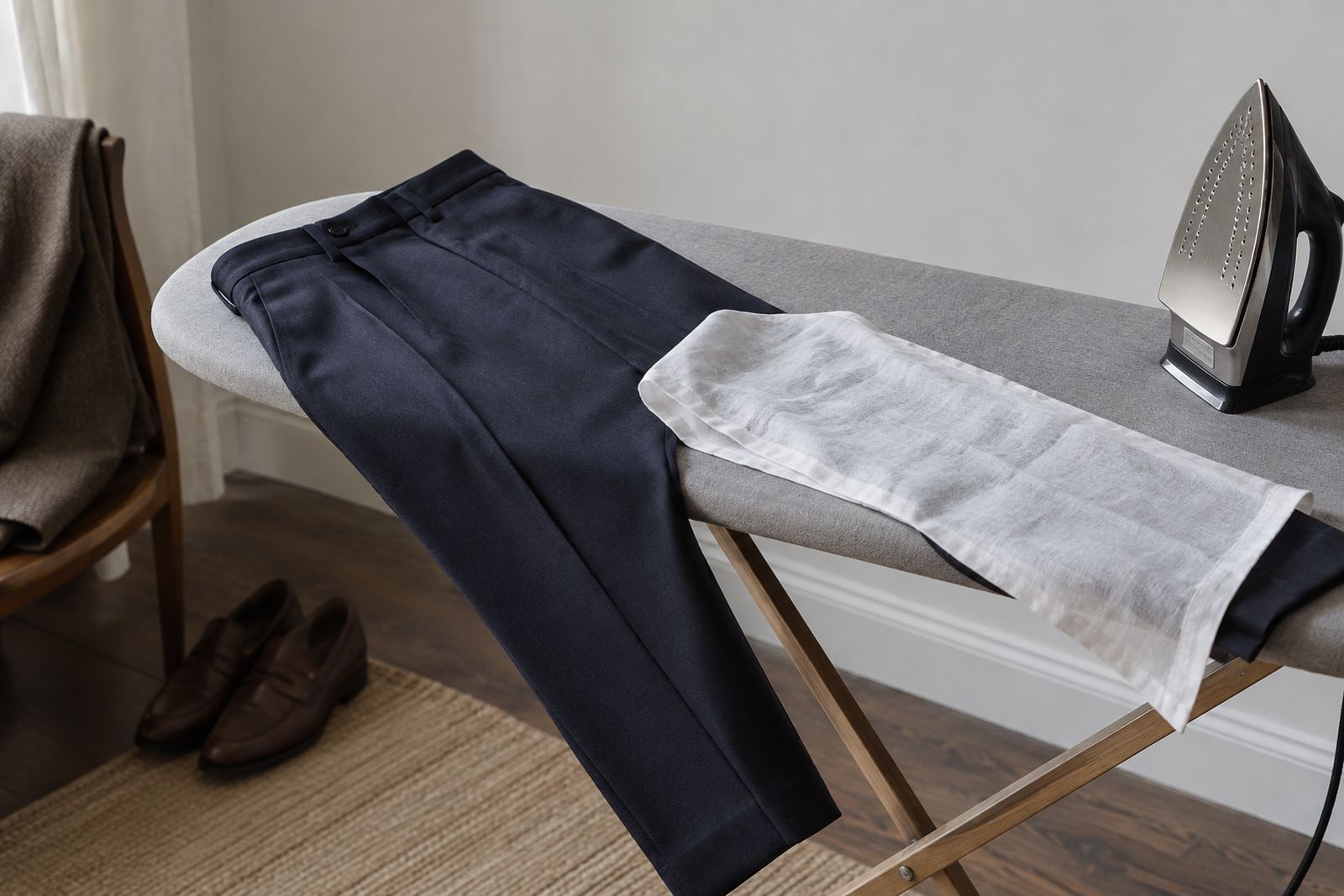
How to press suit trousers and restore the crease
Pressing trousers
- 1
Press the top first
Pull the waistband over the narrow end of the board and press the waist and pocket area through the damp sheet, one section at a time.
- 2
Line up the seams
Lay the trousers flat, hold them by the hems and align the inseam with the outseam on one leg. The existing crease falls into place at the front and back of that leg.
Tip: If the seams will not line up with the old crease, follow the old crease. Two crease lines side by side, a double crease, are hard to remove.
- 3
Fold back the other leg
Fold the top leg back out of the way so you press one leg at a time.
- 4
Press the crease
Lay the damp sheet over the leg and press from the hem upward. The front crease runs up toward the waistband or into the pleat; the back crease stops below the seat.
- 5
Repeat and hang
Press the other leg the same way, then hang the trousers at once by the hems or over a felted bar while they cool.
How to get wrinkles out of a suit in a hotel room
- Use the bathroom. Hang the suit in the bathroom while you shower, then let it dry for 30 minutes before you dress.
- Ask for pressing. Many hotels offer a pressing service. Ask for 'press only', not cleaning, and ask for the lapels to be left unpressed.
- Use the hotel iron carefully. Check that the soleplate is clean, set it to wool and press through a damp cotton pillowcase or handkerchief. Test it on the inside of a trouser hem first.
- Pack a travel steamer. If you travel in suits often, a small handheld steamer is the most reliable tool you can carry.
- Hang it the moment you arrive. Unpacking first does more than any iron. See our guide to packing a suit for the fold that keeps creases to a minimum.
Removing wrinkles from linen, cotton and other fabrics
Different fabrics need different heat and handling. Linen suits will never stay crease-free for long, which is part of their character; aim for neat, not flat.
| Fabric | Best method | Watch out for |
|---|---|---|
| Wool worsted and flannel | Steam; press through a damp sheet for creases | Shine from direct heat |
| Linen | Steam, or press while slightly damp on the high setting | Shine on dark linen: press on the reverse or through a sheet |
| Cotton | Steam; press through a sheet on the high setting | Shine on dark cotton |
| Seersucker | Steam lightly | Never press it flat, or the puckers disappear |
| Mohair and high-twist wool | Steam; both recover well on their own | Too much heat on the smooth surface |
| Velvet | Steam from the inside or from a distance only | Never press: an iron crushes the pile |
| Polyester blends | Steam; low iron setting through a sheet | Melting and shine from high heat |
Common mistakes
- Putting the iron directly on wool.
- Sliding the iron instead of lifting and lowering it.
- Pressing the lapels flat, which kills their roll.
- Steaming or pressing over a stain.
- Pressing a new trouser crease beside the old one.
- Wearing the suit while it is still warm and damp.
- Using the cotton setting on wool.
- Pressing over pocket contents or thick seams without a sheet, which imprints their outline.
What a tailor's pressing does differently
Professional pressers work on vacuum tables, which pull steam through the fabric and cool it quickly so the shape sets, and over shaped pressing forms and hams that match the curves of a jacket. That is why a professional press looks sharper than any home job. Use one a few times a year, or before an important occasion, and ask for the lapels to be rolled, not flattened.
If a suit already has shine from bad pressing, a tailor or a good cleaner can sometimes reduce mild shine with steam and a gentle brushing that lifts the flattened fibers. Heavy shine, where the fibers are worn or scorched, is permanent. A jacket front that has bubbled after heat has a separated fused interlining, which is a construction problem; see fused vs canvas.
Start with steam, keep the iron for trouser creases, and let time and a good hanger do the rest. For the full weekly routine, see how to care for a suit; if the suit needs more than a press, read how often to dry clean a suit.
Questions people ask
Is it better to steam or iron a suit?
Steaming is better for everyday wrinkles, because nothing touches the fabric, so it cannot cause shine or flatten the jacket's shape. Pressing with an iron through a damp pressing sheet is better for sharp results such as trouser creases. Most suits need steaming often and pressing rarely.
Does hanging a suit in the shower remove wrinkles?
Yes. Hanging a suit in a closed bathroom while a hot shower runs for 10 to 15 minutes removes most light wrinkles from wool. Keep it out of the spray, leave it in the steam for another 10 to 15 minutes, then let it dry for at least 30 minutes before wearing.
Can you iron a suit jacket?
Yes, if you press rather than iron. Set the iron to wool, lay a damp pressing sheet over the fabric, and lower and lift the iron instead of sliding it. Use a tailor's ham or a rolled towel for the chest, and never press the lapels flat.
What temperature should you iron a wool suit?
Use the wool setting, marked with two dots, which is a maximum of about 300°F (150°C). Always press through a damp pressing sheet, which adds steam and protects the wool from direct heat.
How do you get wrinkles out of a suit without a steamer?
Hang it in the bathroom while you run a hot shower, or leave it overnight on a wide, shaped hanger so the wool recovers on its own. For trouser creases, press through a damp cotton pillowcase or handkerchief with the iron on the wool setting.
How do you remove shine from a suit?
Mild shine from pressing can sometimes be reduced by steaming the area and brushing it gently to lift the flattened fibers. Heavy shine from scorching or years of wear is permanent. Prevent it by always pressing through a damp sheet.
How do you get wrinkles out of the back of suit trousers?
Hang the trousers upside down by the hems on a clamp hanger, so their weight pulls out the creases behind the knees, then steam them from hem to waist. For a sharp finish, press each leg through a damp pressing sheet with the inseam and outseam aligned.
TailorGuide is independent. Our guides are written and checked by our team and carry no paid endorsements. How we work.