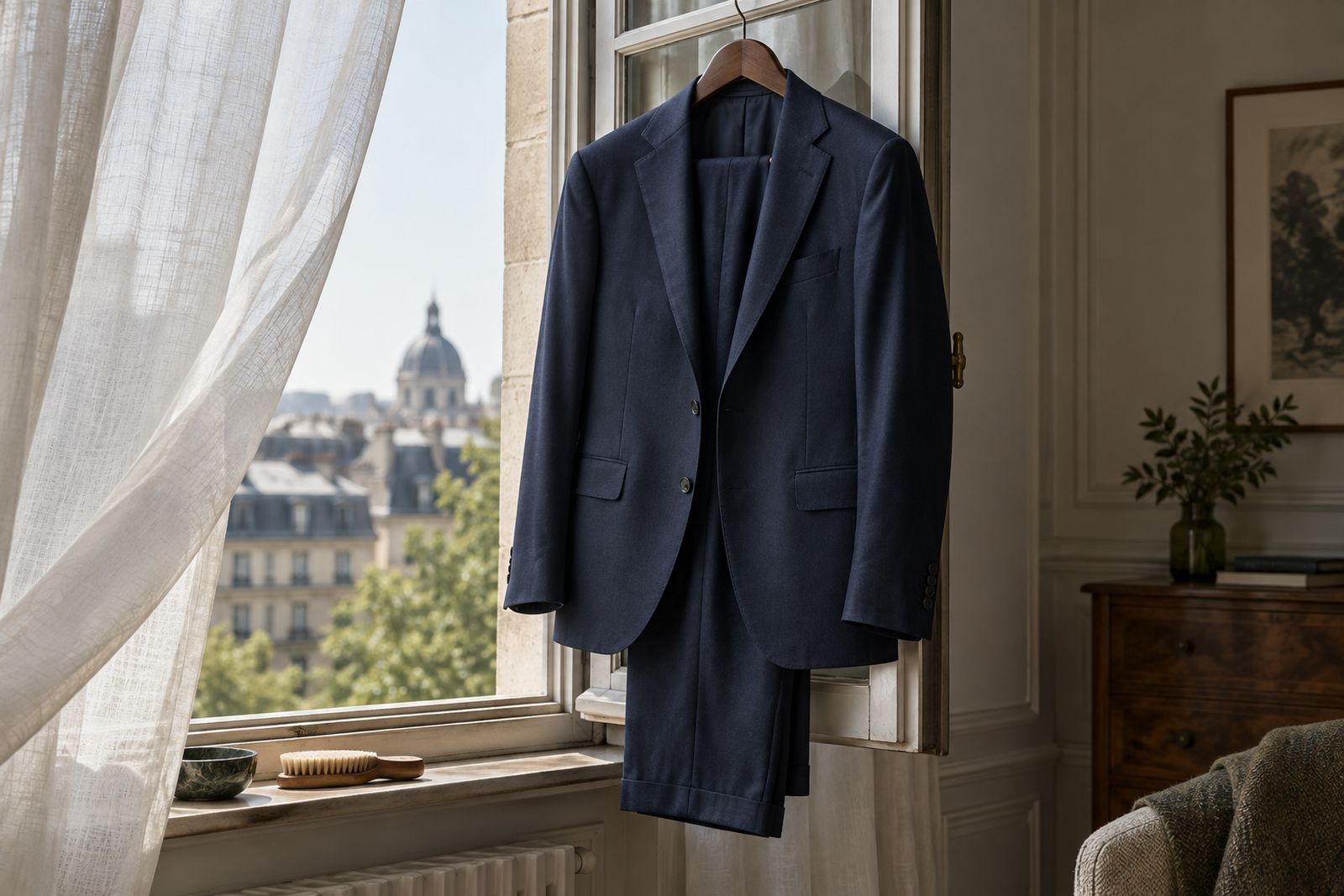
The short answer
Dry clean a suit only when it is visibly soiled, stained or still smells after airing. For a suit worn once or twice a week, that usually means once or twice a season. Always clean the jacket and trousers together. Between cleans, brush, air, steam and spot clean it, and use professional pressing alone when the suit is clean but needs reshaping.
- Clean a suit when it is soiled or smells, not on a schedule.
- With regular wear, once or twice a season is plenty.
- Always clean the jacket and trousers together so they fade and wear evenly.
- Ask for 'press only' when a suit is clean but rumpled.
- Clean before long-term storage: moth larvae prefer soiled wool.
In this guide
- How often should you dry clean a suit?
- Is dry cleaning bad for suits?
- Signs your suit needs dry cleaning
- How to freshen a suit between dry cleans
- Press only: the alternative to dry cleaning
- Should you dry clean the jacket and trousers together?
- How to choose and brief a dry cleaner
- Common dry cleaning mistakes
- Questions people ask
The answer to how often to dry clean a suit is simpler than most cleaners' price lists suggest: as rarely as you can. A suit is cleaned when it is dirty, not on a calendar. For most people that means once or twice a season for a suit in regular rotation, and even less for one worn to a handful of events a year.
The reason is wear. Each clean and press takes a little life out of the fabric and, on a cheaper jacket, out of the glue that holds its front together. The rest of the time, brushing, airing, steaming and spot cleaning keep a suit fresh without any of that cost.
How often to dry clean a suit
- Suit worn once or twice a week
- Once or twice a season
- Occasional suit (weddings, interviews)
- Only when soiled, and before storage
- Suit worn in heat
- When sweat marks or odor will not air out
- After a spill
- Promptly, if spot cleaning does not lift it
- Before storing for a season
- Yes, if worn since its last clean
- Jacket and trousers
- Always together
How often should you dry clean a suit?
Dry clean a suit only when it is visibly soiled, stained or still smells after a night of airing and a steam. For a suit worn once or twice a week in a rotation, that usually works out at once or twice a season. A suit worn a few times a year may need cleaning only before it is stored.
| How you wear it | Dry clean | Between cleans |
|---|---|---|
| Business rotation, once or twice a week | Once or twice a season | Brush after each wear, steam weekly, spot clean marks |
| Most days, without rotation | More often, because sweat builds up; the better fix is a second or third suit | Rest it whenever you can |
| Occasional (weddings, interviews, funerals) | Only after a spill or heavy wear, and before storage | Brush and air after each event |
| Summer or hot-climate wear | When sweat marks or odor persist after airing | Air overnight after every wear |
| Linen and cotton suits | When soiled; follow the care label, since some cotton suits are washable | Steam; expect creases |
| Before seasonal storage | Yes, if worn since the last clean | Store in a breathable cotton bag |
Heat changes the arithmetic. A suit worn through a hot summer absorbs far more sweat than the same suit in winter, and sweat left in wool stains and weakens it. Air a summer suit every night, and see how to stay cool in a suit for fabrics that cope better. Linen suits show dirt faster but also forgive a rumpled look between cleans.
Is dry cleaning bad for suits?
Occasional dry cleaning by a good cleaner is not bad for a suit; frequent dry cleaning is. Sweat, food and skin oils left in wool damage it too, and they attract moths, so a suit that needs cleaning should be cleaned. The harm comes from repetition, because the process is harder on a tailored garment than it looks.
Dry cleaning
Dry cleaning is cleaning in a liquid solvent instead of water. It is 'dry' only in the sense that no water is used: the suit is tumbled in solvent, spun, dried and then pressed.
Three parts of that process wear a suit:
- Tumbling in solvent. The machine turns the suit in solvent much as a washing machine turns clothes in water. The rubbing is gentle, but over many cleans it dulls the surface and thins fine fabrics.
- Machine pressing. Most cleaners finish suits on steam presses. Heavy heat and pressure flatten the fibers, which over time shows as shine on the seat, elbows and seams, and can press a hard crease into lapels that were meant to roll.
- Heat on the interlinings. A fused jacket's front is glued to an interlining with a heat-activated adhesive, and repeated heat and solvent can loosen it so the front bubbles. A full canvas front has no glue, and a half canvas front is fused only below the chest, so it has less glue to fail; but heavy pressing can still flatten the chest shape and lapel roll the canvas was built to hold.
Signs your suit needs dry cleaning
Clean it when you see any of these
- A stain that careful spot cleaning has not lifted.
- An oil or grease mark, which water cannot remove.
- A smell (sweat, smoke, food) that is still there after a night of airing and a steam.
- Sweat marks or discoloration at the underarms, collar or waistband.
- A grimy line along the collar or sleeve ends from skin contact.
- A spill of anything sugary, even if it dried clear.
- The suit has been worn since its last clean and is about to go into storage.
How to freshen a suit between dry cleans
Freshen a suit between cleans by brushing, airing, steaming and spot cleaning. Together they deal with most of what a suit picks up in a day, and none of them wears the fabric.
The between-cleans routine
- 1
Brush after every wear
Use a natural-bristle clothes brush with short downward strokes, starting under the collar. It lifts dust and grit before they work into the weave.
- 2
Air it overnight
Hang the suit on a wide, shaped hanger outside the wardrobe, ideally near an open window but out of direct sun, so moisture and odors can leave the fabric.
- 3
Steam it
A handheld steamer releases creases and light odors. Keep it moving, an inch or two (2.5 to 5 cm) from the fabric, and let the suit dry before wearing it.
Tip: Never steam over a mark: heat can set a stain. Spot clean first.
- 4
Spot clean marks
Blot, never rub, with cold water and a drop of wool detergent, testing a hidden area first and working from the edge of the mark inward.
- 5
Rest it
Give the suit at least 24 hours, ideally 48, before you wear it again.
Each step has its own guide: the full suit care routine, cleaning a suit at home and removing wrinkles.
Press only: the alternative to dry cleaning
When a suit is clean but rumpled, ask the cleaner for 'press only' (some call it 'sponge and press'). The suit is steamed and pressed without going through the solvent, so it comes back with crisp trouser creases and smooth fronts, for less money and far less wear than a full clean.
Press only suits a jacket that has lost its shape after travel or a long day, trousers that need their creases back, and anything clean you want looking sharp for an occasion. It does nothing for stains or smells.
Home care
After every wear
- Brushing, airing, steaming, spot cleaning
- Removes dust, light odors and creases
- No wear on the fabric
- Cannot remove oil or set stains
Press only
When clean but rumpled
- Steam and pressing, no solvent
- Restores trouser creases and a smooth front
- Less wear and lower cost than a clean
- Does not remove stains or smells
Full dry clean
When soiled
- Solvent clean, then pressed
- Removes oil, sweat and most stains
- Wears fabric and interlinings a little each time
- Once or twice a season at most with regular wear
Should you dry clean the jacket and trousers together?
Yes, always clean the jacket and trousers of a suit together, even if only the trousers are marked. Each clean changes a fabric's color and surface very slightly. Clean one piece more often than the other and, over a few years, the trousers will look lighter or flatter than the jacket in daylight, and the suit no longer matches.
Trousers (pants) do get dirtier faster. Spot clean them between full cleans and, when you order a suit, consider a second pair so the wear is shared across two.
How to choose and brief a dry cleaner
A good cleaner matters more than how often you go. Ask your tailor whom they trust: tailors see the results of every cleaner in town on the suits that come back to them for alterations.
What to ask for
- Hand finishing, or at least hand pressing of the jacket fronts and lapels.
- Lapels left rolled, not pressed flat into a crease.
- Trouser creases pressed on the existing lines, not on new ones beside them.
- No pressing over a stain until it has been treated.
- Your suit returned on a shaped hanger, or bring your own.
- Every spill pointed out, with what caused it.
When you collect the suit, check the lapels for a hard crease, the trouser legs for a double crease line, and the seat, seams and pocket edges for shine. Take it out of its plastic cover once you are home: plastic traps moisture and is no place to keep wool.
Some cleaners also offer professional wet cleaning, a controlled water-based process with special detergents and finishing equipment. It appears on care labels as a W inside a circle. Choose it only when your suit's label allows it.
Common dry cleaning mistakes
- Cleaning on a schedule rather than when the suit is dirty.
- Dry cleaning to remove wrinkles, which a steamer or a press-only service handles.
- Cleaning the trousers without the jacket.
- Ironing over a stain before it is cleaned, which can set it permanently.
- Leaving a sugary spill untreated because it dried clear.
- Storing a suit in the cleaner's plastic cover.
- Putting a worn suit into storage uncleaned, where moth larvae, which prefer soiled wool, will find it.
Clean less and care more. If a suit is clean but tired, start with a brush and a steam; if it still looks flat, ask for press only. Keep the full clean for real dirt. And if you want a suit that takes decades of this, read about fused vs canvassed construction before you buy the next one.
Questions people ask
Is dry cleaning bad for suits?
Occasional dry cleaning is fine and removes soil that would otherwise damage the fabric. Frequent cleaning is the problem: tumbling in solvent and repeated machine pressing gradually flatten and shine the fabric, can loosen the glue in fused jackets so the front bubbles, and can flatten a canvassed chest and lapel roll.
How do you freshen a suit between dry cleans?
Brush it after every wear, air it overnight on a shaped hanger, steam out creases and light odors, and spot clean marks with cold water and a little wool detergent. Then rest it for at least 24 hours before wearing it again.
Should you dry clean the jacket and trousers together?
Yes. Each clean alters a fabric's color and surface slightly, so cleaning the trousers on their own leaves them a different shade from the jacket over time. Clean the two together, and spot clean the trousers between cleans.
How often should you dry clean suit trousers?
On the same schedule as the jacket: only when they are soiled or smell, usually once or twice a season with regular wear. Trousers get dirty faster, so spot clean them between cleans rather than sending them in on their own.
Can dry cleaning shrink a suit?
A properly dry cleaned wool suit should not shrink, because the solvent does not make wool fibers swell and felt the way water, heat and agitation do. Problems usually come from too much heat in drying or pressing, or from water-based stain treatment. If a suit comes back tighter, raise it with the cleaner.
What does press only mean at a dry cleaner?
Press only means the suit is steamed and pressed but not cleaned in solvent. It restores trouser creases and smooths the jacket, costs less than a full clean and causes less wear, but it does not remove stains or smells.
Should you dry clean a new suit before wearing it?
No. A new suit is clean and has been pressed by its maker. Wear it, brush it and steam it as needed, and clean it only when it becomes soiled.
TailorGuide is independent. Our guides are written and checked by our team and carry no paid endorsements. How we work.