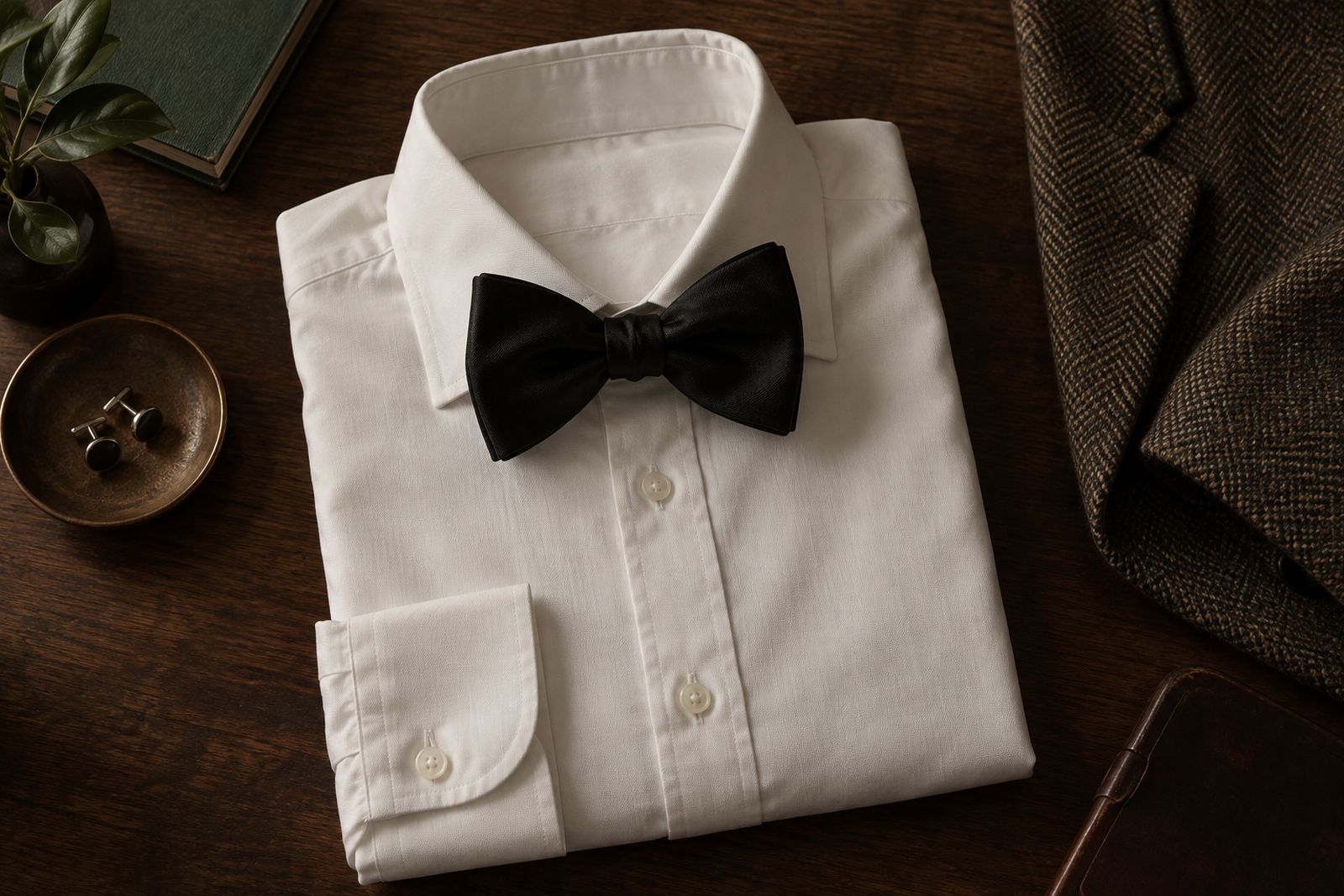
The short answer
To tie a bow tie, set the band to your collar size and let the left end hang about 1½ inches (4 cm) lower. Cross the long end over, bring it up through the neck loop, fold the short end into a bow with the fold on your right, drop the long end over it, then fold it and push it through the hole behind the bow to your left.
- A bow tie is tied with the same knot as a shoelace bow.
- Start with the left end about 1½ inches (4 cm) longer than the right.
- The front bow's fold goes on your right; the back bow comes through to your left.
- Set an adjustable band to your shirt collar size before you start.
- To even the sides, pull the fold or the end on the smaller side.
- Black tie calls for a black self-tie bow tie; white tie for a white piqué one.
In this guide
Learning how to tie a bow tie takes most people a few evenings of practice, not a special talent. The knot is the same bow you use on your shoes: a simple crossing, then a loop made with one end and a second loop pushed through behind it. The difficulty is doing it at your throat while reading a mirror, so the steps below give the direction of every fold.
Bow tie at a glance
- Knot
- The same bow as a shoelace, tied around the neck
- Start
- Left end about 1½ in (4 cm) longer than the right
- Front bow
- Made from the short end, fold on your right
- Back bow
- Made from the long end, pushed through to your left
- Sizing
- Set the band to your shirt collar size
- Width rule
- No wider than your face, no narrower than the outer corners of your eyes
Before you start: size the band
A self-tie bow tie only sits right if the band is the correct length. Fixed-size bow ties are sold by collar size, like shirts. Adjustable ones have a slider or a row of size marks on the band; most cover roughly 14 to 18 inches (36 to 46 cm) of neck, and longer versions exist for bigger collars. Set the band to the size printed on your shirt collar, for example 16 inches (41 cm). If you do not know it, our guide to measuring your shirt size shows how.
How to tie a bow tie, step by step
Left and right mean your own left and right, which is also how they appear when you face a mirror. The front bow is the loop you make first, from the short end; the back bow is the loop you push through behind it, from the long end. Most bow tie instructions, ours included, start with the longer end on the left. If you are left-handed and prefer, mirror every direction.
Tie a self-tie bow tie
- 1
Drape the tie
With the band set to your collar size and your collar up, drape the bow tie around your neck so the end on your left hangs about 1½ inches (4 cm) lower than the end on your right.
- 2
Cross the long end over
Cross the long left end over the short end, from left to right, close to your collar button.
- 3
Up through the neck loop
Bring the long end up behind the crossing and through the neck loop, then let it hang down in front. Pull it snug against your collar button.
Tip: This first knot sets the tension. If it is loose now, the finished bow will sag.
- 4
Even the ends
Check that the two ends hang at roughly the same level. If one is much longer, ease the knot slightly and slide the tie through it until they match. Then flip the long end up over your right shoulder, out of the way.
- 5
Make the front bow
Take the short end, which now points down. Fold it back on itself at its widest point and bring it up so it lies horizontally across your collar points, with the folded loop on your right and the free tip on your left.
- 6
Drop the long end over it
Hold the front bow at its center with your left thumb and forefinger. Bring the long end down from your shoulder, straight down over the middle of the front bow.
- 7
Open the hole
Still pinching the front bow, ease its loop and tip slightly forward. A small hole opens behind the front bow, just in front of the knot at your throat.
- 8
Fold the back bow
Fold the long end back on itself at its widest point, tucking it up behind the front bow, with the fold pointing to your left.
- 9
Push it through
Push the fold through the hole behind the front bow, folded edge first, so it comes out on your left. You now have the front bow's fold on your right and the back bow's fold on your left, with a free tip on each side.
Tip: If the back bow comes out on your right, the knot will twist. Pull it back and push it through to the left.
- 10
Tighten and balance
Pull the two folds outward at the same time to tighten the knot. Then even up the sides: pull gently on the fold or the free end on whichever side looks smaller.
- 11
Finish
Fold your collar down over the band, run a finger around to hide it, and straighten the bow so it sits level.
How to fix a lopsided or crooked bow tie
Most bows need a few small adjustments once tied. Make them one side at a time, and remember the rule: anything you pull on one side moves fabric toward that side. Pulling both folds at once tightens the knot without changing the balance.
| Problem | Cause | Fix |
|---|---|---|
| One side bigger than the other | Uneven folds or uneven ends at the start | Pull the fold or the free end on the smaller side until they match |
| Bow twists to sit diagonally or vertically | The second half of the knot was tied the wrong way round | Untie and retie, with the front bow's fold on your right and the back bow pushed through to your left |
| Bow sits loose and droops | First knot not snug, or the band set too long | Retie with the first knot firm; shorten the band by half a size if needed |
| Collar puckers or the band feels tight | Band set too short | Lengthen the band to your true collar size |
| Band shows above the collar | Collar not fully folded over the band | Fold the collar down and run a finger around to seat it |
| Bow looks too perfect | A pre-tied bow tie | Nothing to fix; a self-tie bow is meant to look slightly irregular |
How wide should a bow tie be?
A common rule of thumb: a tied bow should be no wider than the widest part of your face and no narrower than the outer corners of your eyes. Most men fall comfortably within that range with a standard butterfly bow. The shape of the bow also changes how wide it reads, so choose the shape first, then the size.
Butterfly
Also called thistle
- Flared ends that make a full, rounded bow
- The classic black tie shape
- Suits most faces
- Larger versions suit broad faces
Batwing
Also called straight or slim
- Straight, narrower ends
- A trimmer, more modern bow
- Suits slim faces and narrow lapels
- Can look small on a large frame
Diamond point
Pointed ends
- Ends cut to a point
- Shows one point on each side when tied
- Less common than the butterfly
- Suits men who want a bow with a twist
Self-tie vs pre-tied bow ties
A pre-tied bow tie is a fixed bow sewn onto a band that fastens with a hook or clasp. It is quick and always symmetrical, which is also its weakness: it looks manufactured. A self-tie bow has the slight irregularity of something tied by hand, and it is what black tie traditionally expects.
Self-tie bow ties
For
- +Looks natural, with the small irregularities of a hand-tied knot
- +Expected at black tie and white tie events
- +Can be worn untied around the collar late in the evening
- +Adjustable bands fit a range of collar sizes
Against
- –Takes practice to tie well
- –Needs a mirror and a few minutes
- –Can loosen during a long evening and need retying
When to wear a bow tie
Black tie is the bow tie's natural home: a black self-tie bow tie in silk, matching the facings of the dinner jacket's lapels, satin with satin and grosgrain with grosgrain. White tie calls for a white bow tie in cotton piqué. Outside evening dress, a bow tie with a suit or jacket is a personal signature rather than a default. Our guides to black tie and white tie set out the full rules.
| Occasion | Bow tie | Collar |
|---|---|---|
| White tie | White cotton piqué, self-tie | Detachable wing collar |
| Black tie | Black silk, matching the lapel facings, self-tie | Turndown or wing collar |
| Cocktail or creative black tie | Black or a dark color, velvet or silk | Turndown collar |
| Daytime with a suit or jacket | Patterned silk, wool or cotton | Point, spread or button-down |
| Job interview | Better avoided unless it is genuinely your style | Not applicable |
Which collar works with a bow tie?
A wing collar is standard for white tie and an option for black tie; its small wings tuck behind the bow. Turndown collars, such as a spread or point, are the more common choice for black tie and the only sensible choice in daytime. A spread collar frames a butterfly bow especially well. For more on each style, see our guide to shirt collar types.
The tailor's view
A bow tie should be sized like a collar, not guessed. If you are having a dinner shirt made, the shirtmaker will cut the collar to your neck; set the bow tie band to the same measurement and it will sit exactly at the collar's edge. Bespoke tie makers can also make a bow tie with a fixed band to your neck size and with blades shaped to suit your face, which is the neatest solution of all.
Match the bow to the jacket. On a dinner jacket, the bow's silk should echo the lapel facings, and its width should sit in proportion with the lapels: a slim batwing with narrow lapels, a fuller butterfly with broad peak or shawl lapels. Our guide to tuxedo vs suit explains the jacket itself.
Tie the bow a few times the evening before you need it, not ten minutes before you leave. Once the hands know the folds, it takes under a minute. For everyday neckties, start with our hub on how to tie a tie.
Questions people ask
Is it hard to tie a bow tie?
No harder than tying a shoelace, because it is the same knot. The tricky part is doing it at your throat while reading a mirror, so expect a few failed attempts. Practicing around your thigh, where you see the knot from above, speeds things up.
Self-tie or pre-tied bow tie: which is better?
A self-tie bow tie looks more natural and is what black tie traditionally expects. A pre-tied bow is quicker and always symmetrical, but it looks manufactured to anyone who knows. If you wear black tie more than once a year, learn to tie your own.
How do you adjust the size of a bow tie?
Slide the adjuster on the band until it lines up with the size mark that matches your shirt collar, for example 16 inches (41 cm). If the bow sits loose, shorten the band by half a size; if the collar puckers, lengthen it. Fixed-size bow ties are bought in your collar size.
How wide should a bow tie be?
As a rule of thumb, a tied bow tie should be no wider than the widest part of your face and no narrower than the outer corners of your eyes. Broad faces suit a fuller butterfly bow; slim faces suit a narrower batwing. Keep the bow in proportion with your lapels too.
Why does my bow tie twist vertically?
The second half of the knot was tied the wrong way round, which makes the bow turn instead of lying flat. Retie it with the front bow's fold on your right and push the back bow through to your left. Uneven tension can also tilt the bow slightly, which careful tightening fixes.
Can you wear a bow tie with a suit?
Yes, as a deliberate personal style. Choose a patterned silk, wool or cotton bow in daytime and keep the rest of the outfit simple. For job interviews and conservative offices, a long tie is the safer choice.
What bow tie do you wear with a tuxedo?
A black self-tie bow tie in silk, ideally in the same finish as the jacket's lapel facings: satin with satin lapels, grosgrain with grosgrain. A butterfly or batwing shape both work. White bow ties belong to white tie, not black tie.
TailorGuide is independent. Our guides are written and checked by our team and carry no paid endorsements. How we work.