The short answer
The white tie dress code for men means a black tailcoat, cut short in front with long tails behind, worn open; matching trousers with two braids down each outside seam; a white piqué waistcoat that must not show below the front of the coat; a stiff-fronted white shirt with a detachable wing collar; a white piqué bow tie; and black patent shoes. Gloves are optional.
- The tailcoat is cut short at the front and long behind, and is never buttoned.
- The white waistcoat must not show below the front edge of the coat.
- Shirt: stiff piqué front, detachable wing collar, single cuffs with links.
- Bow tie, waistcoat and shirt front are all white piqué; trousers carry two braids.
- Black patent oxfords or opera pumps; white gloves are optional.
In this guide
- What is white tie?
- What do men wear to a white tie event?
- The tailcoat
- Trousers: high rise and two braids
- The white waistcoat
- The shirt and wing collar
- The white bow tie
- How to put on white tie, in order
- Shoes, gloves and accessories
- What is the difference between white tie and black tie?
- Can you rent white tie?
- Rent, buy second-hand or have one made: the tailor's view
- Questions people ask
The white tie dress code is the most formal in Western dress, and the one most men meet least often. It survives at state banquets, the Nobel Prize banquet in Stockholm, the Vienna Opera Ball and a small number of traditional balls and dinners. Because it is rare, it is often done badly: hired tailcoats with the waistcoat hanging below the front, soft shirts, ready-tied bows. Done properly, it is the most flattering outfit a man can wear. The difference between a correct outfit and a costume comes down to fit, above all where the waistcoat meets the front of the coat.
White tie at a glance
- Coat
- Black evening tailcoat, short in front, long tails behind, peak lapels faced in silk, worn open
- Trousers
- Matching, high-waisted, two braids down each outside seam, worn with braces
- Waistcoat
- White piqué, low-cut, must not show below the front of the coat
- Shirt
- White, stiff piqué front, single cuffs with links
- Collar
- Detachable wing collar
- Bow tie
- White piqué, self-tied
- Shoes
- Black patent oxfords or opera pumps, black silk socks
- Optional
- White gloves, white silk scarf, top hat, pocket watch
What is white tie?
White tie is formal evening dress built around a black tailcoat, worn with a white waistcoat, a white wing-collared shirt and a white bow tie. It is the top rung on the ladder of men's dress codes, one step above black tie, and it is evening wear only. On some older British invitations it appears as "evening dress"; if the wording is unclear, ask the host. The daytime equivalent is morning dress.
Tailcoat
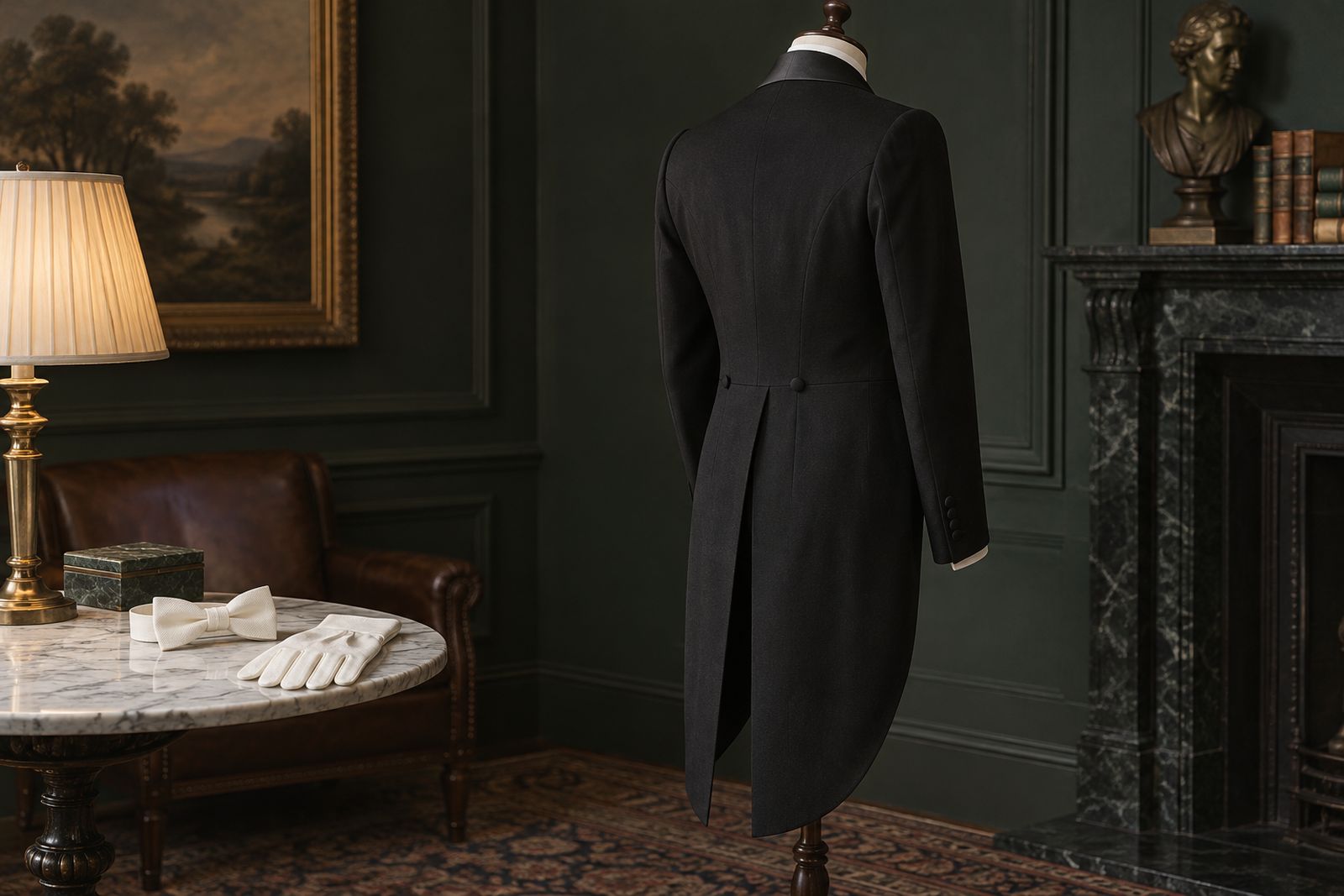
An evening tailcoat is a coat cut away horizontally at the waist in front, so it ends at the natural waist, with two long tails behind that reach to about the back of the knee. It is worn open and is never buttoned.
What do men wear to a white tie event?
Men wear seven fixed items at white tie: tailcoat, trousers, waistcoat, shirt, wing collar, bow tie and shoes. Unlike black tie, there are almost no alternatives. The table sets out each one, what is correct, and the mistakes that are most often seen.
| Garment | Correct | Common mistake |
|---|---|---|
| Tailcoat | Black (midnight blue is rare but correct), peak lapels faced in satin or grosgrain, cut short in front with long tails behind, worn open | Buttoning the coat; a morning coat with sloping fronts; tails too short |
| Trousers | Same fabric as the coat, high-waisted, two braids down each outside seam, braces, no belt loops, no turn-ups | Low-rise trousers that leave a gap below the waistcoat |
| Waistcoat | White piqué (also called marcella), low-cut, single or double-breasted | Showing below the front of the coat; a black waistcoat |
| Shirt | White, stiff (starched) piqué front, one to three studs, stiff single cuffs with cufflinks | A soft pleated black tie shirt |
| Collar | Detachable wing collar, starched, fastened with collar studs | A soft attached wing collar that wilts by midnight |
| Bow tie | White piqué, self-tied, matching the waistcoat | A ready-tied bow; a black bow tie |
| Shoes and socks | Black patent oxfords or opera pumps; black silk over-the-calf socks | Ordinary black business shoes, dull and creased |
| Gloves | Optional: white kid or cotton | Wearing them while eating |
The tailcoat
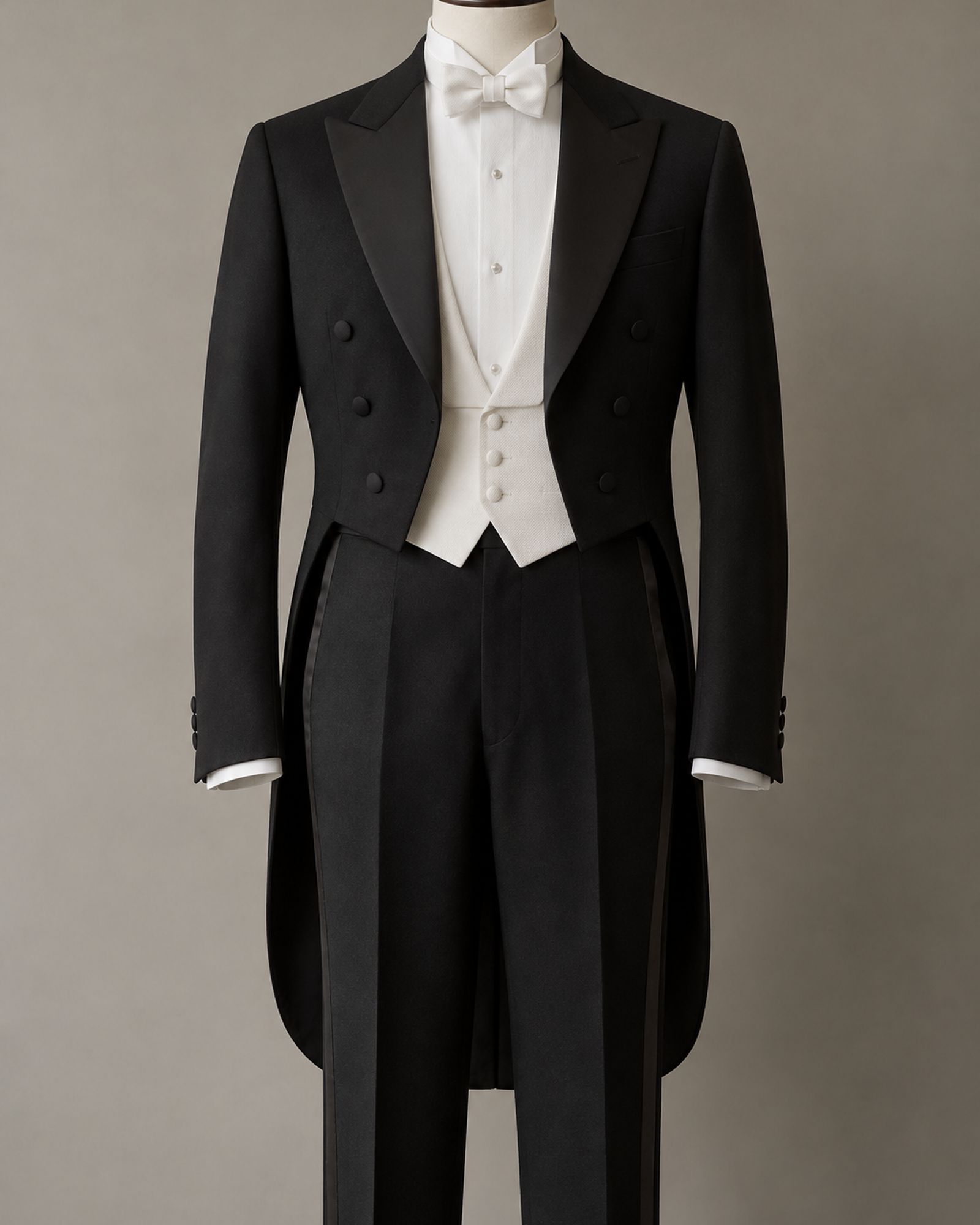
The evening tailcoat is black, or occasionally midnight blue, with peak lapels faced in satin or grosgrain and the buttons covered or faced to match. It is cut double-breasted, with a row of buttons on each side, but those buttons are decorative: the coat is always worn open. At the front it is cut away horizontally at the waist. Behind, two tails fall to about the back of the knee, with a vent between them.
The fit at the front is the whole outfit. The front edges of the coat should end at the natural waist, just low enough to cover the bottom of the waistcoat. The coat should sit close to the body at the chest and shoulders, because it cannot be buttoned to pull it in. Do not confuse it with a morning coat, which has curved fronts that slope away from a single button and is worn by day.
Trousers: high rise and two braids
White tie trousers are cut from the same fabric as the tailcoat, with two lines of braid down each outside seam, where black tie has one. They have no belt loops and no turn-ups (cuffs), and they are held up by braces, which allow the high waist the outfit needs. The waistband should sit at or above the natural waist, so the waistcoat covers it fully and no shirt shows. Length should give a slight break or none.
The white waistcoat
The waistcoat (vest) is white cotton piqué, sometimes called marcella, a stiff fabric with a fine raised texture. It is cut low, so the stiff shirt front shows, and it can be single or double-breasted, often with a shawl or small lapel. Many are backless, fastening with a strap behind. A black waistcoat with a tailcoat is traditionally worn by waiting staff, not guests, which is why guests always wear white. For the general rules of fit, see how to wear a waistcoat.
The shirt and wing collar
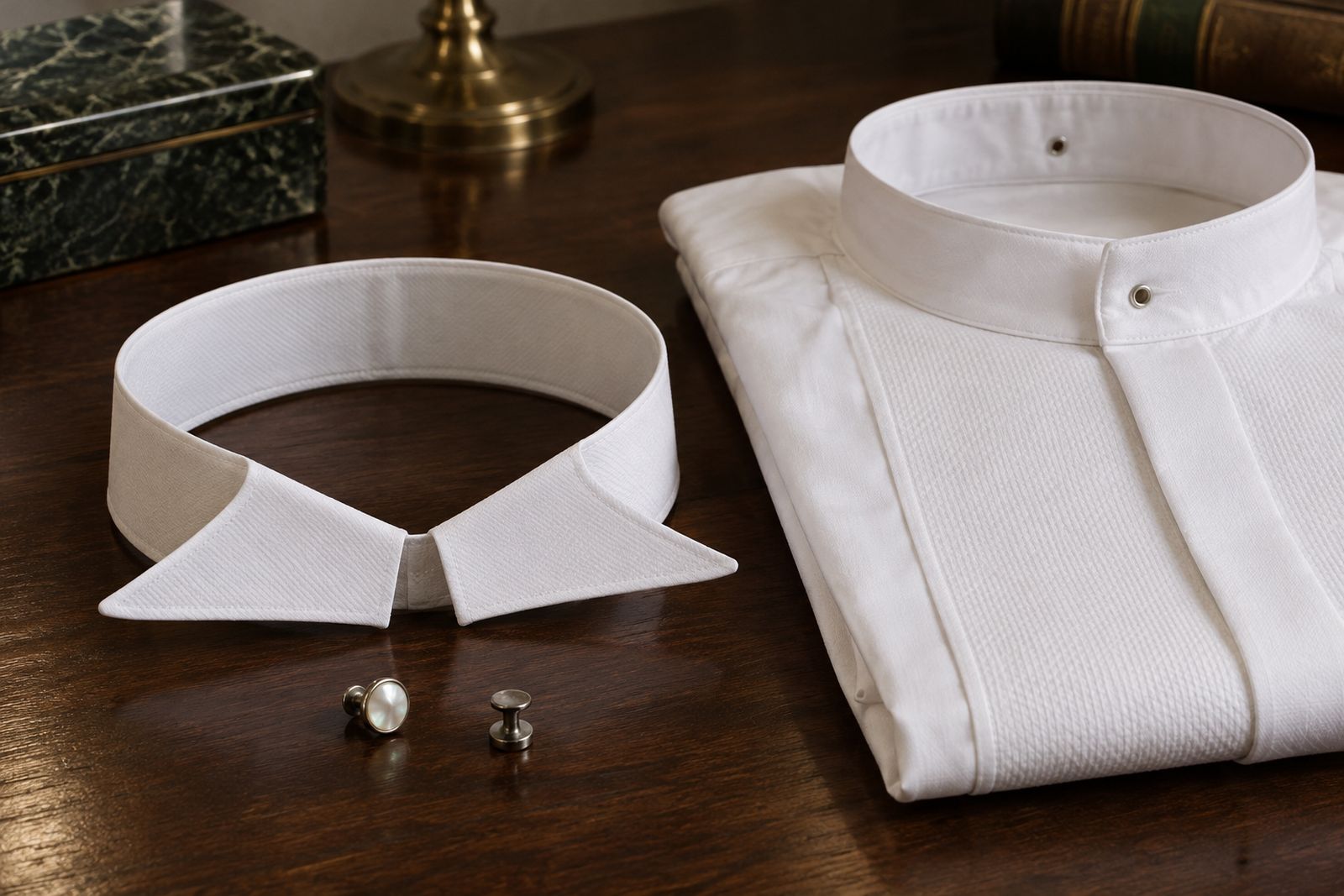
A white tie shirt has a stiff, starched front, usually in piqué, which stays flat under the low waistcoat. It closes with one to three studs, in mother-of-pearl, white enamel or plain metal, and it has stiff single cuffs fastened with cufflinks rather than the double French cuffs of a black tie shirt. The collar is detachable: a separate starched wing collar fastened to the neckband with a front and a back collar stud. Its small points stand up and sit behind the bow tie.
The detachable collar is not an affectation. A starched separate collar keeps its height and shape through a long evening in a way an attached soft collar cannot. Specialist shirtmakers sell the shirts, collars and studs together. Our guide to shirt collars shows how the wing collar differs from the turndown collars worn with black tie and suits.
The white bow tie
The bow tie is white cotton piqué, matching the waistcoat, and self-tied. A ready-tied white bow is easier to spot than a black one because the piqué shows its symmetry clearly. Tie it after fastening the collar, with the band sitting behind the wing points so only the bow sits in front. The method is the same as for a black bow tie: see how to tie a bow tie.
How to put on white tie, in order
White tie has more small fastenings than any other outfit, and the order matters because a starched shirt front and a detachable collar are hard to handle once you are half dressed. Allow twenty minutes the first time.
Dressing for white tie
- 1
Prepare the shirt
Fit the back collar stud into the neckband, and put the front studs and cufflinks in place before the shirt goes on.
Tip: A stiff front is very hard to stud while you are wearing it. Do it on a table.
- 2
Shirt and trousers
Put on the shirt, then the trousers. Attach the braces and adjust them so the waistband sits at or just above your natural waist.
- 3
Attach the collar
Fasten the back of the wing collar to the back stud, then bring the front ends round and fasten them on the front stud, through the shirt neckband.
- 4
Tie the bow tie
Pass the band under the wing points so it sits behind them, and tie the bow in front of the collar stud. The wings should sit behind the bow, not on top of it.
- 5
Waistcoat
Fasten the waistcoat and adjust the back strap. Its points should cover the trouser waistband with no shirt showing.
- 6
Tailcoat
Put the coat on and check in a full-length mirror that its front edges just cover the waistcoat. Leave it open.
Shoes, gloves and accessories
- Shoes: black patent leather oxfords, or opera pumps with a grosgrain bow. Socks are black silk, over the calf.
- Gloves: optional. White kid or cotton, traditionally worn for dancing and when arriving, and removed to eat.
- Outerwear: a black or dark navy overcoat with a white silk scarf. A top hat is traditional but rarely seen now. See overcoat styles.
- Watch: traditionally none on the wrist; a slim pocket watch on a chain is the period option.
- Pocket square: optional; white linen, folded flat.
- Decorations: if the invitation says "decorations" and you hold orders or medals, wear the miniatures on the left lapel.
What is the difference between white tie and black tie?
White tie is the more formal of the two evening codes. It uses a tailcoat instead of a dinner jacket, white piqué for the bow tie and waistcoat instead of black silk, a stiff shirt with a wing collar instead of a soft shirt with a turndown collar, and two trouser braids instead of one. Black tie allows real choices of lapel, waist covering and shoe; white tie allows almost none.
| White tie | Black tie | |
|---|---|---|
| Jacket | Tailcoat, short in front, tails behind, worn open | Dinner jacket (tuxedo), buttoned when standing |
| Lapels | Peak, faced in satin or grosgrain | Peak or shawl faced in satin or grosgrain; notch acceptable |
| Waist | White piqué waistcoat | Black cummerbund or low-cut black waistcoat |
| Shirt | Stiff piqué front, single cuffs | Pleated or piqué bib, French cuffs |
| Collar | Detachable wing collar | Turndown collar |
| Bow tie | White piqué | Black silk |
| Trousers | Two braids per side | One braid per side |
| Shoes | Black patent oxfords or opera pumps | Black patent or highly polished plain oxfords, or opera pumps |
| Gloves | Optional, white | Not worn |
| Warm-climate variant | None | Ivory dinner jacket |
For the full black tie rules, see our black tie guide.
Can you rent white tie?
Yes. Specialist formalwear hire shops in larger cities stock tailcoats, waistcoats and wing-collar shirts, and hire is the sensible choice if you expect to wear white tie once or twice in your life. Book early before a known white tie season, and go to a fitting rather than ordering by size, because hired white tie fails in predictable ways.
Check these at a white tie hire fitting
- With the coat on, no white waistcoat shows below its front edges.
- The trousers come with brace buttons and sit at your natural waist.
- The tails reach to about the back of your knee.
- The shirt has a stiff front, not a soft pleated bib.
- The wing collar is starched and holds its shape; ask for a detachable one.
- The bow tie is self-tie white piqué, not a ready-tied satin bow.
- The sleeve shows a little shirt cuff, about ¼ to ½ inch (6 to 13 mm).
Rent, buy second-hand or have one made: the tailor's view
The choice depends on how often you will wear it. Hire for one or two occasions. If you expect several, a second-hand tailcoat is worth considering: well-made older tailcoats turn up regularly, because the design has barely changed in a century, and a good one can be altered. A tailor can adjust the sleeves, take in or let out the waist a little and shorten the trousers. He cannot lengthen the front of the coat, and he can do little about trousers whose rise is too low, so judge those two points before you buy. Our guide to what a tailor can alter explains the limits.
If white tie is a regular part of your life, have the tailcoat made. It is one of the most demanding garments a tailor cuts, because it must fit closely without the help of a button, and a bespoke coat solves the waistcoat-length problem by being cut with the waistcoat and trousers together. Several of the houses in our ranking of London's best tailors have made tailcoats for generations.
What to tell your tailor: you want the coat, waistcoat and trousers fitted together, at the same fitting, with the waistcoat on. Ask the tailor to check the front edge of the coat against the waistcoat point while you stand naturally, then with your arms raised. Bring the shirt and collar you will wear, because the collar height changes how the coat sits at the neck. Get those three garments in proportion and the rest of white tie is simply a matter of following the list.
Questions people ask
What is the difference between white tie and black tie?
White tie is the more formal evening code. It uses a tailcoat instead of a dinner jacket, a white piqué waistcoat and bow tie instead of black silk, a stiff wing-collared shirt instead of a soft turndown-collared one, and trousers with two braids instead of one. Black tie allows choices of lapel, waist covering and shoe; white tie allows almost none.
What do men wear to a white tie event?
A black evening tailcoat worn open, matching trousers with two braids per side, a white piqué waistcoat, a stiff-fronted white shirt with a detachable wing collar, a white piqué bow tie and black patent shoes. White gloves are optional. The waistcoat must not show below the front of the coat.
Can you rent white tie?
Yes. Specialist formalwear hire shops in larger cities stock tailcoats, white waistcoats and wing-collar shirts. Go to a fitting rather than ordering by size, and check that the waistcoat does not show below the coat, the trousers sit at your waist and the shirt has a stiff front.
What is a tailcoat?
An evening tailcoat is a coat cut away horizontally at the waist in front, with two long tails behind that reach to about the back of the knee. It is black, with silk-faced peak lapels, and is never buttoned. It is the centerpiece of white tie and should not be confused with a morning coat, which has sloping fronts and is worn by day.
Do you button a tailcoat?
No. The evening tailcoat has a double-breasted arrangement of buttons, but they are decorative and the coat is always worn open. Because it cannot be buttoned, it must be cut to sit close to the chest on its own.
Do you have to wear gloves to a white tie event?
No, gloves are optional at white tie today. If you wear them, they should be white kid or cotton, and they come off to eat. Traditionally they were worn for dancing and on arrival.
Can you wear a black waistcoat with white tie?
No. Guests at white tie wear a white piqué waistcoat. A black waistcoat with a tailcoat is traditionally the uniform of waiting staff, so wearing one as a guest sends the wrong signal.
TailorGuide is independent. Our guides are written and checked by our team and carry no paid endorsements. How we work.