The short answer
Five knots cover every coat: the drape (hang it evenly around the neck), the once-around (wrap one end around the neck once), the Parisian knot (fold it in half and pull the ends through the loop), the reverse drape (cross each end over the opposite shoulder) and the overhand (a single loose knot). Match the knot to your coat and the cold.
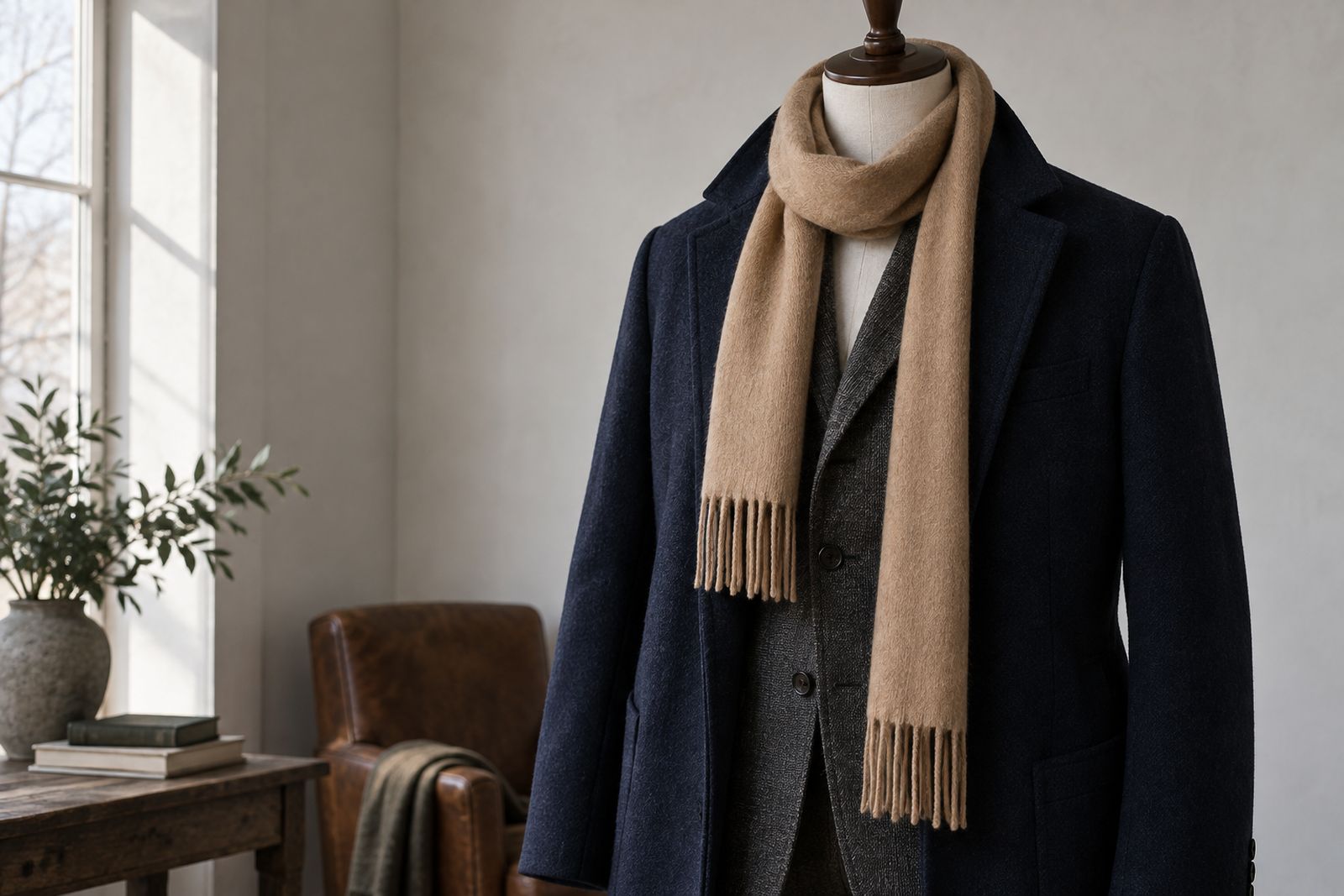
- Drape: the simplest and most formal; best under an open overcoat.
- Once-around: the all-rounder; works with every coat.
- Parisian knot: neat and warm; fills the neck of a buttoned overcoat.
- Reverse drape: covers the throat; best under a buttoned or double-breasted coat.
- A scarf of about 70 inches (180 cm) ties all five knots.
In this guide
- Which scarf knot goes with which coat?
- How to tie the drape
- How to tie the once-around
- How to tie a Parisian knot scarf
- How to tie the reverse drape
- How to tie the overhand knot
- How to wear a scarf with a suit and overcoat
- How long should a men's scarf be?
- Cashmere vs wool scarf: which is better?
- Common scarf mistakes
- Questions people ask
Knowing how to tie a scarf as a man is mostly about choosing the right knot for the coat and the weather. A loose drape under an open Chesterfield, a neat Parisian knot in the V of a buttoned overcoat and a quick once-around with a peacoat all use the same scarf, but each looks right in its place. Five knots cover almost every situation, and none takes more than a few seconds once learned.
At a glance
- Most formal
- The drape, especially a white silk scarf over evening dress
- Most versatile
- The once-around
- Warmest
- The Parisian knot and the reverse drape
- Best with a buttoned overcoat
- Parisian knot or reverse drape
- Best with an open coat
- Drape or once-around
- Scarf length
- About 65 to 75 inches (165 to 190 cm) ties every knot
Which scarf knot goes with which coat?
Choose a flat, low-bulk knot for formal coats and buttoned fronts, and a looser, fuller knot for casual jackets and open coats. The drape and the once-around work with almost anything. The Parisian knot and the reverse drape fill the neck of a buttoned overcoat neatly. The overhand suits casual jackets best.
| Overcoat, open | Overcoat, buttoned | Double-breasted coat | Peacoat | Trench coat | Casual jacket | |
|---|---|---|---|---|---|---|
| Drape | ||||||
| Once-around | ||||||
| Parisian knot | ||||||
| Reverse drape | ||||||
| Overhand |
| Knot | Warmth | Look | Best with |
|---|---|---|---|
| Drape | Low | Formal, relaxed | Open overcoat, Chesterfield over evening dress, trench coat |
| Once-around | Medium | Easy, versatile | Every coat |
| Parisian knot | High | Neat, close to the neck | Buttoned single-breasted overcoat, trench coat |
| Reverse drape | High | Flat cross at the throat | Buttoned or double-breasted coat, peacoat |
| Overhand | Medium | Casual, slightly undone | Peacoat, field jacket, open coat |
How to tie the drape
The drape is the simplest way to wear a scarf: it hangs evenly around the neck with no knot. It gives the least warmth but the cleanest look, and it is the traditional way to wear a white silk scarf over black tie, under an open dark overcoat.
The drape
- 1
Center the scarf
Place the middle of the scarf at the back of your neck.
- 2
Even the ends
Let both ends hang straight down the front at the same length.
Tip: Uneven ends look accidental in a drape; check them in a mirror.
- 3
Settle it
Smooth the scarf flat against your chest. Wear it over the jacket collar and under the overcoat collar, with the coat open so the ends show.
With a buttoned coat, a drape has nowhere to go: tuck the ends inside the coat, where it gives little warmth and can bunch. Choose a knot instead when the coat will be closed.
How to tie the once-around
The once-around wraps one end around your neck a single time, giving a soft loop at the throat and two hanging ends. It is the most versatile knot: warm enough for most winter days, quick to tie and right with every coat on this page.
The once-around
- 1
Hang it unevenly
Drape the scarf around the back of your neck with one end about twice as long as the other.
- 2
Wrap the long end
Take the long end across the front of your neck, around the back, and bring it forward again on the side where it started.
Tip: Keep the wrap loose so it does not crush your shirt collar.
- 3
Adjust
Loosen or tighten the loop to suit the cold, and adjust the ends so they hang at even or deliberately uneven lengths.
How to tie a Parisian knot scarf
The Parisian knot, also called the European loop, is made by folding the scarf in half and pulling the loose ends through the loop. It sits neatly at the throat, stays put, and fills the neck of a buttoned overcoat with no bulk hanging below. It works best with a thin to medium scarf; a very thick scarf makes a large knot.
The Parisian knot
- 1
Fold it in half
Fold the scarf in half end to end, so the two loose ends meet and the fold makes a loop at the other end.
Tip: If the scarf is wide, first fold it in half along its length so the finished knot is narrower and neater.
- 2
Put it around your neck
Place the folded scarf around the back of your neck, with the loop hanging on one side and the two loose ends on the other.
- 3
Pull the ends through
Reach through the loop and pull both loose ends through it.
- 4
Tighten
Slide the loop up toward your neck until the knot is as snug as you want, then straighten the ends so they hang flat.
How to tie the reverse drape
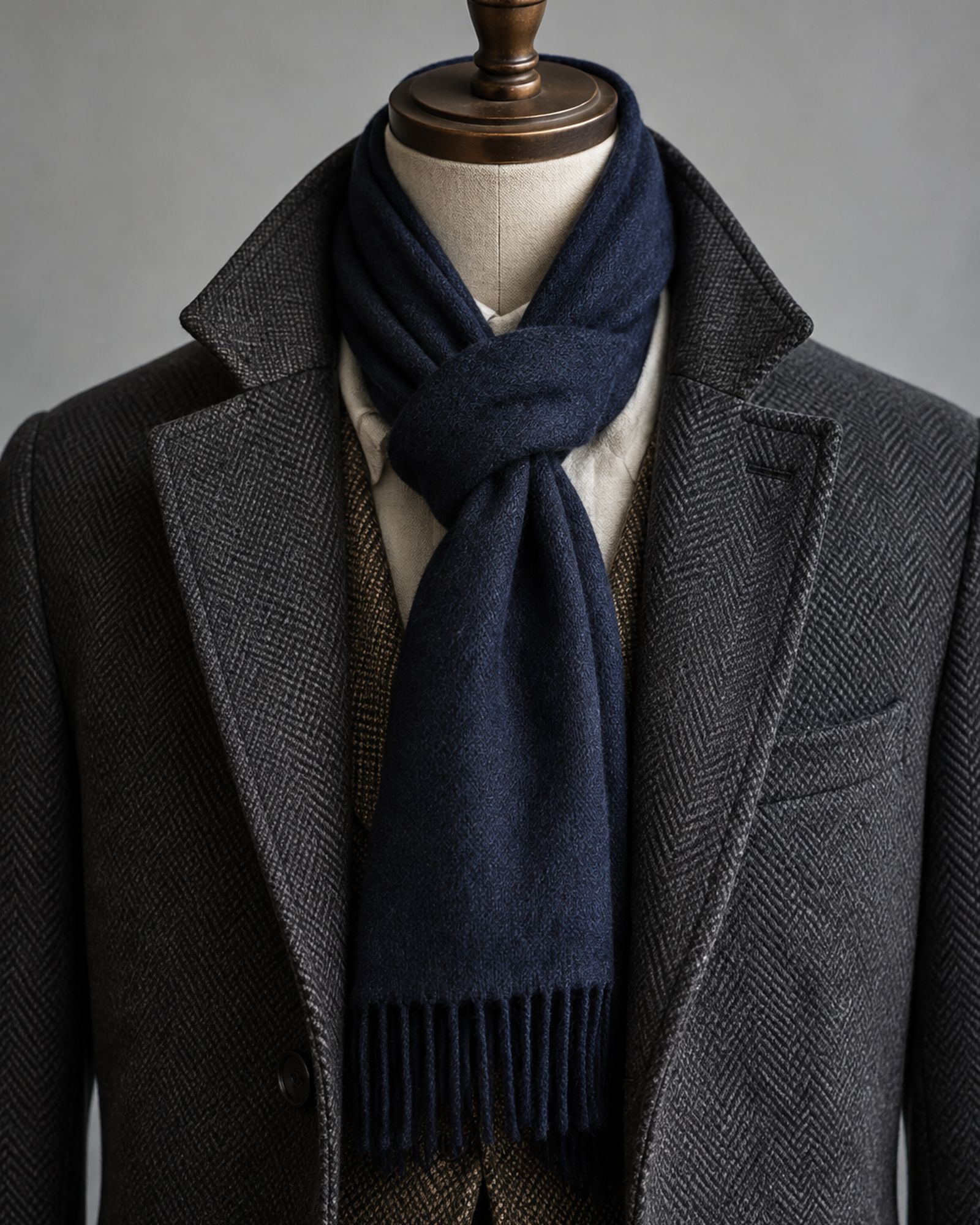
The reverse drape crosses the scarf over the front of your throat and sends both ends over the opposite shoulders, so they hang down your back. It covers the throat completely with a flat cross and no knot, which suits a buttoned or double-breasted coat. Names vary between guides; this is the version that crosses the scarf at the front.
The reverse drape
- 1
Start with a drape
Place the middle of the scarf at the back of your neck with both ends hanging down the front at equal length.
- 2
Throw the first end
Take the left end, bring it across the front of your neck and lay it over your right shoulder so it hangs down your back.
- 3
Throw the second end
Take the right end, bring it across over the first, and lay it over your left shoulder.
Tip: Keep the cross loose enough to sit flat; pulled tight, it rides up into your chin.
- 4
Settle and put on the coat
Smooth the cross at the throat, then put on your coat over it. The ends stay hidden under the coat and the cross fills the neck.
How to tie the overhand knot
The overhand is a single loose knot at the front of the neck, made by passing one end up through the loop around your neck. It looks relaxed and stays in place well, which suits peacoats, field jackets and other casual coats. It adds bulk at the chest, so avoid it under a double-breasted coat.
The overhand
- 1
Hang it unevenly
Drape the scarf around the back of your neck with one end about a third longer than the other.
- 2
Cross the ends
At chest height, lay the long end across the front of the short end.
- 3
Pass it up through
Bring the long end up behind the short end and through the gap between the scarf and your neck.
- 4
Let it fall and tighten
Let the long end drop down over the front of the knot, then pull both ends gently until the knot sits comfortably.
Tip: Leave the knot a little loose; a tight overhand looks like a bandage.
How to wear a scarf with a suit and overcoat
Wear the scarf over your suit jacket and under your overcoat. Put on the shirt, tie and jacket first, tie the scarf, then put on the coat so its collar sits over the scarf. With the coat buttoned, choose a Parisian knot or reverse drape; with the coat open, a drape or once-around lets the ends show against the coat.
- Color: choose a scarf that contrasts with the coat. Camel, gray or burgundy over navy; navy, gray or green over camel. See suit color combinations for the principles.
- Pattern: a plain scarf goes with any suit and tie; a check or stripe works best when the suit and tie are plain.
- Evening: over black tie, a white silk scarf worn as a drape under a dark Chesterfield is the classic combination. See black tie.
- Indoors: take the scarf off with your coat. It is outerwear, not part of the suit.
For the coat itself, our guide to men's overcoat styles explains which coats suit a suit and how long they should be. For a winter wedding, see what to wear to a wedding as a guest.
How long should a men's scarf be?
A men's scarf of about 65 to 75 inches (165 to 190 cm), not counting any fringe, ties all five knots. A shorter scarf of 50 to 60 inches (127 to 152 cm) manages the drape, the overhand and a tight reverse drape, but leaves stubby ends with the once-around and Parisian knot. Typical wool and cashmere scarves are about 10 to 14 inches (25 to 35 cm) wide.
Scale from 40 in to 90 in, with cm below. Drape, overhand, reverse drape: 50 to 64 in. All five knots: 65 to 75 in. Long: extra wraps: 76 to 90 in. About 180 cm: ties every knot: at 70 in.
Taller men and men who wear thick coats need the longer end of the range, because the scarf has farther to travel around the collar. A very long scarf can always be wrapped twice; a short one cannot be made longer.
Cashmere vs wool scarf: which is better?
Cashmere is softer and warmer for its weight, so a cashmere scarf can be thinner and still keep you warm; it is also more expensive and wears faster where it rubs. Wool, especially lambswool or merino, is cheaper, more durable and nearly as warm, but can feel scratchy on the neck. A wool-cashmere blend sits between the two.
| Fabric | Warmth | Feel | Durability | Best for |
|---|---|---|---|---|
| Cashmere | High for its weight | Very soft | Pills and thins with heavy wear | Overcoats, formal wear, sensitive skin |
| Lambswool | High | Soft to slightly scratchy | Good | Everyday winter wear |
| Merino wool | Medium to high | Soft and fine | Good | Thin scarves, Parisian knots |
| Wool-cashmere blend | High | Soft | Better than pure cashmere | A good everyday compromise |
| Silk | Low | Smooth, light | Good with care | Evening dress, spring |
| Cotton or linen | Low | Light, breathable | Good | Spring and autumn, trench coats |
Common scarf mistakes
Start with a once-around and a Parisian knot; between them they cover most coats and most winter days. Add the drape for evenings and the reverse drape for the coldest, windiest days. For the rest of the winter outfit, see how to wear a suit and the three-piece suit, which adds warmth under any coat.
Questions people ask
How do you tie a Parisian knot scarf?
Fold the scarf in half end to end, place it around the back of your neck with the loop on one side, and pull both loose ends through the loop. Slide the loop up until the knot is snug. Fold a wide scarf along its length first so the knot stays neat.
How do you wear a scarf with a suit and overcoat?
Wear the scarf over your suit jacket and under your overcoat, with the coat collar sitting over the scarf. With a buttoned coat, use a Parisian knot or reverse drape; with an open coat, a drape or once-around. Choose a scarf color that contrasts with the coat.
How long should a men's scarf be?
About 65 to 75 inches (165 to 190 cm), not counting fringe, is long enough for every common knot. Shorter scarves of 50 to 60 inches (127 to 152 cm) only suit the drape and simple knots. Taller men and men in thick coats need the longer end of the range.
Cashmere vs wool scarf: which is better?
Cashmere is softer and warmer for its weight but more expensive and less durable. Lambswool and merino are cheaper, hard-wearing and nearly as warm, though they can feel scratchy. A wool-cashmere blend is a sensible middle choice.
Which scarf knot is the warmest?
The Parisian knot and the reverse drape are the warmest of the five, because they cover the throat closely. The once-around is a close third. The drape gives the least warmth.
Should a scarf go inside or outside the coat?
Both are correct. Inside a buttoned coat, a scarf is warmest and neatest; use a flat knot like the Parisian or reverse drape. Outside an open coat, a drape or once-around shows the scarf off.
What is the most formal way to wear a scarf?
The drape, with both ends hanging evenly under an open overcoat, is the most formal. Over black tie, the classic choice is a white silk scarf worn this way under a dark Chesterfield. Avoid bulky knots with formal coats.
TailorGuide is independent. Our guides are written and checked by our team and carry no paid endorsements. How we work.