The short answer
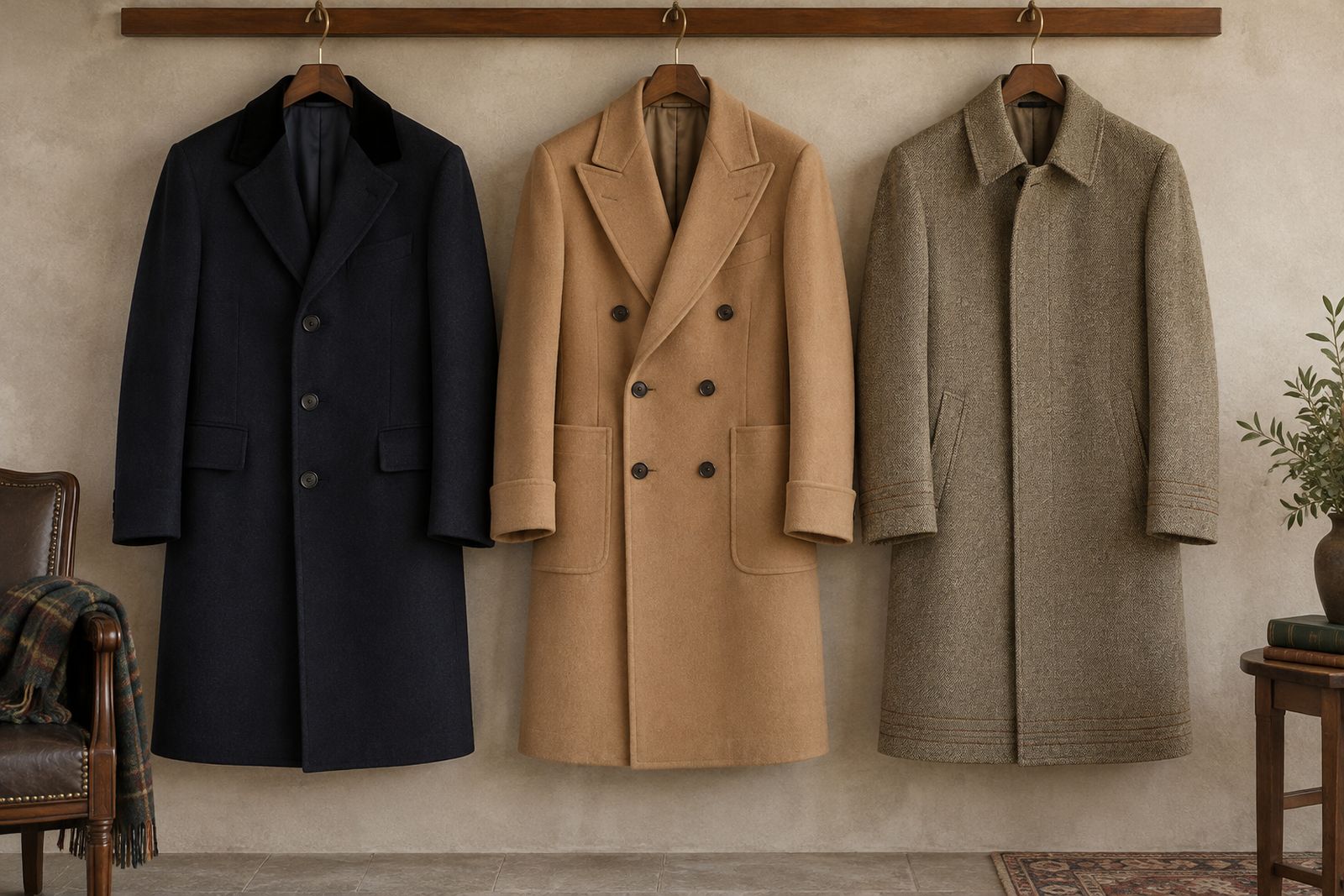
The classic men's overcoat styles are the Chesterfield, Guards coat, polo coat, covert coat, Ulster, balmacaan, trench coat, British warm and peacoat. The Chesterfield is the most formal and the peacoat the most casual. To wear a coat over a suit, choose one that covers the jacket completely, ideally knee length, in a wool of about 18 to 24 oz (560 to 750 g).
- The Chesterfield is the most formal overcoat; the peacoat is the most casual.
- Over a suit, the coat must cover the jacket hem completely; knee length is the safe default.
- Topcoats run about 13 to 17 oz (400 to 530 g); winter overcoats about 18 to 24 oz (560 to 750 g).
- Raglan sleeves are roomier and more casual; set-in sleeves are sharper and more formal.
- Try a coat on over a suit jacket, never over just a shirt.
In this guide
- What are the main men's overcoat styles?
- The classic overcoat styles, one by one
- Topcoat vs overcoat: what's the difference?
- How heavy should an overcoat fabric be?
- What length overcoat should you wear over a suit?
- Raglan vs set-in sleeves: which is better?
- Single or double-breasted overcoat?
- How should an overcoat fit over a suit?
- Which overcoat colors are the most versatile?
- Which overcoat should you buy first?
- The tailor's view: what can be altered on an overcoat
- Questions people ask
Men's overcoat styles grew out of specific jobs: riding, shooting, sailing, soldiering and getting to the office in the rain. Each one kept the details its job needed, so you can still read a coat's formality from its front, collar, pockets and fabric. Know the nine classic styles and you can choose a coat for your suits, your climate and the way you live.
At a glance
- Most formal
- Chesterfield
- Most casual
- Peacoat
- Best first coat
- Navy or charcoal single-breasted, knee length
- Length over a suit
- Covers the jacket completely; knee length is safest
- Topcoat weight
- About 13 to 17 oz (400 to 530 g)
- Overcoat weight
- About 18 to 24 oz (560 to 750 g), heavier for hard winters
What are the main men's overcoat styles?
The nine classic overcoat styles are the Chesterfield, Guards coat, polo coat, covert coat, Ulster, balmacaan, trench coat, British warm and peacoat. All but the peacoat can be worn over a suit when cut long enough. The table compares them on the points that matter when you choose.
| Coat | Front | Typical length | Typical fabric | Formality | Over a suit? |
|---|---|---|---|---|---|
| Chesterfield | Single-breasted, often a fly front; double-breasted versions exist | Knee | Navy, charcoal or black wool; often a velvet collar | Most formal | Yes |
| Guards coat | Double-breasted, peak lapels, half belt and back pleat | Knee or below | Navy wool | Formal | Yes |
| Polo coat | Double-breasted, patch pockets, half belt, turnback cuffs | Knee or below | Camel hair or camel-colored wool | Smart, sporting | Yes |
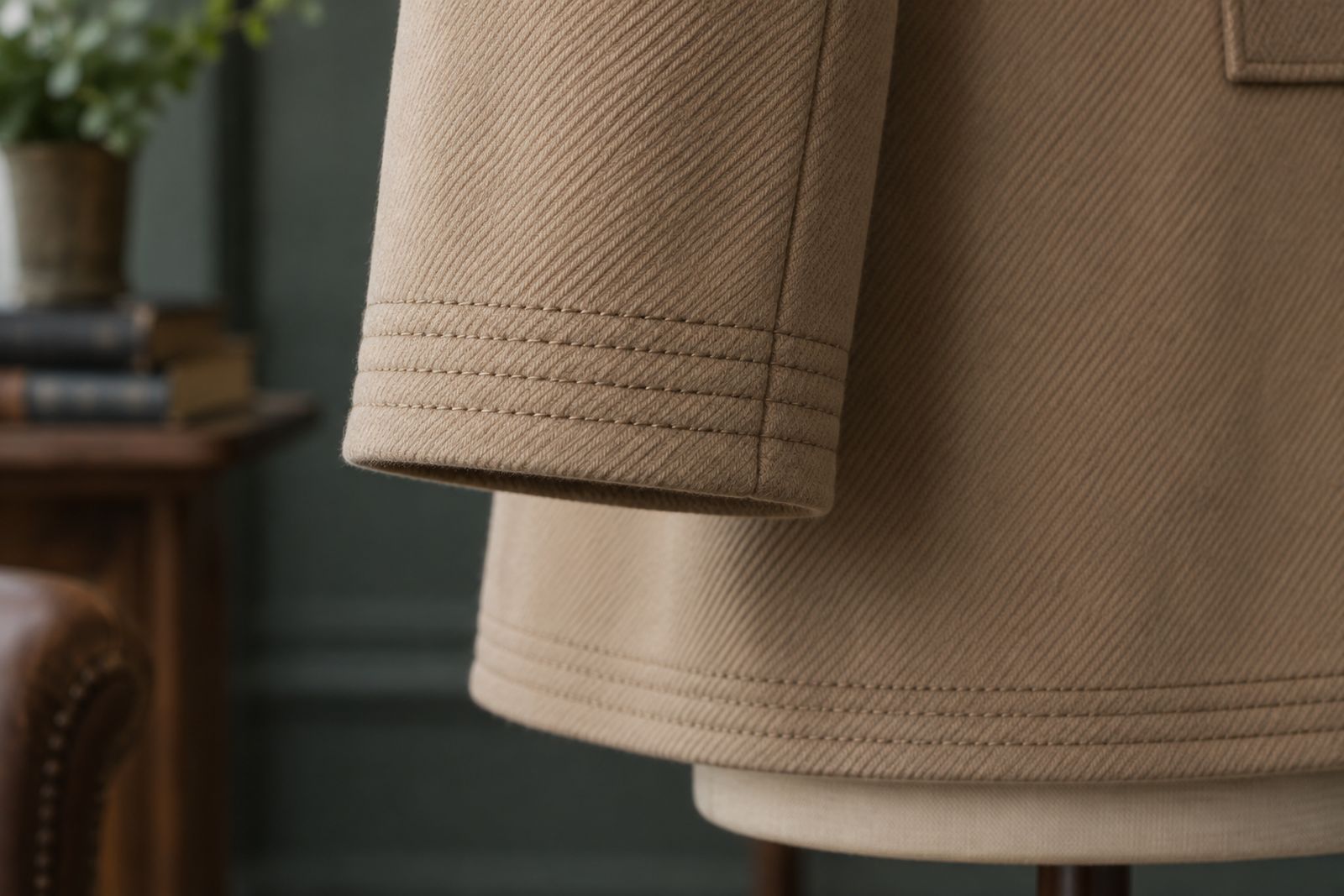
| Covert coat | Single-breasted fly front; rows of stitching at cuffs and hem | Just above the knee | Covert twill in fawn or olive-brown | Smart, town and country | Yes |
| Ulster | Double-breasted; wide collar made to turn up | Below the knee | Heavy tweed | Country, rugged | Yes |
| Balmacaan | Single-breasted, raglan sleeves, small turn-down collar | Knee | Tweed or gabardine | Relaxed | Yes |
| Trench coat | Double-breasted, belted, storm flap and epaulettes | Knee or just above | Cotton gabardine | Versatile rainwear | Yes |
| British warm | Double-breasted, epaulettes, leather buttons | Knee or just above | Fawn or camel melton | Smart casual | Yes, if it covers the jacket |
| Peacoat | Double-breasted, broad collar, vertical hand-warmer pockets | Hip to upper thigh | Heavy navy melton | Casual | No |
Most formal
Chesterfield
Plain dark wool, fly front, velvet collar
Guards coat
Navy, double-breasted, military lines
Polo coat
Camel, double-breasted, sporting details
Covert coat
Fawn twill, stitched cuffs and hem
Trench coat
Gabardine rainwear, belted
Ulster
Heavy tweed, country
Balmacaan
Raglan sleeves, relaxed
British warm
Short melton, military
Peacoat
Short, naval, casual
Most casual
The classic overcoat styles, one by one
Chesterfield
A Chesterfield coat is a knee-length, usually single-breasted overcoat with a slightly fitted body, notch lapels, flap pockets and often a concealed fly front and a velvet collar. It is named after a 19th-century Earl of Chesterfield. In navy, charcoal or black it is the most formal overcoat and the right choice over a dark suit or a tuxedo.
Guards coat
The Guards coat is a navy double-breasted overcoat with peak lapels, a half belt at the back and an inverted pleat below it, derived from the coats of British Guards officers. It is formal and military in line, flattering on a tall or slim figure, and excellent over a dark suit.
Polo coat
The polo coat is a double-breasted coat in camel hair or camel-colored wool, with patch pockets, turnback cuffs and a half belt. It is usually traced to the coats polo players threw on between periods of play, and it became an American classic. Camel works over gray, navy and brown suits alike.
Covert coat
The covert coat is a single-breasted fly-front coat, usually cut to just above the knee, in covert twill, a dense, hard-wearing twill usually woven in fawn or olive-brown. Its signature is the parallel rows of stitching, traditionally four, at the cuffs and hem. It came from English riding and shooting and looks equally right over a city suit.
Ulster
The Ulster is a long, heavy, double-breasted coat named after the Irish province, usually cut in thick tweed. Its collar and lapels are of similar width and are designed to be turned up against wind and rain. It often has a half belt. It is one of the warmest coats on this list and the most country in feeling.
Balmacaan
The balmacaan is a single-breasted coat with raglan sleeves, a small turn-down collar that can be buttoned at the throat, and a body that falls slightly wider at the hem. It is named after an estate in the Scottish Highlands and usually made in tweed or gabardine. The raglan sleeves make it one of the easiest coats to wear over a suit jacket.
Trench coat
The trench coat is a double-breasted, belted raincoat in cotton gabardine, with epaulettes, a storm flap at the shoulder and a back yoke, named for the trenches of the First World War, where British officers wore it. It is a raincoat rather than a warm coat, so it suits spring, autumn and mild wet winters, and some versions come with a zip-in wool lining.
British warm
The British warm is a short double-breasted coat in fawn or camel melton, with epaulettes and leather buttons, worn by British Army officers during the First World War. It usually ends at or above the knee, so check it covers your suit jacket before wearing it over one.
Peacoat
The peacoat is a short, double-breasted naval coat in heavy navy melton, with a broad collar, wide lapels and vertical hand-warmer pockets. It ends around the hip or upper thigh, which is too short to cover a suit jacket. Wear it with knitwear, odd trousers, chinos or jeans.
Fly front
A fly front is a strip of fabric that covers the buttons on a coat, so the front shows a clean, unbroken line when fastened. It is a mark of the Chesterfield and covert coat.
Topcoat vs overcoat: what's the difference?
A topcoat is a lighter coat for spring and autumn, and an overcoat is a heavier coat for winter. Many shops use the two words interchangeably, but in traditional usage the difference is mainly fabric weight. Topcoats are often a little shorter too, though length is not what defines them.
Topcoat
Spring and autumn
- Fabric about 13 to 17 oz (400 to 530 g)
- Often unlined or half-lined
- Gabardine, covert twill, light wool or cashmere
- Covert coat and trench coat are typical
Overcoat
Winter
- Fabric about 18 to 24 oz (560 to 750 g), heavier for hard winters
- Fully lined
- Melton, heavy wool, camel hair, wool-cashmere, tweed
- Chesterfield, Guards, polo coat and Ulster are typical
How heavy should an overcoat fabric be?
For a winter overcoat, choose a fabric of about 18 to 24 oz (560 to 750 g); for a topcoat, about 13 to 17 oz (400 to 530 g). Heavier coatings of 24 oz (750 g) and above suit hard winters and hold their shape well, but feel heavy on the shoulders. Fiber matters too: cashmere and camel hair are warm for their weight, so a cashmere coat can be lighter than a wool one and just as warm. For how woolen fabrics like melton and tweed differ from smooth worsteds, see worsted vs woolen.
Scale from 300 g to 1,000 g, with oz below. Topcoat: 400 to 530 g. Winter overcoat: 560 to 750 g. Heavy overcoat: 750 to 930 g. Year-round suit, for comparison: at 340 g.
| Fabric | Character | Typical coats |
|---|---|---|
| Melton | Dense, felted wool; blocks wind, holds a sharp shape | Peacoat, British warm, Chesterfield |
| Wool and wool-cashmere | Smooth, warm, versatile; cashmere adds softness | Chesterfield, Guards coat |
| Cashmere | Very soft and warm for its weight; wears faster at cuffs and pockets | Chesterfield, polo coat |
| Camel hair | Warm, light, golden color; softer than wool and less hard-wearing | Polo coat |
| Tweed | Thick, textured, hard-wearing, country character | Ulster, balmacaan |
| Covert twill | Dense, smooth twill that sheds light rain | Covert coat |
| Cotton gabardine | Tightly woven, water-resistant, not warm | Trench coat, balmacaan |
| Loden | Fulled wool from the Alps, naturally water-resistant | Loden coats and capes |
What length overcoat should you wear over a suit?
An overcoat worn over a suit must cover the suit jacket completely, with a few inches to spare, so knee length is the safe default. A coat that stops at or above the jacket hem lets the jacket peek out below it, which looks untidy; see suit jacket length for where your jacket should end. Below-knee coats are warmer and dramatic on a tall man, but can overwhelm a shorter frame; just above the knee often suits men under about 5 ft 8 in (173 cm).
| Length | Where it ends | Over a suit? | Examples |
|---|---|---|---|
| Hip | Around the top of the thigh | No | Peacoat, short jackets |
| Mid-thigh | Halfway down the thigh | No, it barely covers the jacket | Car coat |
| Just above the knee | 1 to 3 inches (2.5 to 8 cm) above the knee | Yes, if it clears the jacket hem | Covert coat, British warm, many topcoats |
| Knee | At or just below the knee | Yes, the safest length | Chesterfield, polo coat, balmacaan |
| Below the knee | Mid-calf | Yes; best on taller men | Ulster, some Guards coats |
Raglan vs set-in sleeves: which is better?
Set-in sleeves give a sharper, more formal shoulder; raglan sleeves give a softer, roomier one that slides easily over a suit jacket. A set-in sleeve is sewn into an armhole at the shoulder, like a suit jacket's. A raglan sleeve runs in one piece up to the collar, with a diagonal seam from the underarm to the neck, so there is no seam around the shoulder point.
| Set-in sleeve | Raglan sleeve | |
|---|---|---|
| Construction | Seam around the shoulder, like a jacket | Diagonal seam from underarm to collar |
| Look | Defined, structured shoulder | Soft, sloping shoulder |
| Over a suit | Needs the right size to fit over the jacket shoulder | Very easy; room built in |
| Formality | More formal | More casual and sporting |
| Typical coats | Chesterfield, Guards coat, covert coat | Balmacaan, many trench coats |
A split raglan combines the two: raglan at the back for movement, set-in at the front for a cleaner line.
Single or double-breasted overcoat?
Choose a single-breasted overcoat if you want one coat for everything; choose double-breasted for extra warmth and a stronger, more military look. A single-breasted coat is easier to wear open, sits neatly with a scarf and suits every build. A double-breasted coat overlaps across the chest, which keeps out wind, but adds visual width and looks best buttoned.
How should an overcoat fit over a suit?
An overcoat should fit comfortably over your suit jacket without pulling at the buttons or bunching the jacket sleeves. Always try it on over a jacket. The shoulders should extend just past your jacket's shoulders, and the sleeves should cover the jacket and shirt cuffs completely, roughly ½ inch (1.3 cm) longer than your jacket sleeve.
Overcoat fit check, wearing a suit jacket
- Buttons fasten without X-shaped pulls across the front.
- You can cross your arms and reach forward without strain across the back.
- The jacket sleeves do not bunch up inside the coat sleeves.
- No jacket or shirt cuff shows below the coat sleeve.
- The collar sits against the jacket collar without standing away from the neck.
- The hem covers the jacket completely, with a few inches to spare.
Which overcoat colors are the most versatile?
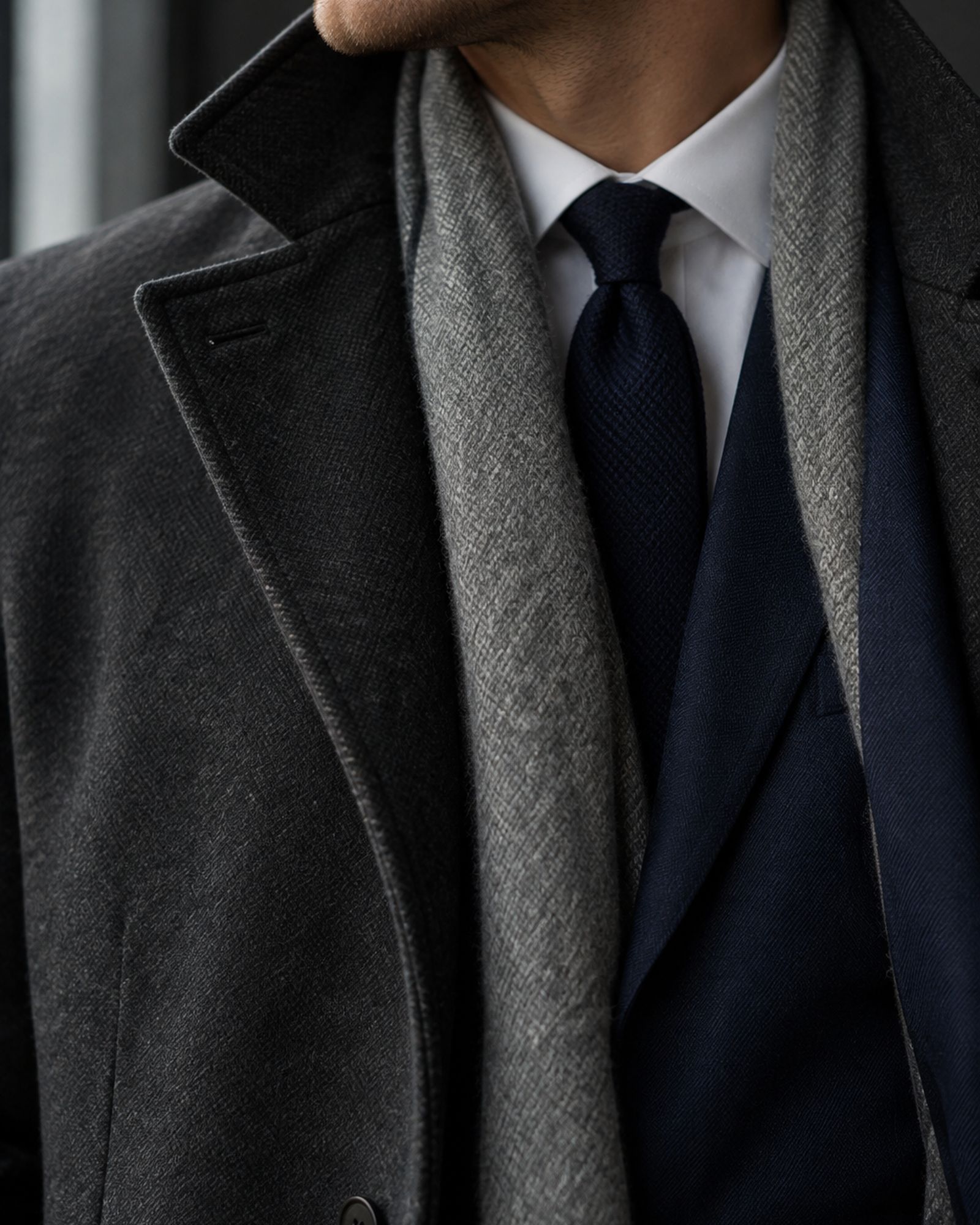
Navy and charcoal are the most versatile overcoat colors: they go over every suit color, look right in the city and in the evening, and hide dirt. Camel is the next most useful, because it warms up gray and navy suits and works with casual clothes. Mid-gray, brown and fawn are good second coats; black is formal and severe, best kept for evening and for a coat worn over black tie.
| Color | Over suits | Casual wear | Notes |
|---|---|---|---|
| Navy | All colors | Yes | The safest first coat |
| Charcoal | All colors | Yes | Slightly more formal than navy |
| Camel | Navy, gray, brown | Very good | Classic for the polo coat |
| Fawn or olive-brown | Gray, navy, brown | Very good | Typical of covert and British warm coats |
| Mid-gray | Navy, charcoal, brown | Good | Shows dirt more than darker coats |
| Black | Dark suits, black tie | Limited | Formal; looks stark in daylight |
Which overcoat should you buy first?
Buy a navy or charcoal single-breasted coat that reaches the knee, in a wool or wool-cashmere of about 18 to 22 oz (560 to 680 g), in a Chesterfield-like cut. It goes over every suit, a tuxedo, and odd jackets and knitwear on the weekend. Add a camel polo coat, a covert coat or a trench as a second coat, depending on your climate and whether you need rain protection or warmth.
The tailor's view: what can be altered on an overcoat
Sleeve length is the easiest overcoat alteration, provided there is enough fabric turned up inside and no working buttonholes at the cuff. Taking in the body a little at the back seam is usually possible. Shortening the hem works within limits, because the pocket position and the proportions of the coat set how much can come off. Shoulders that are too narrow or too wide cannot be fixed properly, so judge the shoulders first.
Finish the coat with a scarf tied to suit its collar; our guide to how to tie a scarf with a coat shows which knots suit which coats. For a winter wedding, pair a dark overcoat with a three-piece suit or see what to wear to a wedding as a guest. For a coat made to your measurements, start with the best tailors in London.
Questions people ask
What is a Chesterfield coat?
A Chesterfield is a knee-length, usually single-breasted overcoat with notch lapels, flap pockets and often a fly front and velvet collar. It is the most formal overcoat style. In navy, charcoal or black, it can be worn over a suit or a tuxedo.
What's the difference between a topcoat and an overcoat?
A topcoat is a lighter coat for spring and autumn, typically about 13 to 17 oz (400 to 530 g). An overcoat is a heavier winter coat, typically about 18 to 24 oz (560 to 750 g). Many shops use the words interchangeably.
What length overcoat should I wear over a suit?
Wear a coat that covers your suit jacket completely, with a few inches to spare. Knee length is the safest choice for most men. Coats shorter than mid-thigh, such as peacoats, leave the jacket showing.
Single vs double-breasted overcoat: which is better?
A single-breasted overcoat is more versatile, easier to wear open and suits every build. A double-breasted overcoat is warmer and more military in look but adds visual width. For a first coat, choose single-breasted.
Can you wear a peacoat over a suit?
It is not a good choice. A peacoat ends around the hip, so the suit jacket shows below it, and its naval styling is casual. Wear a knee-length overcoat over a suit and keep the peacoat for casual clothes.
Is a trench coat warm enough for winter?
Not on its own in a cold winter. A trench coat is a raincoat in cotton gabardine, best for spring, autumn and mild, wet winters. Some have a removable wool lining that extends their season.
How should overcoat sleeves fit?
Overcoat sleeves should cover your jacket and shirt cuffs completely, roughly ½ inch (1.3 cm) longer than your jacket sleeve. Check them with your arms relaxed at your sides. Sleeves are usually the easiest part of a coat to alter.
TailorGuide is independent. Our guides are written and checked by our team and carry no paid endorsements. How we work.