The short answer
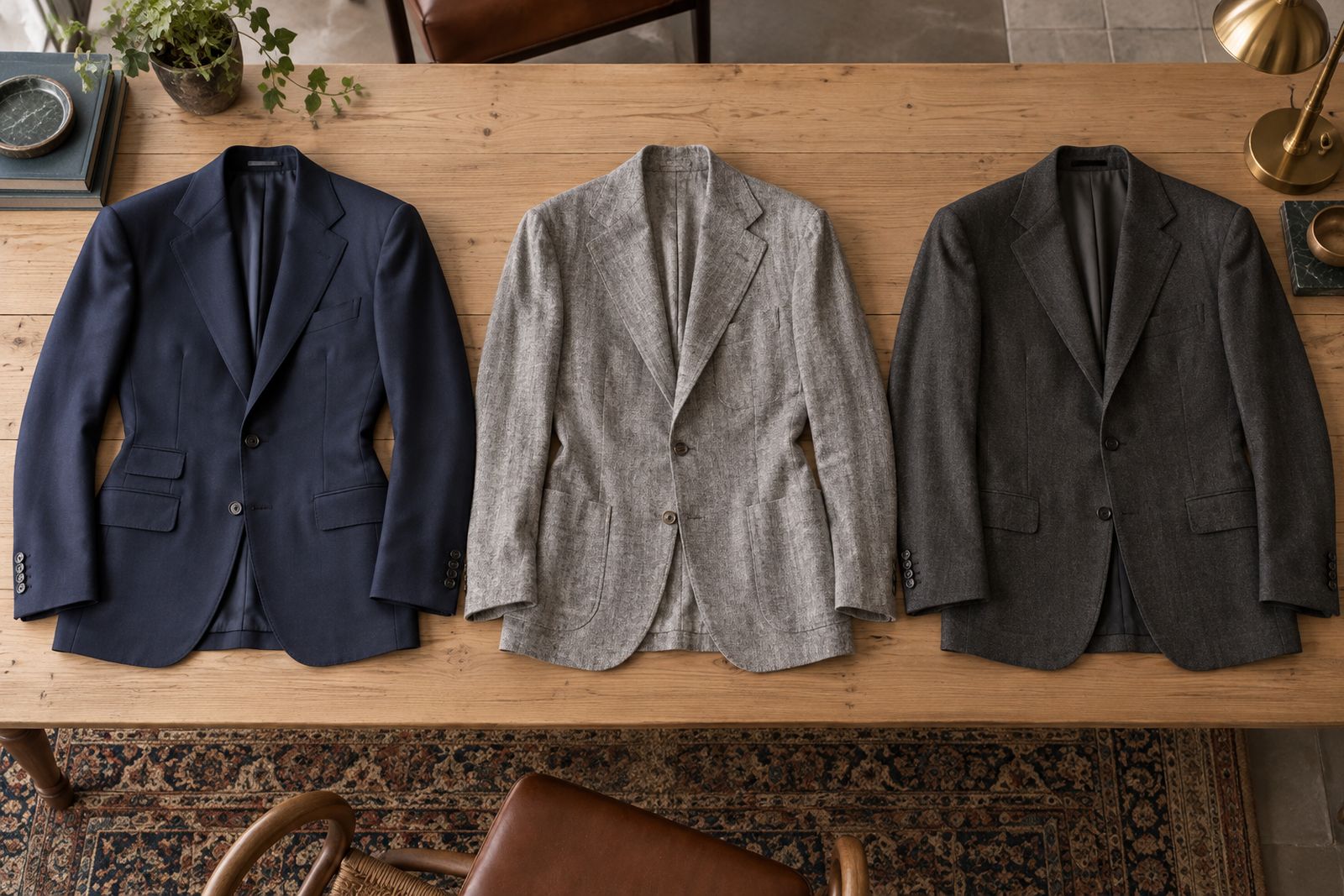
English tailoring builds a structured, often padded shoulder, a suppressed waist and a longer coat in medium-weight fabrics. Italian tailoring is lighter: Milan keeps a clean, defined shoulder, while Naples uses an unpadded spalla camicia shoulder, patch pockets and a barchetta breast pocket. The American sack suit has a natural shoulder, an undarted front and a straight, roomy cut.
- English: structured shoulder, high armholes, suppressed waist, longer skirt, double vents.
- Neapolitan: spalla camicia shoulder, light canvas, barchetta pocket, patch pockets.
- Milanese: a defined but light shoulder and clean chest, between London and Naples.
- American sack: natural shoulder, no front darts, straight body, hook vent.
- Choose by climate and build: soft for heat and movement, structured for definition.
In this guide
- What is the difference between British and Italian suits?
- Shoulders: structured vs natural vs spalla camicia
- Chest, waist and length compared
- Lapels, buttons and pockets
- What is Neapolitan tailoring?
- What is Milanese tailoring?
- What is an American sack suit?
- How to tell the styles apart on the rail
- Fabrics: what each tradition favors
- Which tailoring style suits your body?
- Which style suits your life and climate?
- What to tell your tailor
- Questions people ask
English vs Italian tailoring is the oldest debate in menswear, and the American tradition adds a third answer. Each style grew from a climate, a way of life and a group of tailors, and each solves the same problem differently: how to make a coat that flatters the body and moves with it. Once you can see the differences in the shoulder, the chest and the length, you can choose the style that suits you instead of the one that is fashionable.
| Style | Shoulder | Silhouette | Character |
|---|---|---|---|
| English | Structured, padded, often roped | Suppressed waist, longer skirt | Upright, formal |
| Milanese | Defined, light padding | Clean, close chest | Composed, businesslike |
| Neapolitan | Little or no padding; spalla camicia | Soft, shorter, open quarters | Relaxed, light |
| Roman | Usually described as between Milan and Naples | Close, clean line | Polished |
| American sack | Natural, little padding | Straight, undarted, roomy | Easy, traditional |
These are tendencies. Every house has its own style, and many modern tailors blend traditions.
What is the difference between British and Italian suits?
The main difference between British and Italian suits is structure. A classic English coat is built up: a padded shoulder, a firm canvas, high armholes and a waist that is clearly suppressed, with a longer skirt that covers the seat. Italian tailoring takes structure out, most of all in Naples, where the shoulder is unpadded and the jacket is light enough to wear like a cardigan. Milan sits in between.
Climate explains much of this. English tailoring grew up in a cool, damp country, for men who rode, hunted and served in the army, and its medium and heavier fabrics need structure to hang well. Southern Italy is hot, so Neapolitan tailors made coats that let air and movement through. Within each country, houses differ widely: London's Anderson & Sheppard cuts a soft drape, while Huntsman cuts a structured one-button coat. See Savile Row house styles.
English
London
- Padded, often roped shoulder
- High armholes, firm canvas
- Suppressed waist, longer skirt
- Double vents, ticket pocket
- Medium to heavier fabrics
Italian
Milan and Naples
- Milan: defined, light shoulder
- Naples: spalla camicia, no padding
- Light canvas, shorter coat in Naples
- Barchetta and patch pockets in Naples
- Lighter fabrics
American
The sack suit
- Natural shoulder, little padding
- No front darts, straight body
- Three-roll-two front common
- Hook vent
- Worsteds, flannels, seersucker
Shoulders: structured vs natural vs spalla camicia
The shoulder is the quickest way to tell the styles apart. Look at the line from the collar to the top of the sleeve, and at the seam where the sleeve joins the body.
Roped shoulder
A roped shoulder is one where the top of the sleeve is set slightly higher than the shoulder line, often over a small roll of padding, forming a visible ridge. It is common at structured English houses.
Spalla camicia
Spalla camicia, Italian for shirt shoulder, is an unpadded Neapolitan shoulder where a fuller sleevehead is eased into the armhole like a shirt sleeve, leaving small ripples (shirring) along the seam.
- English structured shoulder. Padding builds a square, clean line that extends slightly beyond the natural shoulder. It gives a narrow or sloping shoulder presence.
- Roped shoulder. The sleevehead stands proud of the shoulder in a ridge. Seen at houses such as Gieves & Hawkes and Edward Sexton.
- Natural shoulder. Little or no padding, so the jacket follows your own shoulder. Typical of the American sack and of soft English houses.
- Spalla camicia. No padding and a shirred sleevehead, as in Naples. It looks relaxed and lets the arm move freely.
Chest, waist and length compared
Below the shoulder, the styles differ in how firmly they shape the chest and waist, and in how long the coat is. These choices change your proportions more than any detail.
| Feature | English | Milanese | Neapolitan | American sack |
|---|---|---|---|---|
| Chest | Firm canvas; clean, or draped at soft houses | Clean and close | Light canvas, soft | Easy, unshaped |
| Waist | Clearly suppressed | Shaped | Shaped but easy | Little or no suppression |
| Front darts | Yes | Yes | Yes, often extended to the hem | No |
| Length | Longer, covers the seat | Medium | Often shorter | Medium to long, straight |
| Armholes | High | High | High | Often lower and roomier |
| Front | Two buttons, one at some houses | Usually two buttons | Often three-roll-two | Often three-roll-two |
| Vents | Usually double | Varies | Varies | Single hook vent |
| Pockets | Flap, often slanted, with a ticket pocket | Flap | Patch, curved; barchetta breast pocket | Flap |
Tendencies, not rules. Ask each house how it cuts.
Higher armholes are common to all the bespoke traditions because they let you lift your arm without the whole jacket rising. The American sack, born as a ready-made garment, often has a lower, roomier armhole. Our guides to jacket length and suit jacket vents go into each detail.
Lapels, buttons and pockets
Details follow the silhouette. English coats favor flap pockets, often with a ticket pocket above the right one, and slanted pockets on country and riding-influenced coats. Neapolitan jackets are known for patch pockets and the curved barchetta breast pocket, shaped like a little boat. Milanese jackets keep flap pockets and often carry a raised, hand-sewn Milanese lapel buttonhole. The American sack usually has flap pockets and a soft three-roll-two front, where the lapel rolls past the top button.
Lapel width follows fashion as much as tradition, but the shape varies: Neapolitan lapels often have a slight curve, or belly, and English peak lapels tend to be bold. See lapels explained for every shape.
What is Neapolitan tailoring?
Neapolitan tailoring is the soft, light style of Naples: an unpadded spalla camicia shoulder, a light canvas, high armholes, a fuller sleevehead, curved patch pockets and a barchetta breast pocket. Hand work runs through it, from the shoulder seam to the buttonholes. It is the most comfortable of the classic styles in heat. Read Neapolitan tailoring explained for the full picture.
What is Milanese tailoring?
Milanese tailoring is the cleaner, more structured Italian style of the north: a defined, fairly straight shoulder with light padding, a close chest, a shaped waist and businesslike details. It is lighter than a traditional English coat and firmer than a Neapolitan one. Read Milanese tailoring explained for how to commission it.
And Roman tailoring?
Rome's tradition is usually described as sitting between Milan and Naples, with more structure than Naples and a close, clean line. Its best-known name, Caraceni, was founded in Rome by Domenico Caraceni in 1913; he developed a lighter, more fluid style that drew on British tailoring, which he is often said to have studied by taking apart Henry Poole garments.
What is an American sack suit?
An American sack suit is a jacket cut straight, without front darts, with a natural, lightly padded shoulder and a single hook vent, usually with a three-roll-two front. It hangs from the shoulders like a sack rather than following the waist. Brooks Brothers popularized it around the turn of the 20th century, and it became the uniform of Ivy League style in the mid-century decades.
Modern American business suits are often closer to the English or Italian cuts, with darts and a shaped waist. The sack survives as a traditional style. For how the American market works today, see bespoke tailoring in New York.
How to tell the styles apart on the rail
You can identify most jackets in under a minute by checking a few details in order. No single detail is proof, but three or four together usually are.
A one-minute style check
- Ripples where the sleeve meets the shoulder, and no padding: Neapolitan.
- A curved breast pocket shaped like a little boat, plus patch pockets: Neapolitan.
- A ridge where the sleeve meets the shoulder: a roped, structured English coat.
- A ticket pocket above the right hip pocket and double vents: likely English.
- No darts on the front panels and a single vent with a hook at the top: American sack.
- A clean, lightly padded shoulder, flap pockets and a raised hand-sewn lapel buttonhole: likely Milanese.
- A lapel that rolls softly past the top of three buttons: three-roll-two, common in Naples and on the sack suit.
Construction matters as much as the visible details. A soft shoulder on a fused, mass-produced jacket is not the same as a hand-set Neapolitan shoulder over a light canvas. Our guide to fused vs canvas construction explains what lies underneath.
Fabrics: what each tradition favors
Each tradition grew up with the fabrics its climate demanded. English tailors traditionally worked in medium and heavier worsteds, flannels and tweeds; Italian tailors, especially in the south, in lighter wools and linens; American tailoring in worsteds, flannels and, for summer, seersucker and cotton.
| Tradition | Typical weights | Typical fabrics |
|---|---|---|
| English | 10 to 13 oz (310 to 400 g) | Worsted, flannel, tweed, heavier twills |
| Milanese | 9 to 11 oz (280 to 340 g) | Navy and gray worsteds, fine flannels |
| Neapolitan | 7 to 10 oz (220 to 310 g) | Light wools, linens, wool-silk-linen blends |
| American | 8 to 12 oz (250 to 370 g) | Worsted, flannel, seersucker and cotton in summer |
Typical, not fixed: every tradition now uses the full range of weights.
Structure and fabric weight work together. A soft Neapolitan jacket in a heavy flannel can look shapeless, while a heavily structured English coat in a very light fabric can look stiff. Our guide to year-round suit fabric helps you choose a weight.
Which tailoring style suits your body?
Choose the style that corrects what you want corrected and flatters what you want shown. Structure adds definition; softness shows the body as it is. Use the matrix as a starting point, then try both kinds of jacket on.
| English | Milanese | Neapolitan | American sack | |
|---|---|---|---|---|
| Sloping or narrow shoulders | ||||
| Broad, athletic shoulders | ||||
| Heavier build | ||||
| Slim build | ||||
| Shorter height |
- Sloping or narrow shoulders: a structured English or Milanese shoulder builds a cleaner line; an unpadded shoulder shows the slope.
- Broad, athletic shoulders: a soft or natural shoulder avoids adding more width.
- Heavier build: the length and firm canvas of an English coat, or the straight hang of the sack, skim the body more kindly than a short, shaped jacket.
- Shorter height: a slightly shorter Neapolitan or Milanese jacket makes the legs look longer.
Which style suits your life and climate?
| Your situation | Consider | Why |
|---|---|---|
| Formal business in a cool climate | English | Structure holds its shape through long days in medium-weight fabric |
| Office work in a mixed climate | Milanese | Clean and businesslike, lighter to wear |
| Hot climate or relaxed dress codes | Neapolitan | Light, unpadded and easy to move in |
| Traditional, understated American style | American sack | Easy fit, natural shoulder, classic proportions |
What to tell your tailor
Describe the style by its parts, not its country. Say how much padding you want in the shoulder, how close the chest should be, how firmly the waist is shaped and how long the coat should run, then bring photos. A good tailor will tell you which elements belong together and which fight each other.
Questions people ask
What is the difference between British and Italian suits?
British suits are traditionally more structured, with a padded shoulder, a firm canvas, a suppressed waist and a longer coat. Italian suits are lighter: Milan keeps a clean, defined shoulder, while Naples removes padding entirely for a soft spalla camicia shoulder and patch pockets. Climate drove much of the difference.
What is Neapolitan tailoring?
Neapolitan tailoring is the soft style of Naples, with an unpadded spalla camicia shoulder, a light canvas, high armholes, a fuller sleevehead, patch pockets and a curved barchetta breast pocket. It is light and comfortable in heat. Hand work is central to it.
What is Milanese tailoring?
Milanese tailoring is the northern Italian style: a defined, fairly straight shoulder with light padding, a clean and close chest, a shaped waist and sober details such as flap pockets. It sits between English structure and Neapolitan softness. It suits office wear well.
What is an American sack suit?
An American sack suit has a straight, undarted front, a natural shoulder with little padding, a single hook vent and usually a three-roll-two front. It hangs loosely from the shoulders rather than shaping the waist. Brooks Brothers popularized it around the turn of the 20th century.
Is English or Italian tailoring better?
Neither is better; they suit different bodies, climates and tastes. English structure flatters sloping shoulders and suits cooler climates and formal business, while Italian softness suits heat, movement and a relaxed look. Try both on before you commit to a bespoke house.
What is a roped shoulder?
A roped shoulder has the top of the sleeve set slightly higher than the shoulder line, forming a visible ridge, often over a small roll of padding. It is common at structured English houses such as Gieves & Hawkes and Edward Sexton. It gives a strong, defined line.
Which tailoring style is best for hot weather?
Neapolitan tailoring is the most comfortable in hot weather, because its unpadded shoulder, light canvas and lighter fabrics let air and movement through. A soft English drape or a light Milanese cut in a 7 to 9 oz (220 to 280 g) fabric also works. Ask for a half lining.
TailorGuide is independent. Our guides are written and checked by our team and carry no paid endorsements. How we work.