The short answer
Neapolitan tailoring is the soft, light style of Naples. Its jackets have a spalla camicia shoulder with little or no padding, a fuller, shirred sleevehead, high armholes, a light canvas, a curved barchetta breast pocket, patch pockets and often a three-roll-two front. A bespoke Neapolitan suit costs roughly $3,400 to $9,000+ in Naples (approximate, 2026), with prices for clients abroad often quoted separately.
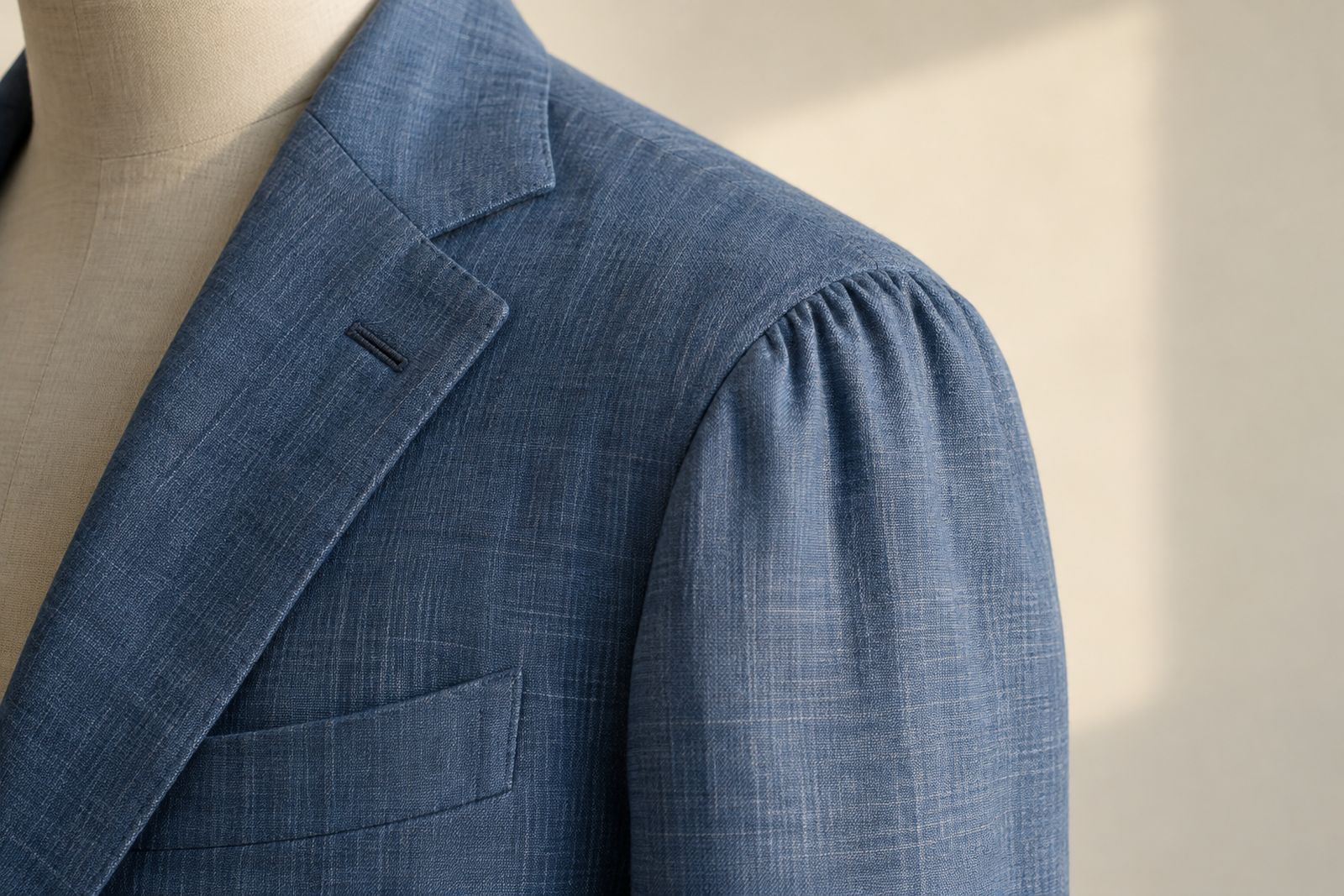
- Spalla camicia: little or no padding, and a fuller sleevehead eased in with small ripples.
- Barchetta: a curved breast pocket shaped like a little boat.
- Patch pockets, open quarters, a three-roll-two front and an extended front dart.
- A light canvas and lighter fabrics make it the coolest classic style to wear.
- Bespoke in Naples costs roughly $3,400 to $9,000+; allow three or more fittings.
In this guide
- What makes a Neapolitan suit different?
- What is a spalla camicia shoulder?
- Why do Neapolitan jackets have higher armholes and a fuller sleevehead?
- What is a barchetta pocket?
- Front, dart and length
- Where did Neapolitan tailoring come from?
- Neapolitan vs Milanese tailoring
- How much does a Neapolitan suit cost?
- How to commission a suit in Naples
- Is a Neapolitan suit right for you?
- How to look after a soft Neapolitan jacket
- What to tell a Neapolitan tailor
- Questions people ask
Neapolitan tailoring takes almost everything a traditional English coat builds in and leaves it out. There is no shoulder pad, little canvas and often only a half lining, yet the jacket still holds a clean, shaped line. The result is the lightest classic suit you can wear, made largely by hand, and its details are recognizable across a room once you know where to look.
Neapolitan tailoring at a glance
- Shoulder
- Little or no padding; spalla camicia with a fuller, shirred sleevehead
- Armholes
- High and close
- Chest
- Light canvas, soft
- Pockets
- Barchetta breast pocket; curved patch pockets
- Front
- Often three-roll-two; open quarters; front dart often run to the hem
- Fabrics
- Light wools, linens and blends, about 7 to 10 oz (220 to 310 g)
- Bespoke price in Naples
- Roughly $3,400 to $9,000+ (2026, approximate)
What makes a Neapolitan suit different?
A Neapolitan suit is different because it removes structure. Where an English coat relies on padding and a firm canvas to hold its shape, a Neapolitan jacket relies on the cut and on hand work. Menswear writer Simon Crompton of Permanent Style summarizes the typical features as soft shoulders, a shirt-style sleeve, a three-roll-two front, curved pockets and an extended front dart.
- Spalla camicia shoulder. No pad, with the sleeve set in like a shirt sleeve.
- Higher armholes and a fuller sleevehead. Freedom to move without the jacket riding up.
- Barchetta breast pocket. A curved pocket shaped like a little boat.
- Patch pockets. Often curved at the corners.
- Three-roll-two front. The lapel rolls softly past the top button.
- Extended front dart and open quarters. The dart often runs to the hem, and the fronts curve away below the button.
- Light construction. A light canvas and often a half lining, or none.
What is a spalla camicia shoulder?
A spalla camicia is an unpadded Neapolitan shoulder in which the sleeve is set into the armhole like a shirt sleeve, with more fabric in the sleevehead than the armhole strictly needs. The tailor eases that extra fabric in by hand, which leaves small ripples, called shirring, along the top of the seam. The name means shirt shoulder.
Spalla camicia
Spalla camicia (shirt shoulder) is an unpadded shoulder where a fuller sleevehead is eased into the armhole by hand, leaving visible shirring along the seam, as on a shirt.
The amount of shirring varies by house and by fabric: some tailors show pronounced ripples, others very few. Permanent Style notes that Naples tailors also vary in how much padding they put at the top of the sleeve, from none to a slight roll, or rollino. The sleeve itself is often called manica a mappina, a Neapolitan phrase likening its soft ripples to a dishcloth.
Why do Neapolitan jackets have higher armholes and a fuller sleevehead?
Higher armholes and a fuller sleevehead let you move your arms freely without the jacket lifting. A high, close armhole anchors the body of the coat, so it stays in place when you reach forward. The extra fabric at the top of the sleeve gives the arm room to rise. The sleeve then narrows toward the cuff, keeping the line clean.
This combination is why a good Neapolitan jacket feels unusually comfortable for something so close-fitting. It is also why the fit must be right at the first fitting: a high armhole that is too tight is uncomfortable, and there is little padding to hide a poorly balanced shoulder.
What is a barchetta pocket?
A barchetta pocket is the curved breast pocket of a Neapolitan jacket, so called because its shape resembles a little boat (barchetta in Italian). Instead of a straight welt, the opening curves upward at the ends, following the chest. It is one of the clearest signs of a Neapolitan coat, and it is sewn by hand on the best jackets.
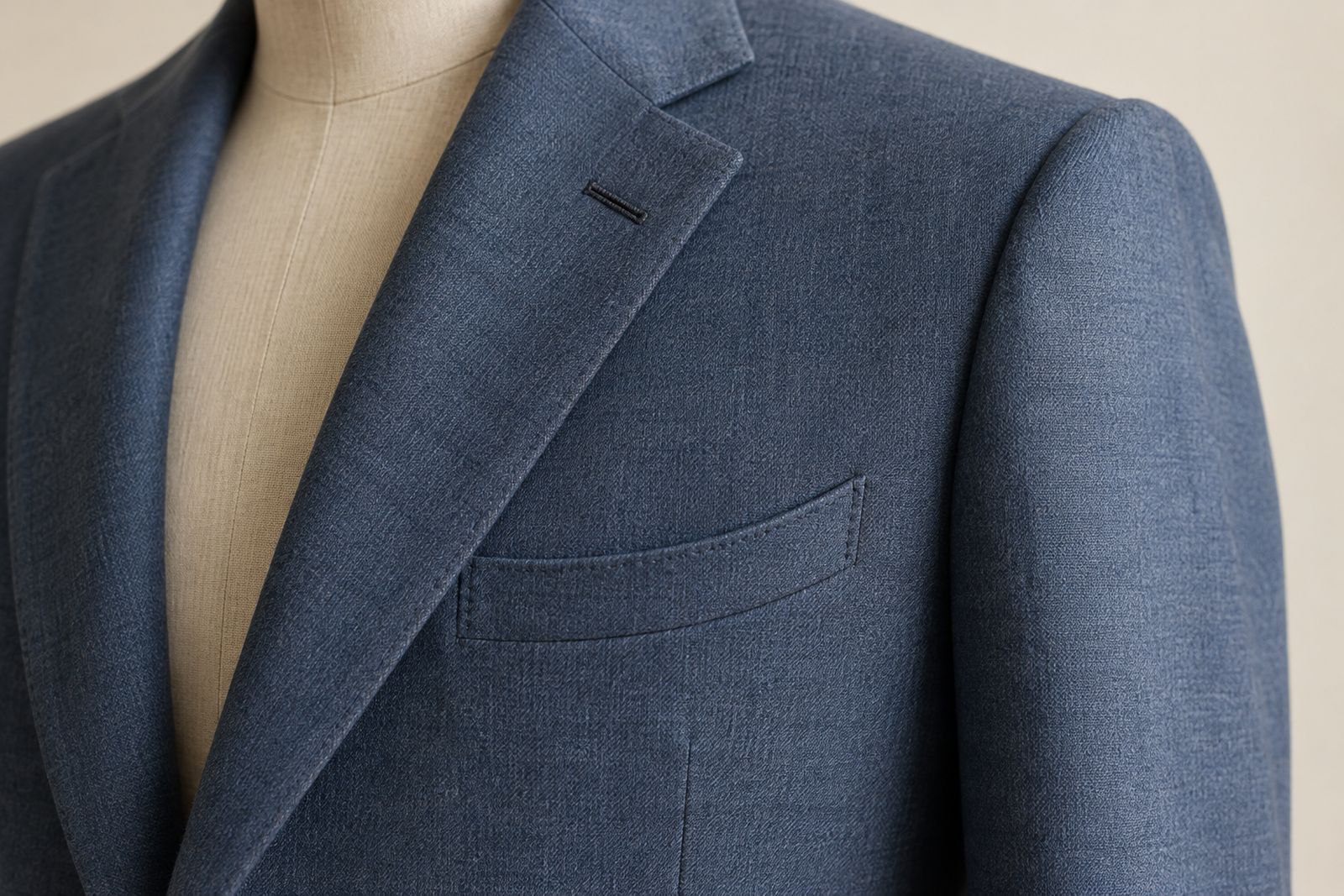
Patch pockets are the other Neapolitan signature. Sewn onto the outside of the jacket, often with rounded corners, they make the coat look relaxed and are traditional on Neapolitan sports jackets and many suits. If you want the jacket to look more formal, ask for flap or jetted pockets instead; a good tailor will keep the rest of the cut.
Front, dart and length
Neapolitan jackets often have a three-roll-two front: three buttons, with the lapel rolling softly past the top one so that you fasten only the middle button. The front dart often runs down to the hem, which helps shape the coat without padding, and the quarters below the button curve open. The jacket is often a little shorter than an English coat.
As an example of proportions, Permanent Style's measurements of a Solito jacket recorded a lightly padded 5¾-inch (14.6 cm) shoulder with no roping, a 4-inch (10.2 cm) lapel and a 30½-inch (77.5 cm) length, with a close chest and moderate waist suppression. Every house differs, but those figures show how a light, close cut can still have generous lapels.
Where did Neapolitan tailoring come from?
Neapolitan tailoring grew from Naples' admiration for English tailoring, adapted to a hot climate and a relaxed way of life. Its best-known early house, London House, founded by Gennaro Rubinacci in the early 1930s, took its name from that English influence, and the cutter Vincenzo Attolini, who worked there, is widely credited with developing the soft, unstructured jacket. The style was then carried on by generations of small family workrooms.
Naples' tailors have long trained in each other's workrooms. Antonio Panico, for example, spent many years at Rubinacci and left as its master tailor to run his own atelier. Today the style is also made by larger Neapolitan houses that produce hand-finished ready-to-wear, which has spread the look far beyond the city.
Neapolitan vs Milanese tailoring
The difference between Neapolitan and Milanese tailoring is structure. Milan keeps a defined, lightly padded shoulder, a clean close chest and flap pockets; Naples removes the padding, sets the sleeve like a shirt and adds patch and barchetta pockets. Both use extensive hand work. Read Milanese tailoring explained for the northern style.
Naples
Soft and light
- Spalla camicia, no pad
- Barchetta and patch pockets
- Three-roll-two front
- Shorter, open quarters
- Light wools and linens
Milan
Clean and composed
- Defined shoulder, light pad
- Flap pockets
- Usually two buttons
- Medium length
- Navy and gray worsteds
London
Structured and upright
- Padded, often roped shoulder
- Flap pockets, ticket pocket
- Suppressed waist
- Longer skirt
- Medium to heavier fabrics
| Feature | Neapolitan | Milanese |
|---|---|---|
| Shoulder | Unpadded spalla camicia, shirred | Defined, light padding, smooth |
| Chest | Light canvas, soft | Firmer canvas, clean |
| Breast pocket | Curved barchetta | Straight welt |
| Hip pockets | Patch, curved | Flap |
| Front | Often three-roll-two | Usually two buttons |
| Length | Often shorter | Medium |
| Best for | Heat, movement, relaxed dress | Office wear, a sharper line |
For how both compare with English and American suits, see English vs Italian vs American tailoring.
How much does a Neapolitan suit cost?
A bespoke Neapolitan suit costs roughly $3,400 to $9,000 or more in Naples in 2026, depending on the house and the fabric. Small workrooms sit at the lower end, the best-known houses at the upper end and beyond. Prices reported online even a few years ago were noticeably lower, so ask each house for its current figure.
| Route | Typical price | Notes |
|---|---|---|
| Small sartoria in Naples | About $3,400 to $5,100 | Personal pattern, three or more fittings |
| Well-known Naples house | About $5,600 to $9,000+ | Higher for rare fabrics |
| Neapolitan tailor at a trunk show abroad | Quoted separately, often higher | Fittings on scheduled visits |
Italian prices normally include 22% VAT. Ask whether a price for an overseas client differs from the local one.
Permanent Style's Simon Crompton has noted that tailors generally price foreign and local customers separately, so a price you read online may not be the price you are quoted. Our bespoke suit prices by city compares Italy with London, New York and Dubai.
How to commission a suit in Naples
Commissioning a Neapolitan suit takes three or more fittings over several weeks. Simon Crompton of Permanent Style advises that you will need to meet the tailor at least three times, possibly four. Many of the city's tailors and shirtmakers work in and around the Chiaia district.
Ordering a Neapolitan suit
- 1
Book ahead
Email with your dates, what you want and your budget. Many workrooms are small and family-run.
Tip: Avoid mid-August, when many Italian businesses close for part of the month.
- 2
Choose a light fabric
Neapolitan construction suits lighter fabrics, about 7 to 10 oz (220 to 310 g). See suit fabric for hot weather.
- 3
Agree the details
Decide on patch or flap pockets, the barchetta breast pocket, the front, the amount of shirring and the lining.
- 4
Do the first fitting in person
The basted fitting fixes the shoulder and balance, which a soft jacket cannot hide. Plan to be in Naples for it.
- 5
Plan the remaining fittings
Return to Naples, or ask whether the tailor visits your city. Some Neapolitan tailors travel to other Italian cities and abroad to see clients.
Is a Neapolitan suit right for you?
The Neapolitan jacket
For
- +The lightest, most comfortable classic jacket in warm weather
- +Free arm movement thanks to the high armhole and full sleevehead
- +Distinctive hand details: shirring, barchetta, curved patch pockets
- +Flattering on broad, athletic shoulders, since it adds no width
Against
- –Shows a sloping or uneven shoulder, since there is no pad to correct it
- –Patch pockets read as casual in very formal offices
- –A soft jacket can look shapeless in heavy fabrics
- –Commissioning in Naples needs several trips or a visiting tailor
How to look after a soft Neapolitan jacket
A soft jacket needs slightly different care from a structured one, because there is little padding or canvas to hold the shoulder's shape. Treated well, it keeps its line for years.
- Hang it on a wide, shaped wooden hanger that fills the shoulder; a thin wire or plastic hanger will dent an unpadded shoulder.
- Steam the sleevehead rather than pressing it, so the shirring is not flattened.
- Ask your dry cleaner not to press the shoulders flat, or take the jacket back to the tailor for pressing.
- Rest the jacket for a day between wears so light fabrics recover.
- Brush rather than clean it after each wear; see our guide to caring for a suit.
What to tell a Neapolitan tailor
Points to agree at the first meeting
- How much shirring you want at the shoulder: pronounced, subtle or minimal.
- Whether you want any padding or roll at the sleevehead.
- Pocket style: patch for a relaxed look, flap for business.
- Front: three-roll-two or two buttons.
- Lining: full, half or unlined. See suit linings.
- Jacket length relative to your height and seat.
- Fabric weight for your climate.
TailorGuide publishes its city rankings separately; see all city rankings. To compare the Neapolitan jacket with every other part of a coat, read parts of a suit jacket.
Questions people ask
What is a spalla camicia shoulder?
A spalla camicia, Italian for shirt shoulder, is an unpadded Neapolitan shoulder where a fuller sleevehead is eased into the armhole by hand, like a shirt sleeve. This leaves small ripples, called shirring, along the seam. It gives the arm freedom and the jacket a relaxed look.
What is a barchetta pocket?
A barchetta pocket is the curved breast pocket of a Neapolitan jacket, named for its resemblance to a little boat (barchetta in Italian). The opening curves upward at the ends rather than running straight. It is one of the clearest signs of a Neapolitan coat.
Who are the best Neapolitan tailors?
TailorGuide does not rank Neapolitan tailors in this guide; its city rankings are published separately. Historically important names include London House, founded by Gennaro Rubinacci in the early 1930s, and the many family workrooms trained in that tradition. Choose a house by its cut and how it fits your plans for fittings.
What is the difference between Neapolitan and Milanese tailoring?
Neapolitan tailoring removes structure: an unpadded spalla camicia shoulder, light canvas, barchetta and patch pockets and a three-roll-two front. Milanese tailoring keeps a defined, lightly padded shoulder, a clean chest and flap pockets. Naples suits heat and ease; Milan suits the office.
How much does a Neapolitan suit cost?
A bespoke Neapolitan suit costs roughly $3,400 to $9,000 or more in Naples in 2026 (approximate), depending on the house and fabric. Small workrooms sit at the lower end and the best-known houses at the upper end. Prices for overseas clients may be quoted separately.
Is a Neapolitan suit formal enough for business?
Yes, if you choose the details carefully. A navy or gray worsted with flap pockets and a two-button front keeps the soft shoulder but reads as a business suit. Patch pockets and linen look more relaxed.
Why does a Neapolitan jacket have ripples at the shoulder?
The ripples come from extra fabric in the sleevehead, eased into the armhole by hand in the spalla camicia construction. They are deliberate and give the arm room to move. The amount varies from house to house.
TailorGuide is independent. Our guides are written and checked by our team and carry no paid endorsements. How we work.