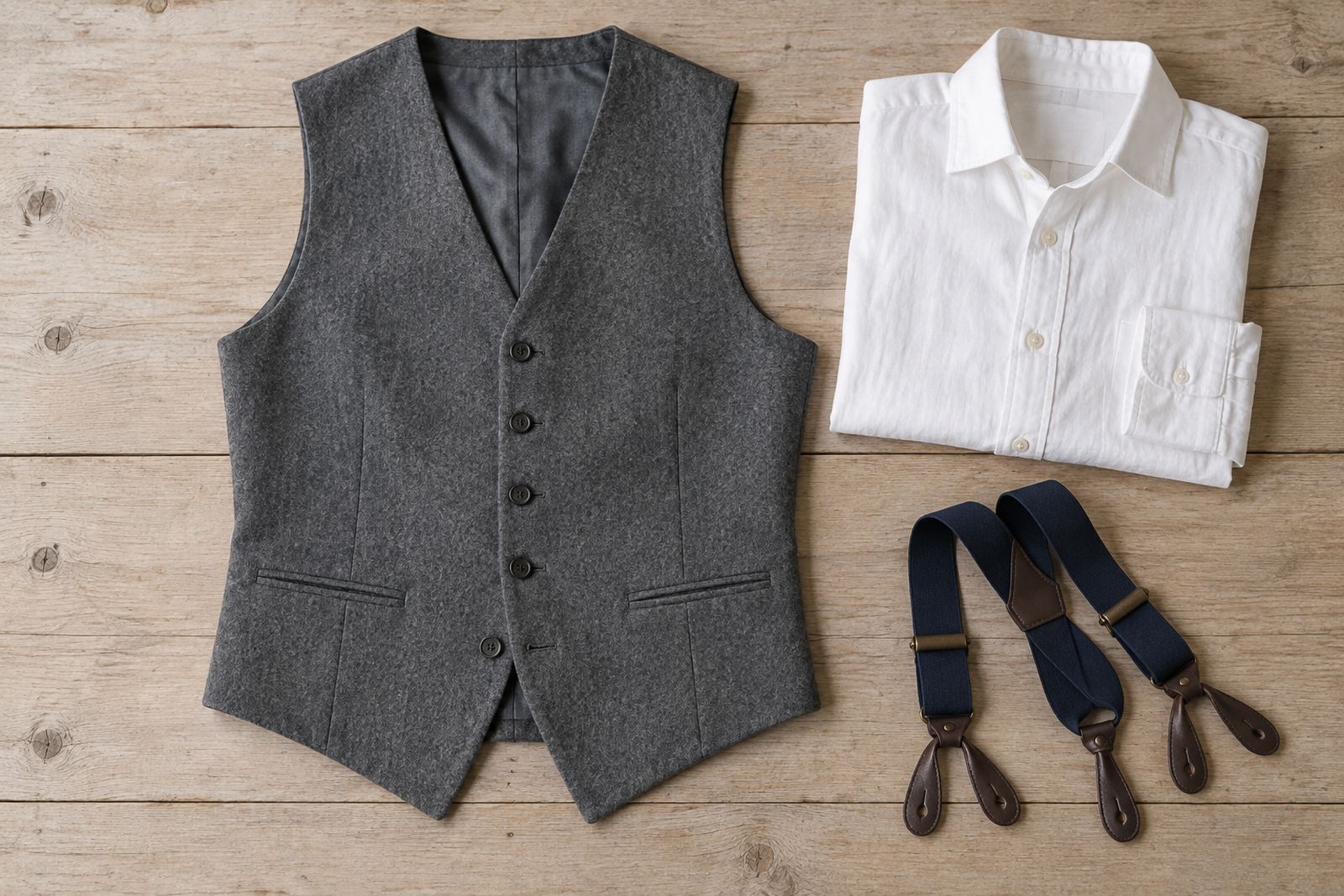
The short answer
To wear a waistcoat well, fit it close to the body and long enough to cover your trouser waistband, leave the bottom button undone unless it is cut straight across, and wear braces instead of a belt. Under a jacket it is formal; on its own a waistcoat reads casual, so wear it alone with odd trousers rather than as a formal outfit.
- Leave the bottom button undone on most waistcoats; fasten every button on straight-cut and most double-breasted ones.
- The waistcoat covers the trouser waistband: no shirt or belt should show.
- Wear braces (suspenders), not a belt, with a waistcoat.
- Always wear a long-sleeved shirt underneath.
- Without a jacket, a waistcoat reads casual; choose an odd waistcoat for that.
In this guide
- How should you wear a waistcoat? The rules
- Should you leave the bottom button of a waistcoat undone?
- Should a waistcoat cover the belt?
- How should a waistcoat fit?
- What shirt, tie and accessories go with a waistcoat?
- Single vs double-breasted waistcoat: which should you choose?
- Can you wear a waistcoat without a jacket?
- Can you wear a waistcoat with jeans?
- How do you wear an odd waistcoat?
- Waistcoats for formal dress
- Common waistcoat mistakes
- The tailor's view: having a waistcoat made or altered
- Questions people ask
Knowing how to wear a waistcoat comes down to a handful of rules about length, buttons, what holds your trousers up and what you wear around it. Get them right and a waistcoat makes a suit look complete and a pair of trousers look deliberate. Get them wrong and the eye goes straight to the gap of shirt at your waist or the strained bottom button.
Waistcoat (vest)
A waistcoat is a sleeveless, close-fitting garment worn over a shirt and under a jacket. Americans call it a vest; in Britain, a vest is an undershirt, so British tailors always say waistcoat.
At a glance
- Bottom button
- Undone, unless the waistcoat is cut straight across
- Length
- Covers the trouser waistband
- Belt or braces
- Braces
- Shirt
- Long-sleeved, always
- Without a jacket
- Casual; best as an odd waistcoat
- Fit
- Close, flat, no pulling at the buttons
How should you wear a waistcoat? The rules
Wear a waistcoat close to the body, long enough to cover the waistband, with the bottom button open on most cuts and braces holding up the trousers. The table shows each rule as a tailor sees it: what right looks like and what wrong looks like.
| Rule | Right | Wrong |
|---|---|---|
| Bottom button | Open on a waistcoat with a curved front and points; all fastened on a straight-cut or double-breasted waistcoat | Last button fastened on a curved waistcoat, so the points pull and crease across the hips |
| Length | Points finish just below the waistband; no shirt visible when standing or sitting | A band of shirt or belt buckle showing between waistcoat and trousers |
| What holds the trousers | Braces or side adjusters | A belt, which adds a ridge and a buckle bump |
| Fit | Lies flat and close; buttons sit without strain | X-shaped pulls at each button, or a loose front that gapes |
| Under a jacket | The top waistcoat buttons show in the V of the buttoned jacket | The waistcoat hidden below the lapels or bunching under the jacket |
| Shirt | Long sleeves, cuffs showing at the wrist | Short sleeves or a T-shirt under a suit waistcoat |
| Pockets | Empty, or a slim watch only | A phone or keys pulling the front out of shape |
Should you leave the bottom button of a waistcoat undone?
Yes, leave the bottom button undone on most waistcoats. A waistcoat with a curved front and two points at the hem is cut to be worn that way: the lowest button sits where the front starts to flare over the hips, and fastening it pulls the points together and creases the fabric. A popular story credits King Edward VII with starting the habit; whatever its origin, the cut followed the convention.
Some waistcoats are cut straight to be fully buttoned. A waistcoat with a straight, horizontal hem, most double-breasted waistcoats and many low-cut evening waistcoats fasten every button. If you are unsure, button it fully and look in a mirror: if the bottom button pulls or the points draw inward, leave it open.
Should a waistcoat cover the belt?
Yes. A waistcoat should always cover the trouser waistband, and with it any belt. Better still, do not wear a belt at all: wear braces (suspenders) that button inside the waistband, or trousers with side adjusters. A belt under a waistcoat adds bulk, the buckle presses a bump into the front, and belted trousers tend to slip lower and open a gap of shirt.
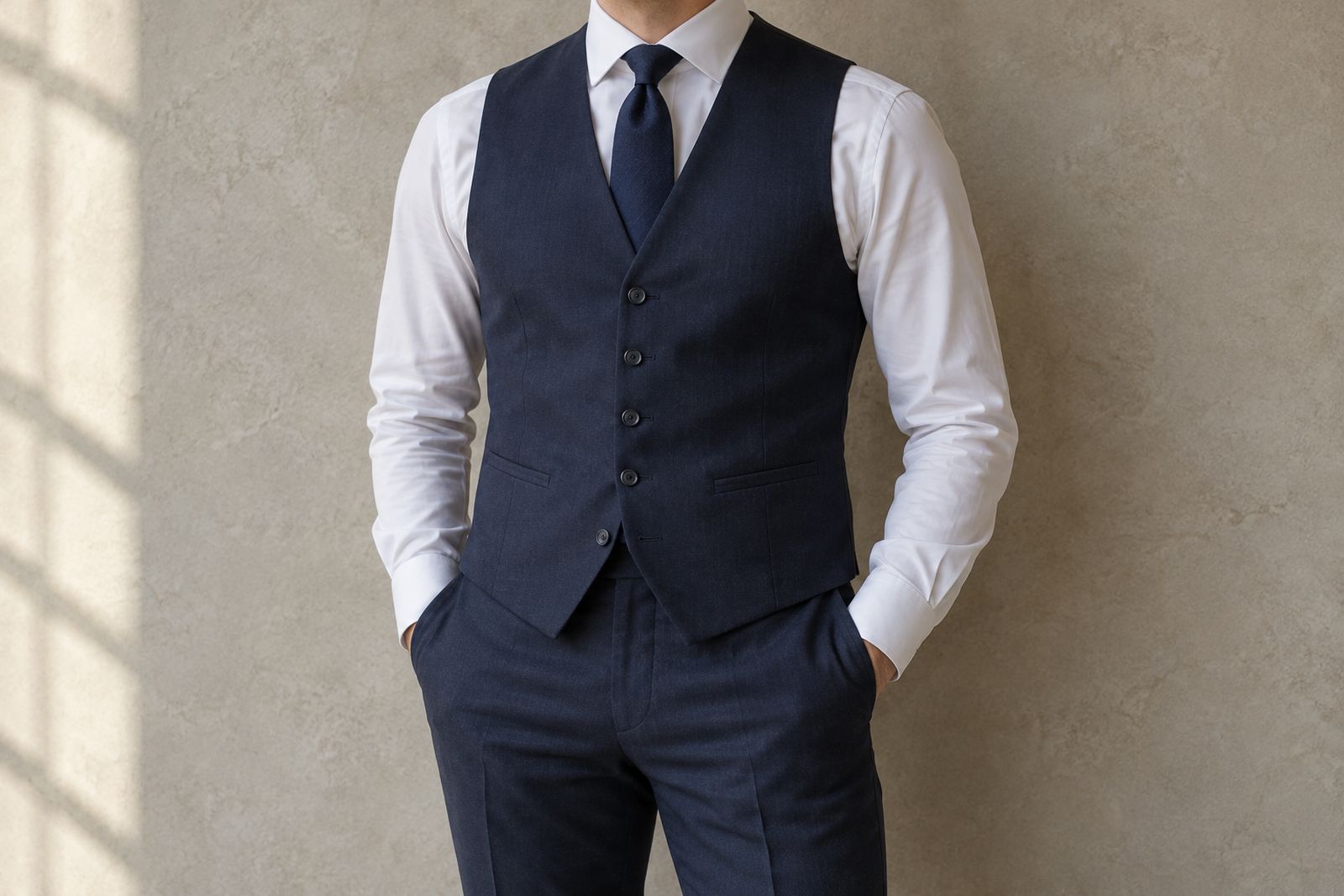
Covering the waistband needs trousers that sit at or near your natural waist. Many modern ready-to-wear trousers sit lower, and no waistcoat of normal length will cover them. With casual trousers or jeans that need a belt, choose a slim belt and a waistcoat long enough to cover the buckle. For more on rise, see how suit trousers should fit.
How should a waistcoat fit?
A waistcoat should fit close to the body without strain: flat against the chest, smooth across the stomach and just long enough to overlap the waistband. It sits closer than a jacket because nothing goes over it but the jacket. The back strap is for small adjustments, not for pulling a loose waistcoat in by several inches.
Waistcoat fit check
- The neckline lies flat on the shirt with no gap when you stand straight.
- No horizontal pulls at the buttons, standing or sitting.
- The points overlap the waistband and finish just below it.
- The armholes sit close without cutting into the armpit or showing a bulge of shirt.
- The back lies flat, with the strap only lightly drawn in.
- Under a buttoned jacket, the top buttons show in the V of the lapels.
What shirt, tie and accessories go with a waistcoat?
Wear a long-sleeved shirt with a collar that stands up well, and tuck the tie fully under the waistcoat. The tie tip should never show below the waistcoat hem; because the waistcoat hides it, a tie can be slightly short without anyone noticing. A spread or semi-spread collar frames the tie neatly in the waistcoat's V.
- Shirt: long sleeves, smooth at the waist so it does not bunch under the waistcoat. A slim-cut shirt helps.
- Tie: fully covered by the waistcoat; a four-in-hand knot keeps the V tidy. See tie length for the general rule.
- Pocket watch: the chain runs from a waistcoat buttonhole to a lower pocket. Keep it slim.
- Pocket square: in the jacket breast pocket as usual; the waistcoat pockets stay empty.
Single vs double-breasted waistcoat: which should you choose?
Choose a single-breasted waistcoat for everyday suits and versatility, and a double-breasted or lapelled waistcoat when you want a more formal or more distinctive look. Double-breasted waistcoats are usually cut straight across and fully buttoned, and they look best on a slim to average build because the overlap adds visual width.
Single-breasted
The standard
- Usually five or six buttons
- Curved front with points; bottom button undone
- Works with suits and odd trousers
- The most versatile cut
Double-breasted
More formal
- Two columns of buttons
- Often cut straight across; fully buttoned
- Adds width; best on slim to average builds
- Strong with a single-breasted jacket
Lapelled
Distinctive
- Small lapels on a single- or double-breasted front
- Reads dressier and more traditional
- Visible lapels frame the tie in the jacket V
- Good for weddings and formal day wear
Pair a double-breasted waistcoat with a single-breasted jacket; two double-breasted garments on top of each other look heavy. For jacket choices, see single vs double-breasted suits.
Can you wear a waistcoat without a jacket?
Yes, but it reads casual. A waistcoat worn without a jacket is shirtsleeve dress, so it suits relaxed occasions: a smart casual dinner, a summer party, a creative office, or a wedding reception after the jackets come off. It is not a substitute for a jacket at a formal event.
An odd waistcoat, one not part of a suit, looks better on its own than a suit waistcoat does. A suit waistcoat usually has a back in lining fabric, which looks unfinished without the jacket, and the matching trousers make the missing jacket obvious. If you want to wear a waistcoat alone, choose one with a back in the same fabric as the front, in a texture such as tweed, flannel, linen or cotton.
Can you wear a waistcoat with jeans?
Yes, if you choose the right waistcoat. Wear an odd waistcoat in a textured fabric, such as tweed, wool flannel, cord, linen or cotton, with dark jeans, a long-sleeved shirt and boots or loafers. Avoid the waistcoat from a smooth business suit: next to denim, fine worsted looks borrowed from another outfit.
- Keep the waistcoat fitted; a loose one over jeans looks sloppy.
- Wear jeans with a mid or high rise so the waistcoat can cover the waistband.
- A slim belt is fine with jeans if the waistcoat covers the buckle.
- Wear an oxford, chambray or flannel shirt; avoid a T-shirt under a tailored waistcoat.
How do you wear an odd waistcoat?
An odd waistcoat is one in a different fabric or color from the jacket and trousers. Choose one that contrasts in color or texture with the jacket rather than nearly matching it, which looks like a mistake. Traditional choices are buff, tan, cream or tattersall check with tweeds and grays, and dove gray or buff with morning dress.
Classic
Tweed jacket, tattersall waistcoat, cord trousers
Brown tweed
Jacket
Tan cord
Trousers
Cream tattersall
Waistcoat
Pale blue
Shirt
Dark brown
Shoes
Works
Gray flannel suit, buff waistcoat
Mid-gray flannel
Suit
Buff
Waistcoat
White
Shirt
Navy
Tie
Works
Navy blazer, gray flannel waistcoat and trousers
Navy
Jacket
Gray flannel
Trousers
Gray flannel
Waistcoat
White
Shirt
Works
Jeans, tweed waistcoat, oxford shirt
Dark denim
Trousers
Olive tweed
Waistcoat
White oxford
Shirt
Brown suede
Shoes
Avoid
Black suit waistcoat over a T-shirt
Faded denim
Trousers
Black worsted
Waistcoat
Gray marl
Shirt
Waistcoats for formal dress
Formal dress has its own waistcoats with their own rules. At black tie, a low-cut evening waistcoat in black, usually with three or four buttons, is an alternative to a cummerbund; never wear both. At white tie, the waistcoat is white cotton pique and must not show below the front of the tailcoat. With morning dress, the waistcoat is buff, dove gray, pale blue or matched to the coat.
| Dress code | Waistcoat | Notes |
|---|---|---|
| White tie | White pique, low-cut | Must not extend below the tailcoat front |
| Black tie | Black, low-cut, in the jacket's fabric or the lapel silk | Instead of a cummerbund, never with one |
| Morning dress | Buff, dove gray, pale blue, or matching gray | Single- or double-breasted |
| Lounge suit | Matching suit waistcoat or a contrasting odd waistcoat | Bottom button open on curved cuts |
| Smart casual | Odd waistcoat in tweed, flannel, linen or cotton | Can be worn without a jacket |
For the rest of formal dress, see our guides to black tie and white tie. For the waistcoat as part of a suit, see the three-piece suit.
Common waistcoat mistakes
The tailor's view: having a waistcoat made or altered
A good tailor fits a waistcoat over the shirt you will wear, with the trousers at the height you will wear them, and checks it under the jacket. Tell them whether you will wear it without the jacket, because that decides the back fabric and how close they cut it.
What to tell your tailor
- Whether it is for a suit, as an odd waistcoat, or both.
- Whether you will wear it without a jacket, and so need a fabric back.
- Your preferred number of buttons, usually five or six on a single-breasted waistcoat.
- Single- or double-breasted, with or without lapels.
- How you hold up your trousers: braces, side adjusters or a belt.
- Any pocket watch you want to wear, so a buttonhole can carry the chain.
Alterations are possible within limits. A tailor can usually take a waistcoat in or let it out slightly at the back seams and adjust the strap. Adding length is rarely possible once the waistcoat is cut, so check the length carefully at the fitting. For a full suit with a waistcoat, start with our ranking of the best tailors in London.
Questions people ask
Should a waistcoat cover the belt?
Yes, a waistcoat should always cover the trouser waistband and any belt. Better still, wear braces or trousers with side adjusters instead of a belt. A belt under a waistcoat adds bulk and a visible buckle bump.
Can you wear a waistcoat without a jacket?
Yes, but it reads casual. It works at relaxed events and once jackets come off at a reception, not as a formal outfit. An odd waistcoat with a fabric back looks better on its own than a suit waistcoat.
Can you wear a waistcoat with jeans?
Yes, with an odd waistcoat in a textured fabric such as tweed, flannel, cord, linen or cotton. Wear it with dark jeans, a long-sleeved shirt and boots or loafers. Avoid smooth suit waistcoats, which look out of place with denim.
Should you button the bottom button of a waistcoat?
Leave it undone on most waistcoats, which have a curved front cut for that convention. Waistcoats with a straight hem and most double-breasted waistcoats are made to be fully buttoned. If fastening the last button makes the points pull, leave it open.
Single vs double-breasted waistcoat: which is better?
A single-breasted waistcoat is more versatile and suits every build. A double-breasted waistcoat is more formal and distinctive, is usually fully buttoned and suits slim to average builds best. Wear either with a single-breasted jacket.
What is the difference between a vest and a waistcoat?
In American English they mean the same garment: a sleeveless layer worn over the shirt and under the jacket. In British English, a vest is an undershirt, so tailors there say waistcoat. Both words describe the same piece of a three-piece suit.
How long should a waistcoat be?
A waistcoat should be just long enough to cover the trouser waistband, with its points finishing just below it. No shirt should show between the waistcoat and trousers, standing or sitting. That requires trousers that sit at or near your natural waist.
TailorGuide is independent. Our guides are written and checked by our team and carry no paid endorsements. How we work.